
A science-informed look at the remarkable praying mantis, from its swiveling head and lightning-fast forelegs to egg cases, garden myths, and the realities of being a small predator.
A praying mantis can look almost otherworldly: triangular head, oversized eyes, and front legs folded as though in prayer. Behind that calm pose is a specialized insect built to spot, seize, and eat other animals.
What is a praying mantis?
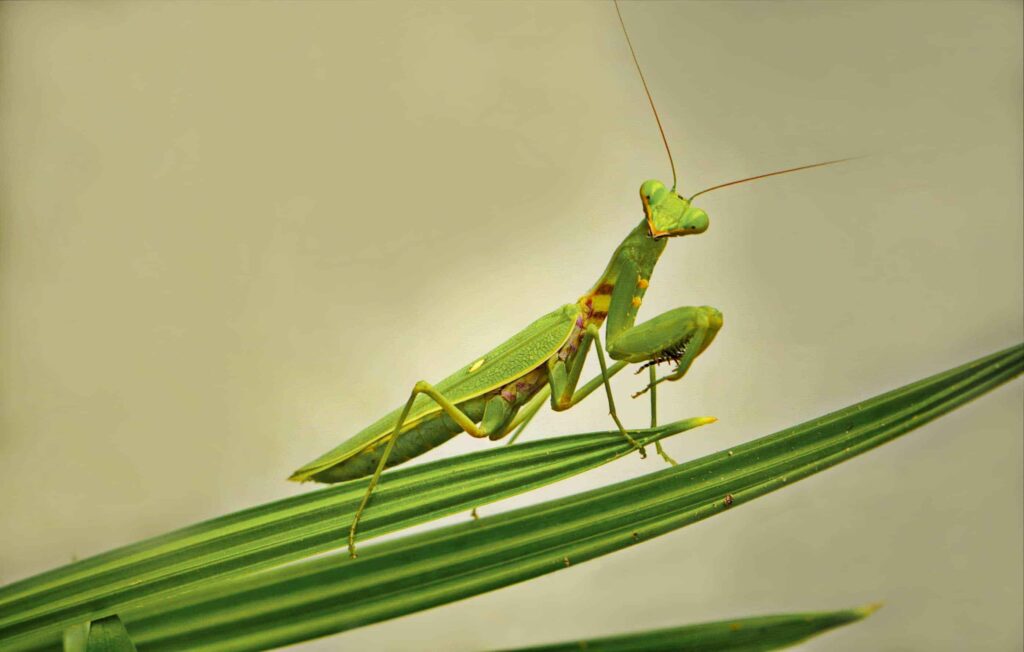
Praying mantises are insects in the order Mantodea. The name refers to their enlarged front legs, which are held in a folded position. These are not ordinary walking legs: they are raptorial legs, fitted with spines that help a mantis grip prey.
There are more than 2,400 described mantis species worldwide, with especially high diversity in warmer regions. Their size, color, wings, and behavior vary by species and life stage, so no single fact applies perfectly to every mantis.
Why do mantises look like they are praying?
The “praying” pose is really a hunting posture. A mantis keeps its front legs close to its body, ready to snap outward in a fraction of a second. Each leg has sharp spines that act like a cage around the prey.
Their head is another standout feature. Mantises can turn it far more freely than most insects, often rotating it close to 180 degrees. Their large compound eyes and three small simple eyes help them detect movement and judge the distance to prey.
What do praying mantises eat?
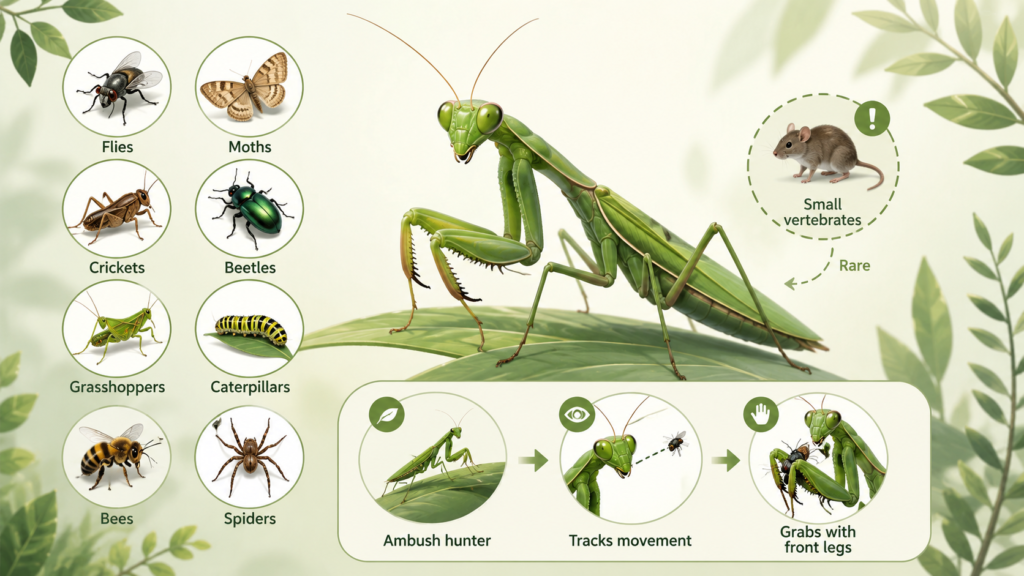
Most mantises eat other invertebrates, including flies, moths, crickets, beetles, grasshoppers, caterpillars, bees, and spiders. What is on the menu depends on the mantis’s size, the local habitat, and what it can physically overpower.
A mantis usually relies on ambush rather than a long chase. It stays still, tracks movement visually, then grabs with its front legs. Larger species have been documented catching small vertebrates on rare occasions, but that is not a typical meal for most mantises.
Where praying mantises live, and common species
Mantises occur on every continent except Antarctica. Many species live among shrubs, tall grasses, flowers, woodland edges, and other vegetation where they can blend in and wait for prey. Their camouflage can be green, brown, gray, pink, or patterned depending on species and surroundings.
In North American gardens, people may encounter native species as well as introduced mantises. Local identification matters: an insect’s color alone is not enough, and a regional insect guide or extension service can help confirm what you have found.
| Species | Range context | A useful clue |
|---|---|---|
| Carolina Mantis | Native to much of eastern and central North America | Often smaller; color may range from green to mottled brown or gray |
| Chinese Mantis | Introduced and widespread in parts of North America | Often long and slender; common egg cases are elongated and foamy-looking |
| European Mantis | Introduced in several North American regions | Usually green or brown; egg case is more rounded than the Chinese mantis’s |
Species distributions change over time, and identification can be difficult from one photo. Avoid releasing purchased egg cases into natural areas unless your local wildlife authority specifically recommends it.
Egg cases, mating, and lifespan
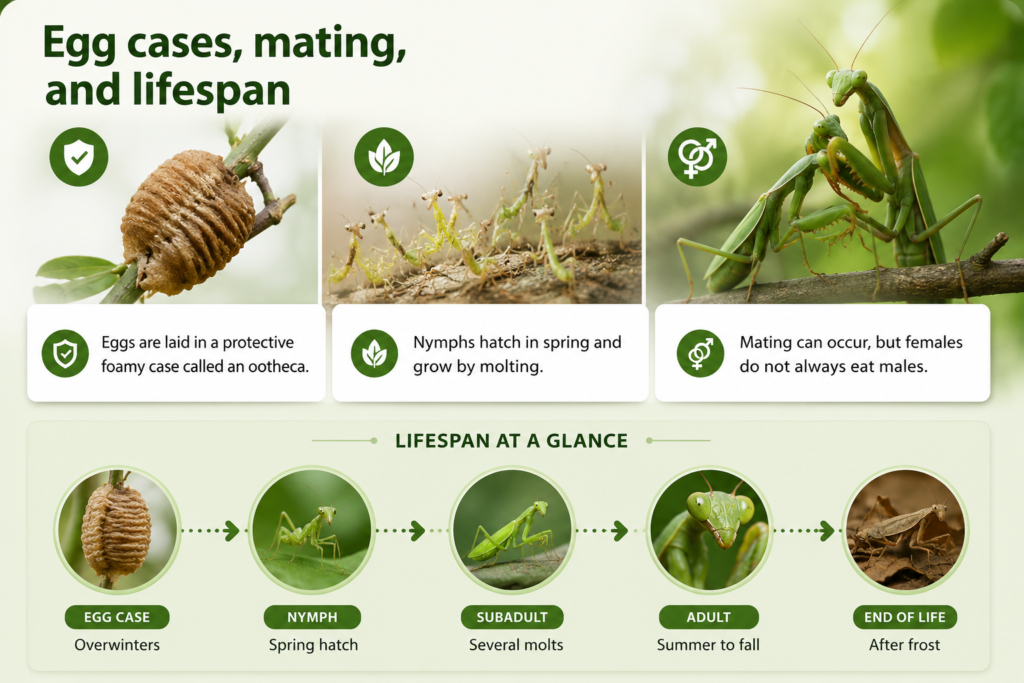
Female mantises lay eggs in a protective foamy case called an ootheca. The foam hardens around the eggs and helps insulate them through changing weather. Depending on the species, dozens to hundreds of tiny nymphs may emerge when conditions are suitable.
Young mantises resemble small wingless adults and grow by molting. In temperate places, many species hatch in spring, mature by late summer, reproduce in fall, and die after frost—while the egg case overwinters. Sexual cannibalism can occur in some circumstances, but females do not always eat males after mating.
Are praying mantises good for gardens?
Seeing a mantis in a garden can be a sign that the space supports insect life. However, a healthy garden needs more than one predator. Diverse plantings, habitat for many species, and thoughtful pest prevention generally have a bigger impact than adding mantises alone.
A practical, low-impact approach
- Leave some stems, seed heads, and sheltered plant structure through winter where appropriate; insects use these spaces for cover and egg-laying.
- Avoid broad-spectrum insecticides whenever possible, because they can harm mantises, pollinators, and natural predators alike.
- Use a varied mix of plants to support a food web instead of relying on one “beneficial bug” to solve a pest problem.
- Observe rather than handle: mantises can be stressed or injured by rough handling, especially while molting.
Praying mantises are not considered dangerous to people. A large individual may pinch or bite if handled, but this is generally a defensive response and is not medically significant for most people. Enjoy them with a little respectful distance.
Four more fascinating praying mantis facts
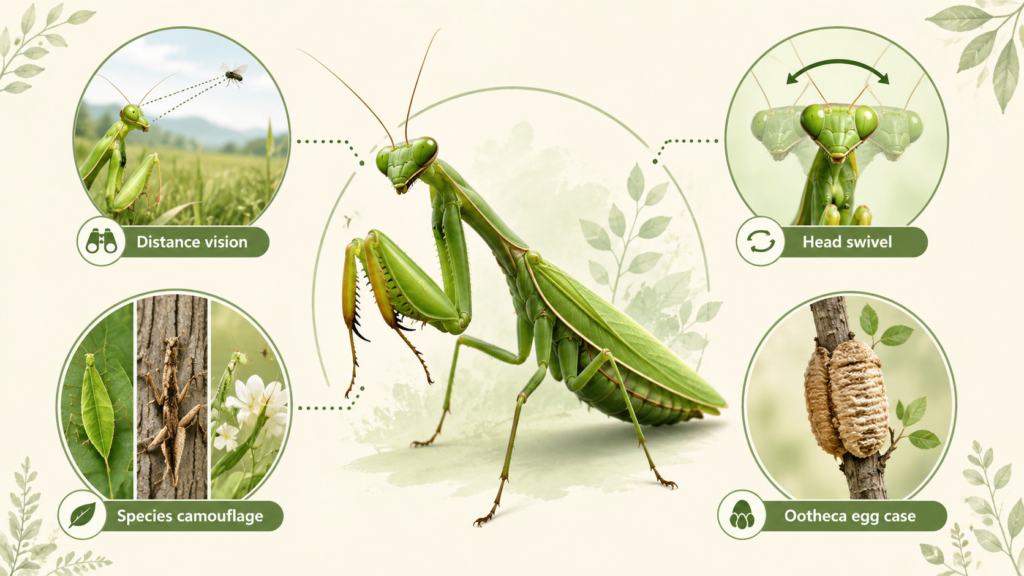
They can judge distance
Mantises are among the insects known for stereoscopic vision, which helps them estimate how far away prey is before they strike.
Their head can swivel
Their flexible neck gives them an unusually wide field of view for an insect and adds to their alert, watchful appearance.
Camouflage is species-specific
Some mantises resemble leaves, bark, twigs, grass, or flowers. Their appearance is an adaptation shaped by where and how they hunt.
Egg cases are not cocoons
An ootheca holds many eggs. It is different from a butterfly or moth cocoon, which surrounds one developing insect.
Praying mantis FAQs
Can praying mantises fly?
Many adult mantises have wings, but flight ability varies by species and sex. In some species males fly more readily, while females may have shorter wings or heavier bodies that make flight limited.
Do praying mantises bite humans?
They can bite or pinch if they feel threatened, especially when handled. This is uncommon, usually minor, and not a sign that mantises seek people out as prey.
Should I move an egg case into my garden?
Usually, it is best to leave an egg case where you found it. Purchased cases may belong to non-native species or be unsuitable for your area. Supporting local habitat is generally a more responsible way to welcome wildlife.