A complete seasonal guide to cherry blossom timing — from first bud to peak bloom and petal fall — covering varieties, weather effects, and regional differences.
Cherry Blossom Season at a Glance
Typical Season: March–May (Northern Hemisphere) · Peak Bloom Duration: 1–2 weeks · Full Display Window: 2–4 weeks · Key Factor: Accumulated winter chill + spring warmth · Most Common Variety: Somei-yoshino (Yoshino) · Bloom Trigger: Sustained temperatures above 10°C (50°F)
What Are Cherry Blossoms?
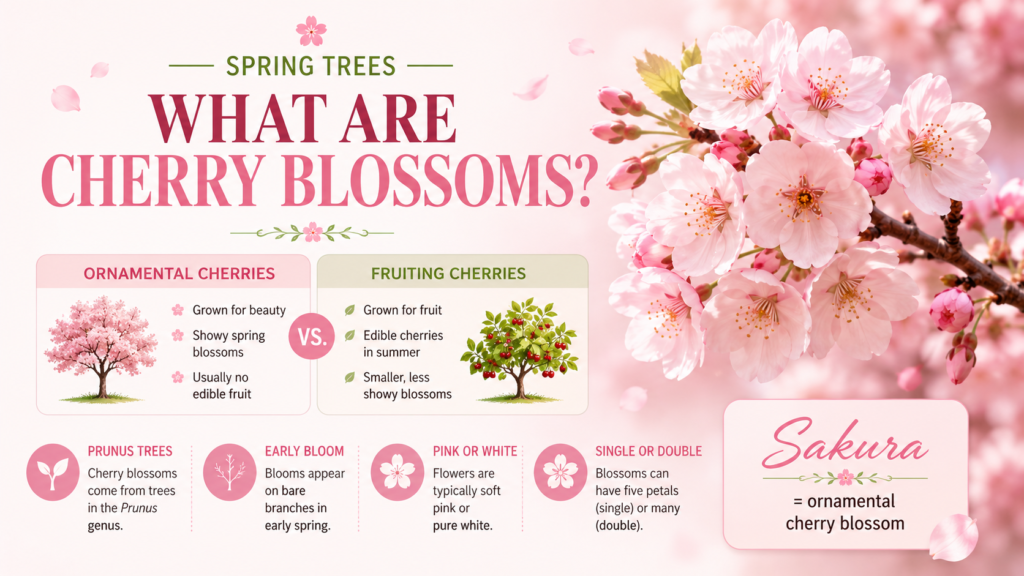
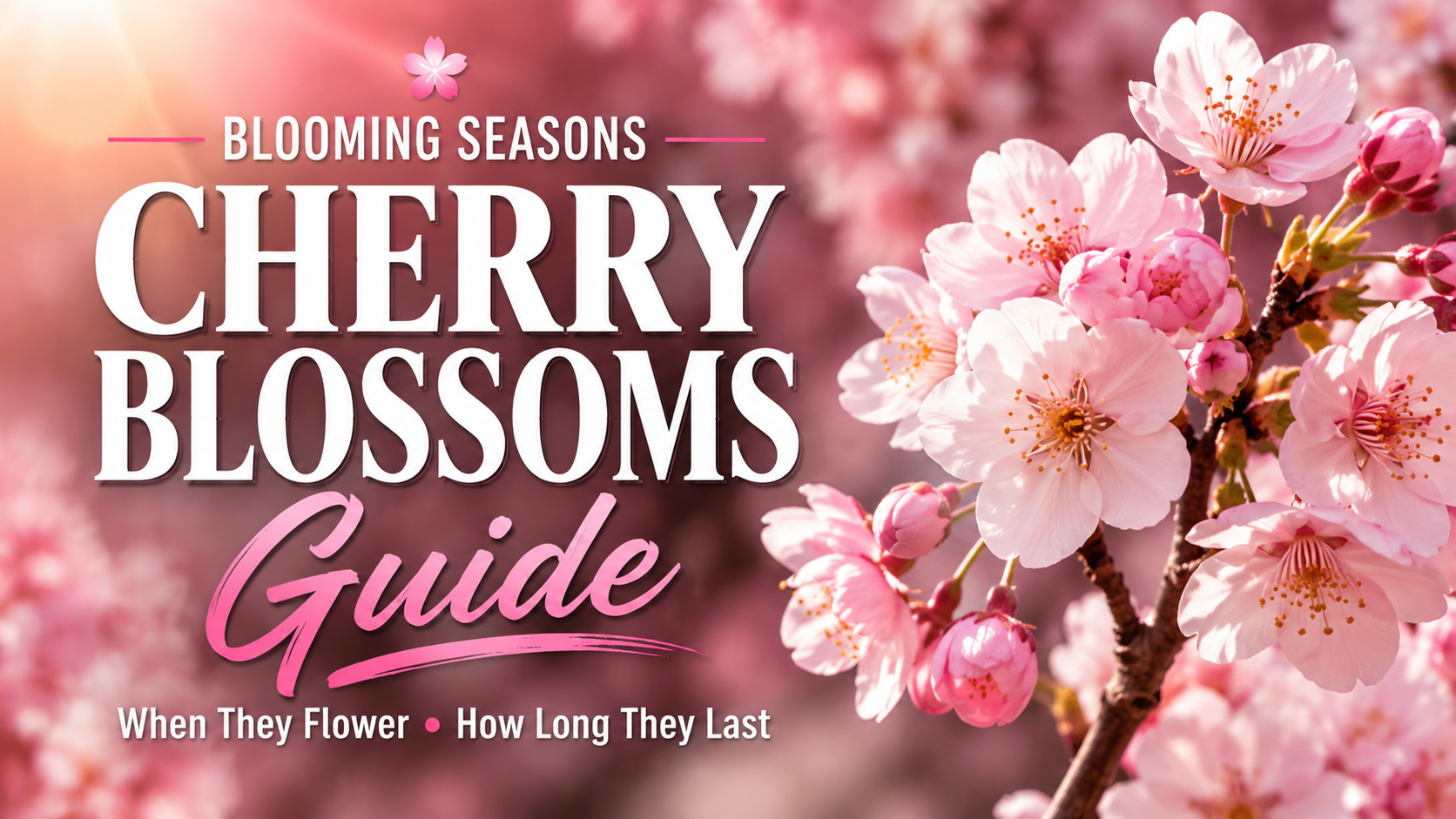
Cherry blossoms (sakura in Japanese) are the flowers produced by ornamental cherry trees in the genus Prunus. Unlike fruiting cherry trees grown for their harvest, ornamental flowering cherries are cultivated specifically for their spectacular spring flower displays. They are among the most celebrated flowering trees in the world, with cultural significance spanning centuries in Japan, Korea, and increasingly in Western gardens.
The flowers typically appear in clusters along bare branches before the leaves emerge, creating the iconic effect of entire trees covered in clouds of pink or white blossom. Each individual flower is small — usually 2–3 cm across — but the collective display of thousands of blooms on a single tree is breathtaking. Most cherry blossoms have five petals in their single form, though many popular cultivars are ‘double-flowered’ with 20 or more petals per bloom.
🌸 Key Distinction: Ornamental flowering cherries (grown for blossoms) are different from fruiting cherry trees (grown for eating). This guide covers ornamental varieties — the ones celebrated during cherry blossom season.
When Is Cherry Blossom Season?
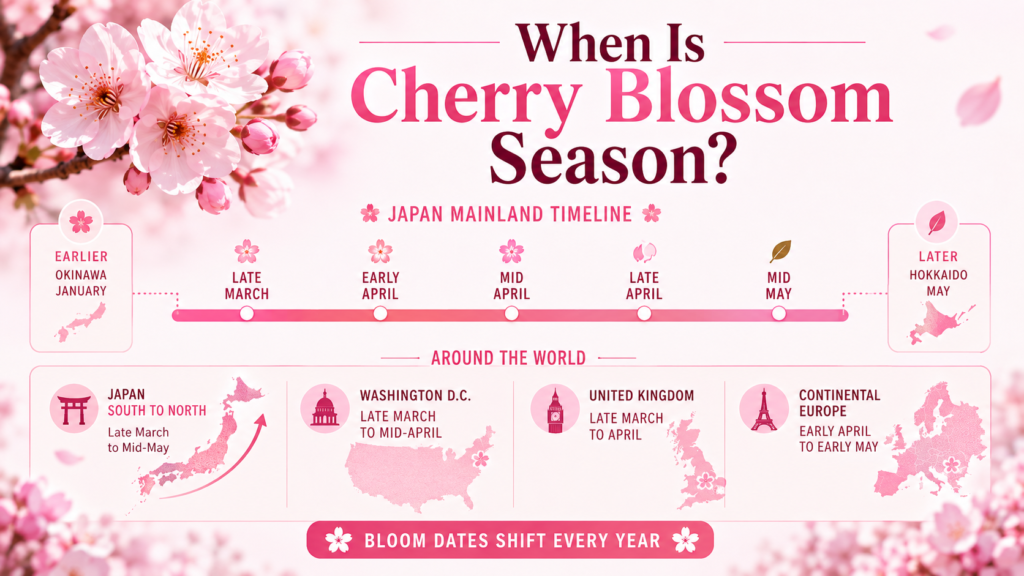
Cherry blossom season generally falls between late March and mid-May in the Northern Hemisphere, though exact timing varies significantly by location, variety, and yearly weather patterns. In Japan, the season progresses from south to north — Okinawa may see blooms as early as January, while Hokkaido’s trees don’t flower until May.
In Washington D.C., the famous Tidal Basin cherry trees typically reach peak bloom between late March and mid-April. In the UK, most cherry blossoms appear from late March through April. Across continental Europe, expect blooms from early April in southern regions to late April or early May further north.
The crucial point is that cherry blossom season is not a fixed calendar date. It shifts every year depending on winter temperatures (chill hours), spring warmth, and rainfall. Think of bloom dates as seasonal windows rather than guaranteed dates. Tracking local forecasts and bloom reports gives far more accurate timing than calendar predictions alone.
Cherry Blossom Bloom Stages Explained
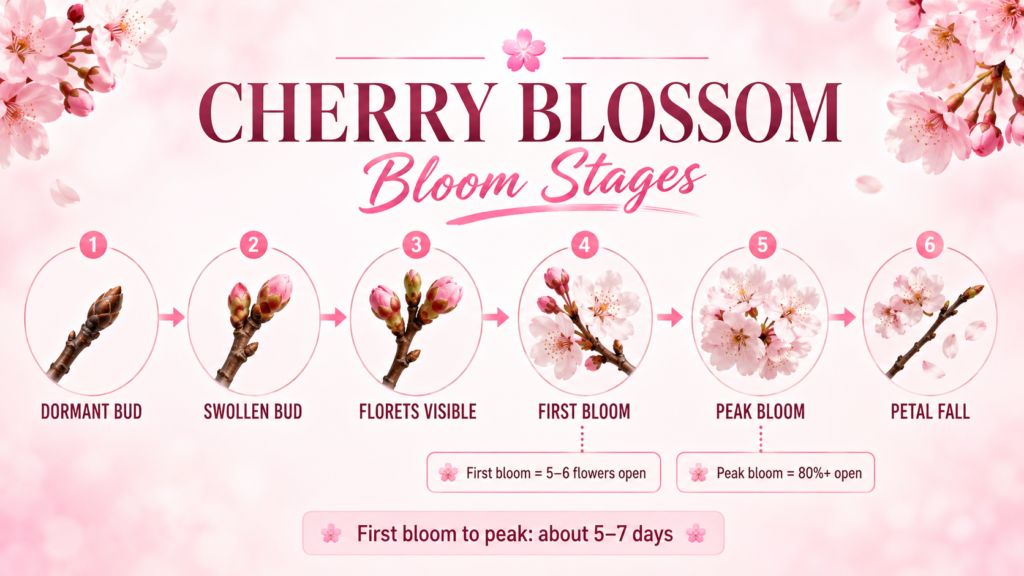
Understanding bloom stages helps you time visits and appreciate the full flowering cycle. The Japan Meteorological Agency tracks six official stages: dormant bud, swollen bud, florets visible, first bloom (kaika — when 5–6 flowers open on a sample tree), peak bloom (mankai — when 80% or more of buds are open), and petal fall (when petals begin scattering in the wind).
From first bloom to peak bloom typically takes 5–7 days in warm conditions, or up to 10–14 days during a cool spring. Peak bloom itself lasts only a few days before petal fall begins. The entire visible flowering window — from first flowers opening to the last petals dropping — spans roughly 2–3 weeks under average conditions. This is why timing a visit requires following real-time bloom reports rather than relying on fixed dates.
Early-Blooming Cherry Varieties
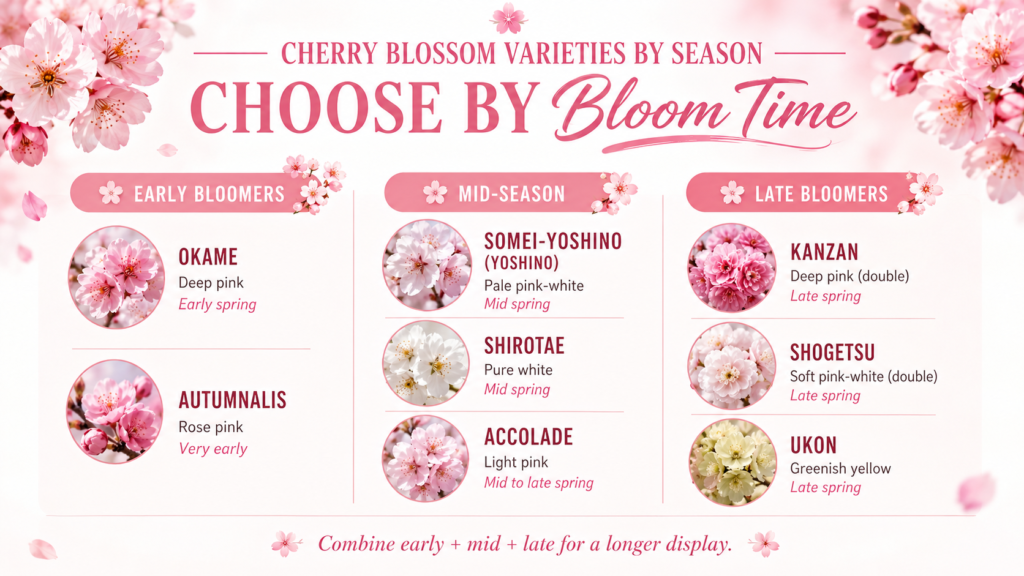
‘Okame’ is one of the earliest flowering cherries, often blooming 2–3 weeks before the main Yoshino season. It produces vivid deep-pink single flowers on a compact tree (5–8 m tall), making it excellent for smaller gardens. ‘Okame’ is a hybrid created by British plantsman Collingwood Ingram and flowers reliably even after mild winters.
‘Autumnalis’ (Prunus × subhirtella ‘Autumnalis’) is unusual — it can produce some flowers during mild autumn and winter periods, with its main flush in early spring. The semi-double white-to-pale-pink flowers appear well before Yoshino, giving you blossom interest from November right through to April in favourable years. Kanzakura and Taiwan cherry also bloom early in warmer regions.
Mid-Season Varieties: The Main Event
‘Somei-yoshino’ (Yoshino cherry) is the most iconic cherry blossom variety worldwide. It dominates Japan’s sakura forecasts, lines Washington D.C.’s Tidal Basin, and fills parks across Europe. The pale pink-to-white single flowers open in dense clusters along bare branches, creating the classic ‘cloud of blossom’ effect. Peak bloom is typically late March to mid-April depending on location.
‘Shirotae’ (Mount Fuji cherry) is another mid-season beauty with large, fragrant, semi-double white flowers on gracefully spreading branches. It flowers at roughly the same time as Yoshino and is stunning as a specimen tree. ‘Accolade’ is a reliable mid-season hybrid with clusters of semi-double pink flowers that open slightly before Yoshino and last well.
🌸 Peak Bloom Defined: ‘Peak bloom’ means 80% or more of a tree’s flower buds are open. It is NOT the first day flowers appear — that’s called ‘first bloom.’ The gap between first bloom and peak bloom is usually 5–7 days.
Late-Blooming Cherry Varieties
‘Kanzan’ (sometimes spelled Kwanzan) is the most widely planted late-flowering cherry. Its large, densely double deep-pink flowers appear 1–2 weeks after Yoshino has finished, extending the cherry blossom season into late April or early May. The flowers are showy and heavy, carried in hanging clusters that bob in the breeze.
‘Shogetsu’ and ‘Ukon’ are other late bloomers. ‘Shogetsu’ produces large, frilly double white flowers with a delicate green tinge on a spreading tree. ‘Ukon’ is distinctive for its unusual pale yellow-green flowers — rare among cherry blossoms. Planting a late variety alongside an early or mid-season one can give you 4–6 weeks of continuous blossom in a garden.
How Long Do Cherry Blossoms Last?
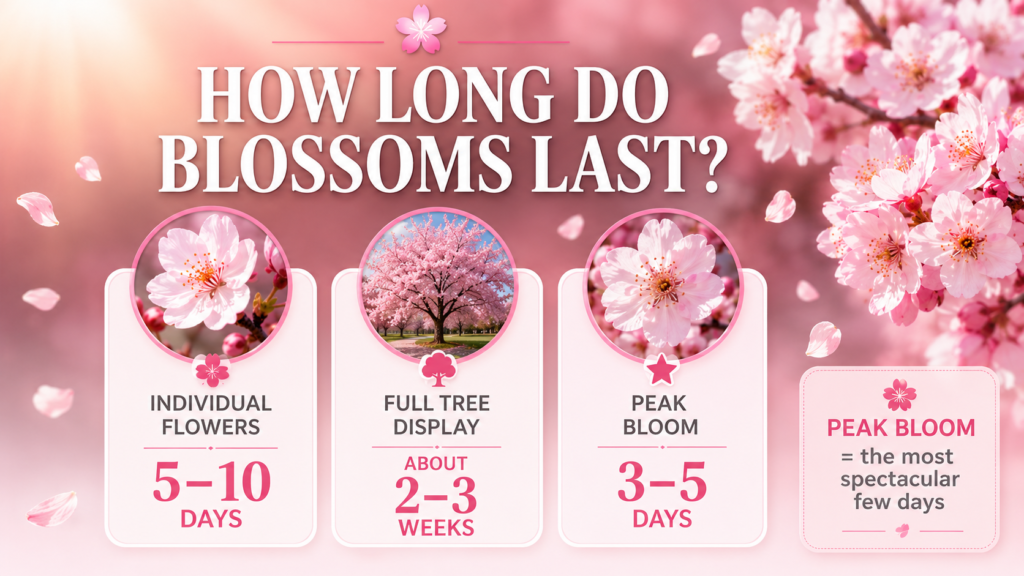
Individual cherry blossom flowers remain attractive for about 5–10 days once fully open. However, since not all flowers on a tree open simultaneously, the overall display from a single tree typically lasts 2–3 weeks from the first flowers opening to the last petals falling. Peak bloom — the most spectacular few days — lasts only about 3–5 days.
Weather dramatically affects longevity. Cool, calm conditions can extend the display, while heavy rain, strong winds, or sudden heat can strip petals within a day or two. Double-flowered varieties like ‘Kanzan’ tend to hold their petals slightly longer than single-flowered types like Yoshino. The brief, ephemeral nature of cherry blossoms is central to their cultural significance — in Japan, it represents the beauty of impermanence (mono no aware).
How Weather Affects Cherry Blossom Timing
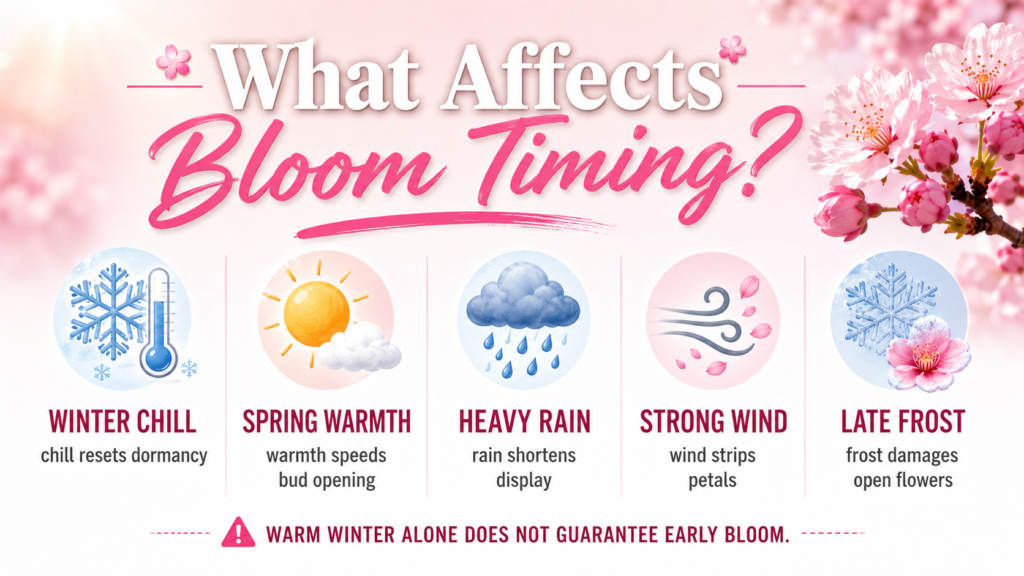
Cherry trees require a period of winter cold (chill hours below 7°C / 45°F) to break dormancy properly. Without adequate chilling, bud development is erratic and flowering may be sparse or delayed. Once the chill requirement is met, spring warmth triggers bud development — the warmer the spring, the faster buds progress toward opening.
An unusually warm February or March can bring peak bloom forward by 1–2 weeks. Conversely, a cold snap in early spring can delay opening. Once flowers are open, heavy rain batters delicate petals off branches, strong winds accelerate petal fall (creating the beautiful ‘cherry blossom snow’ effect), and late frost can brown and damage newly opened flowers.
⚠️ Important: A warm winter does NOT mean earlier bloom. Cherry trees need cold to reset their biological clock. Insufficient winter chill can actually delay or reduce flowering. It’s the combination of adequate winter cold followed by spring warmth that triggers timely, abundant blooms.
Regional Cherry Blossom Timing
Japan: The sakura front moves north from late January (Okinawa) through March–April (Tokyo, Kyoto) to May (Hokkaido). Tokyo’s average peak bloom is around March 27–April 3. Kyoto typically peaks a few days later. Washington D.C.: Average peak bloom is April 4, but has ranged from March 15 to April 18 over the past century.
United Kingdom: Most ornamental cherries bloom late March through April in southern England, with northern areas and Scotland 1–2 weeks later. Continental Europe: Southern France and coastal areas see blooms from late March; Germany and the Netherlands typically peak in mid to late April. Climate change is shifting these windows earlier — bloom dates have advanced by approximately 5–7 days over the past 50 years across most regions.
Extending Cherry Blossom Season in Your Garden
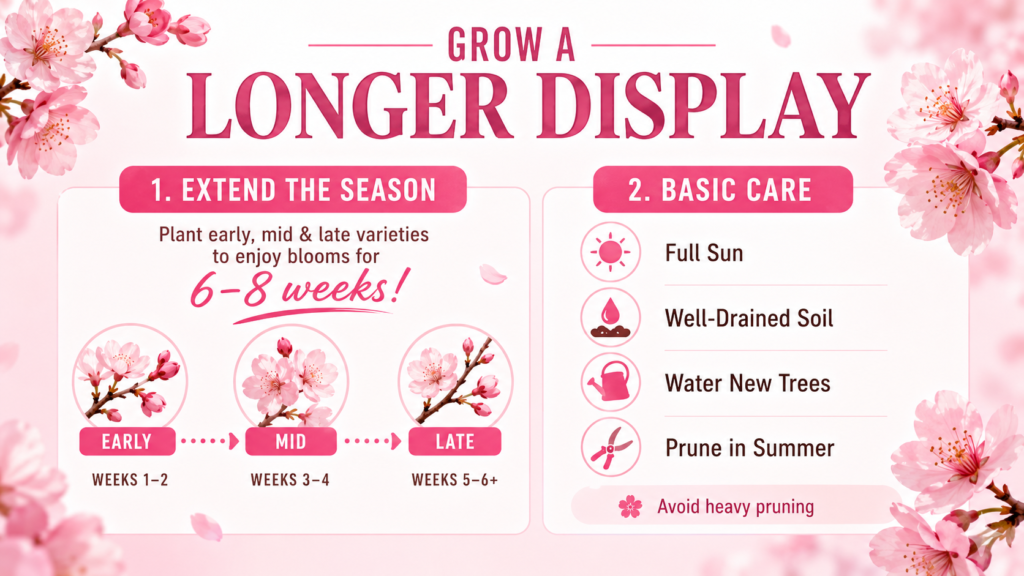
By planting cherry varieties with different bloom times, you can enjoy 6–8 weeks of continuous blossom. Start with an early bloomer like ‘Okame’ or ‘Autumnalis’ (February–early March), follow with a mid-season Yoshino or ‘Accolade’ (late March–mid April), and finish with a late variety like ‘Kanzan’ or ‘Shogetsu’ (late April–early May).
For smaller gardens, consider compact varieties: ‘Okame’ stays manageable at 5–8 m, while columnar forms like ‘Amanogawa’ grow upright and narrow. Even a single well-chosen tree provides a spectacular annual display. Position trees where you can enjoy them from inside the house — the bloom period passes quickly, and being able to watch from a window means you won’t miss a day.
Basic Flowering Cherry Tree Care
Plant flowering cherries in full sun to light shade in well-drained soil. They dislike waterlogged ground. Most ornamental cherries are hardy to USDA Zones 5–8 (some to Zone 4). Water newly planted trees regularly during their first two summers while they establish. Once established, they rarely need watering except during prolonged drought.
Prune only in summer (July–August) to reduce the risk of bacterial canker and silver leaf disease, both of which enter through wounds during the dormant season. Remove dead, crossing, or damaged branches. Ornamental cherries generally don’t need heavy pruning — their natural shape is part of their beauty. Feed with a balanced fertiliser in early spring if growth seems poor.
Frequently Asked Questions
What month do cherry blossoms bloom?
Most cherry blossoms bloom between late March and mid-April in temperate regions. However, early varieties can flower from February, and late varieties may bloom into May. The exact month depends on your location, local climate, and the specific cherry variety.
What is the difference between first bloom and peak bloom?
First bloom is when the first 5–6 flowers open on a tree. Peak bloom is when 80% or more of flower buds are open — this is the most visually spectacular stage. The gap between first bloom and peak bloom is typically 5–7 days, sometimes longer in cool weather.
Can cherry blossom trees grow outside Japan?
Absolutely. Ornamental cherry trees grow successfully across the US, UK, Europe, Canada, South Korea, and many other temperate regions. They need winter cold (chill hours) and moderate rainfall. Washington D.C., London, Paris, Vancouver, and many other cities have famous cherry blossom displays.
Why do cherry blossom dates change every year?
Bloom timing depends on accumulated winter chill followed by spring warmth. A warmer-than-average spring pushes bloom earlier; a cool spring delays it. Year-to-year temperature variations mean peak bloom can shift by 2–3 weeks in either direction from the long-term average.
Do cherry blossoms bloom before the leaves appear?
Yes — most popular cherry blossom varieties (including Yoshino) flower on bare branches before leaves emerge. This creates the dramatic ‘cloud of blossom’ effect. Some later varieties like ‘Kanzan’ produce flowers and new copper-coloured leaves simultaneously, which is also beautiful.