
Black pepper is the world’s most traded spice — but most of us have never seen the tropical vine it grows on. Here’s the full story from plant to peppercorn.
Quick Answer
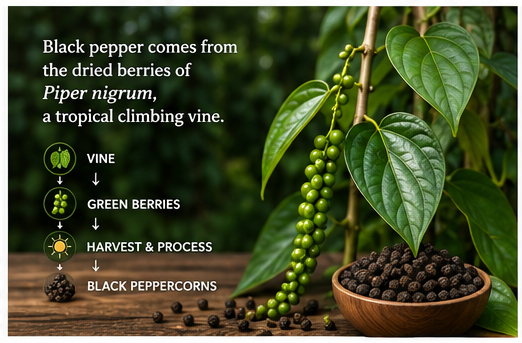
Black pepper comes from the dried berries of Piper nigrum, a tropical climbing vine native to the Malabar Coast of southwestern India. The plant produces clusters of small green berries (drupes) that are harvested, briefly cooked, and sun-dried to become the wrinkled black peppercorns used worldwide.
What Is a Black Pepper Plant?
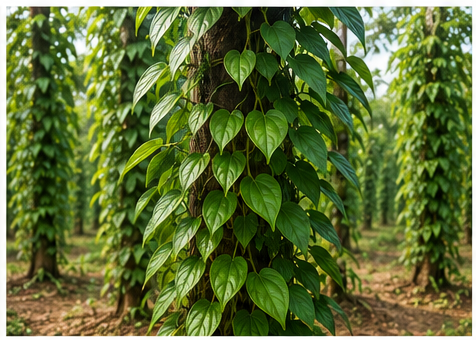
Black pepper (Piper nigrum) is a flowering vine in the family Piperaceae. It is native to the tropical forests of Kerala, India, where it has been cultivated for over 4,000 years. The ancient Greeks and Romans prized it so highly that peppercorns were used as currency — the phrase “peppercorn rent” survives in English law to this day.
Unlike bell peppers or chilli peppers (genus Capsicum), black cherry peppers are botanically unrelated to other “peppers.” It is a perennial woody vine that climbs trees or support poles and produces the small, round fruits we know as peppercorns. A single plant can live and produce fruit for over 20 years in the right conditions.
What Does the Black Pepper Plant Look Like?
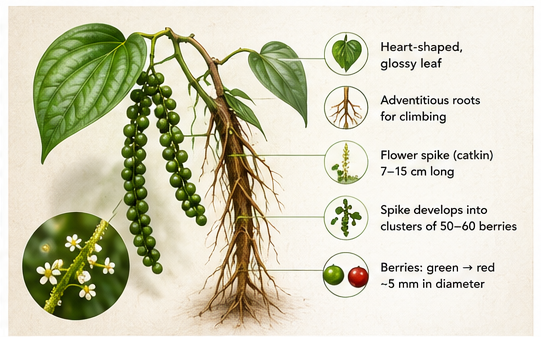
Piper nigrum is an evergreen climbing vine with smooth, heart-shaped leaves that are dark green and glossy. The vine produces adventitious roots that grip onto tree trunks or wooden poles for support. Under commercial cultivation, the vines are trained onto concrete or wooden pillars and typically kept to about 4 metres (13 feet) tall for easier harvesting.
The plant produces tiny white flowers on slender spikes (called catkins) that hang 7–15 cm long. Each spike develops into a cluster of 50–60 small round fruits. These start green, ripen to red, and are about 5 mm in diameter — much smaller than most people expect when they first see them on the vine.
Where Does Black Pepper Grow?
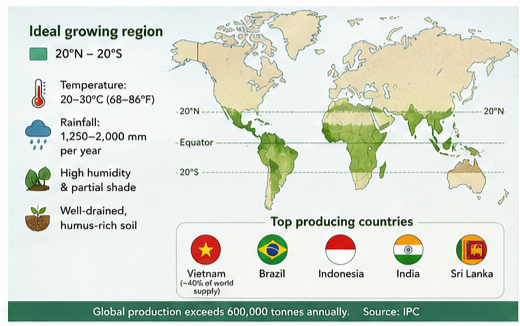
Black pepper thrives in tropical climates between 20°N and 20°S latitude, requiring consistent warmth (20–30°C / 68–86°F), high humidity, well-distributed rainfall of 1,250–2,000 mm per year, and partial shade. It grows best at low altitudes up to about 1,500 metres above sea level in well-drained, humus-rich soil.
Vietnam is the world’s largest producer and exporter of black pepper, followed by Brazil, Indonesia, India, and Sri Lanka. India’s Malabar and Tellicherry regions remain famous for premium-grade pepper. According to the International Pepper Community (IPC), global production exceeds 600,000 tonnes annually, with Vietnam alone accounting for roughly 40% of world supply.
How Do Black Pepper Berries Grow?
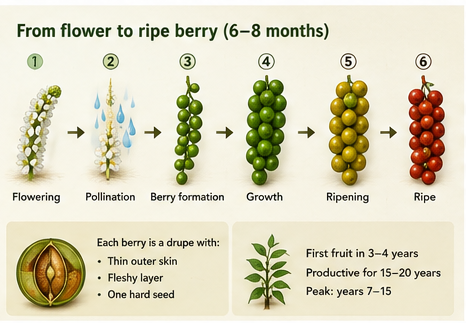
A pepper vine typically begins fruiting 3–4 years after planting. The tiny white flowers are pollinated primarily by rain-splash and gravity rather than insects. After pollination, berries form along each spike and take approximately 6–8 months to mature. A healthy vine can produce fruit for 15–20 years, with peak production usually between years 7 and 15.
The berries develop in dense, hanging clusters. Each berry (technically a drupe) consists of a thin outer skin, a fleshy middle layer, and a single hard seed inside. The berries transition from green to yellow to red as they ripen. The stage at which they are harvested determines whether they become black, white, or green peppercorns.
How Are Black Peppercorns Harvested?
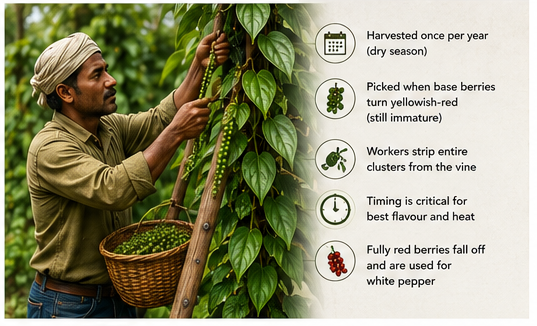
Black pepper is harvested by hand when the berries at the base of each spike have just begun to turn from green to yellowish-red — indicating they are still slightly immature. Workers climb ladders or use long-handled hooks to reach the higher spikes, then strip the entire cluster from the vine. Harvesting typically occurs once per year during the dry season.
Timing is critical. Berries harvested too early lack piperine (the compound that gives pepper its heat) and flavour depth. Berries left too long will turn fully red, fall from the spike, and are better suited for white pepper production. Experienced growers judge readiness by the colour shift of the lowest berries on each spike.
How Does a Pepper Berry Become Black Pepper?
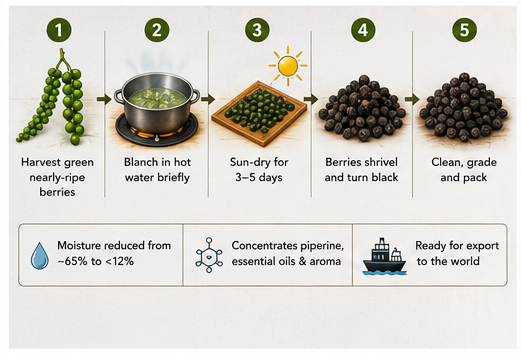
After harvest, the green berry clusters are separated from their stems and blanched briefly in hot water. This ruptures the cell walls of the fruit skin, speeding enzymatic browning during drying. The berries are then spread on mats or raised platforms and sun-dried for 3–5 days, during which they shrivel and darken to the familiar wrinkled black peppercorn.
The drying process reduces moisture content from around 65% to below 12%, concentrating the piperine, essential oils, and aromatic compounds that give black pepper its flavour and heat. Some modern operations use mechanical dryers for more consistent results, but traditional sun-drying remains common in India and Southeast Asia. Once dried, the peppercorns are cleaned, graded by size, and packed for export.
Black Pepper vs. White and Green Peppercorns
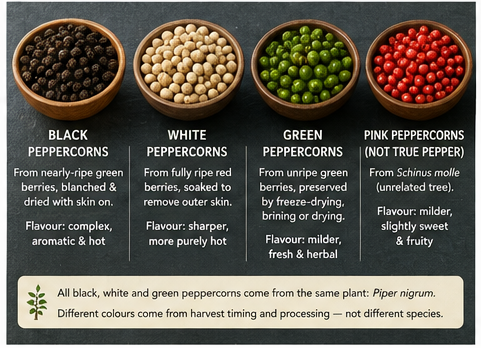
All three common peppercorn colours — black, white, and green — come from the same plant, Piper nigrum. The differences arise from harvest timing and processing method, not from different species.
Black peppercorns are made from nearly-ripe green berries that are blanched and dried with their skin intact. White peppercorns come from fully ripe red berries that are soaked in water for about a week to soften and remove the outer fruit layer, leaving only the pale inner seed. Green peppercorns are unripe berries preserved by freeze-drying, brining, or dehydration without the darkening process.
Flavour-wise, black pepper is the most complex with both heat and aromatic depth. White pepper is sharper and more purely “hot” with less aroma. Green peppercorns are milder, fresher, and slightly herbal. Note: pink peppercorns (often sold alongside) are not true pepper — they come from Schinus molle, an unrelated tree.
Can You Grow Black Pepper at Home?
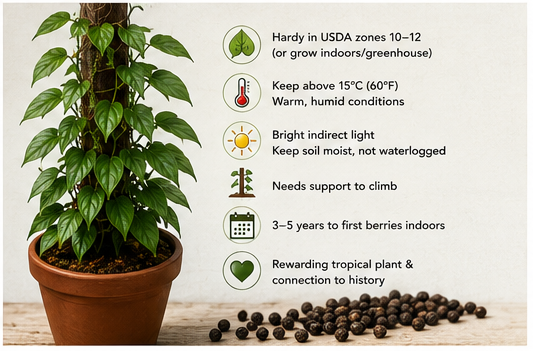
Yes — if you can provide warm, humid conditions year-round. Piper nigrum is hardy in USDA zones 10–12 and can be grown as a houseplant or in a heated greenhouse in cooler climates. It needs bright indirect light, consistently moist (but not waterlogged) soil, temperatures above 15°C (60°F), and something to climb.
A potted pepper plant may take 3–5 years to produce its first berries indoors. Keep humidity above 60%, use a well-draining potting mix rich in organic matter, and feed with a balanced fertiliser during the growing season. While you’re unlikely to harvest large quantities, growing your own pepper vine is a rewarding way to connect with one of history’s most important spices.
Frequently Asked Questions About Black Pepper
Is black pepper a fruit, seed, or berry?
A whole black peppercorn is technically a dried fruit (drupe). It includes the outer skin and flesh of the berry dried around the inner seed. When you grind black pepper, you are grinding both the dried fruit layer and the seed together.
How long does it take to grow black pepper?
From planting a cutting, a Piper nigrum vine typically takes 3–4 years to produce its first fruit spikes. Peak production occurs between years 7 and 15. A healthy vine can continue producing for 20+ years with proper care.
What is the difference between Tellicherry and regular black pepper?
Tellicherry pepper refers to the largest peppercorns from India’s Malabar region — those that pass through a 4.25 mm mesh grade. Because they are left on the vine longer before harvest, they develop more complex flavour and higher essential oil content. The name is a quality grade, not a separate variety.
Why is black pepper called the ‘King of Spices’?
Black pepper has been the world’s most widely traded spice for thousands of years. It drove ancient trade routes between India, the Middle East, and Europe, and was so valuable in medieval Europe that it was used as currency, given as dowry, and even accepted for tax payments.
Is black pepper related to bell peppers or chilli peppers?
No. Black pepper (Piper nigrum, family Piperaceae) is completely unrelated to bell peppers and chillies (genus Capsicum, family Solanaceae