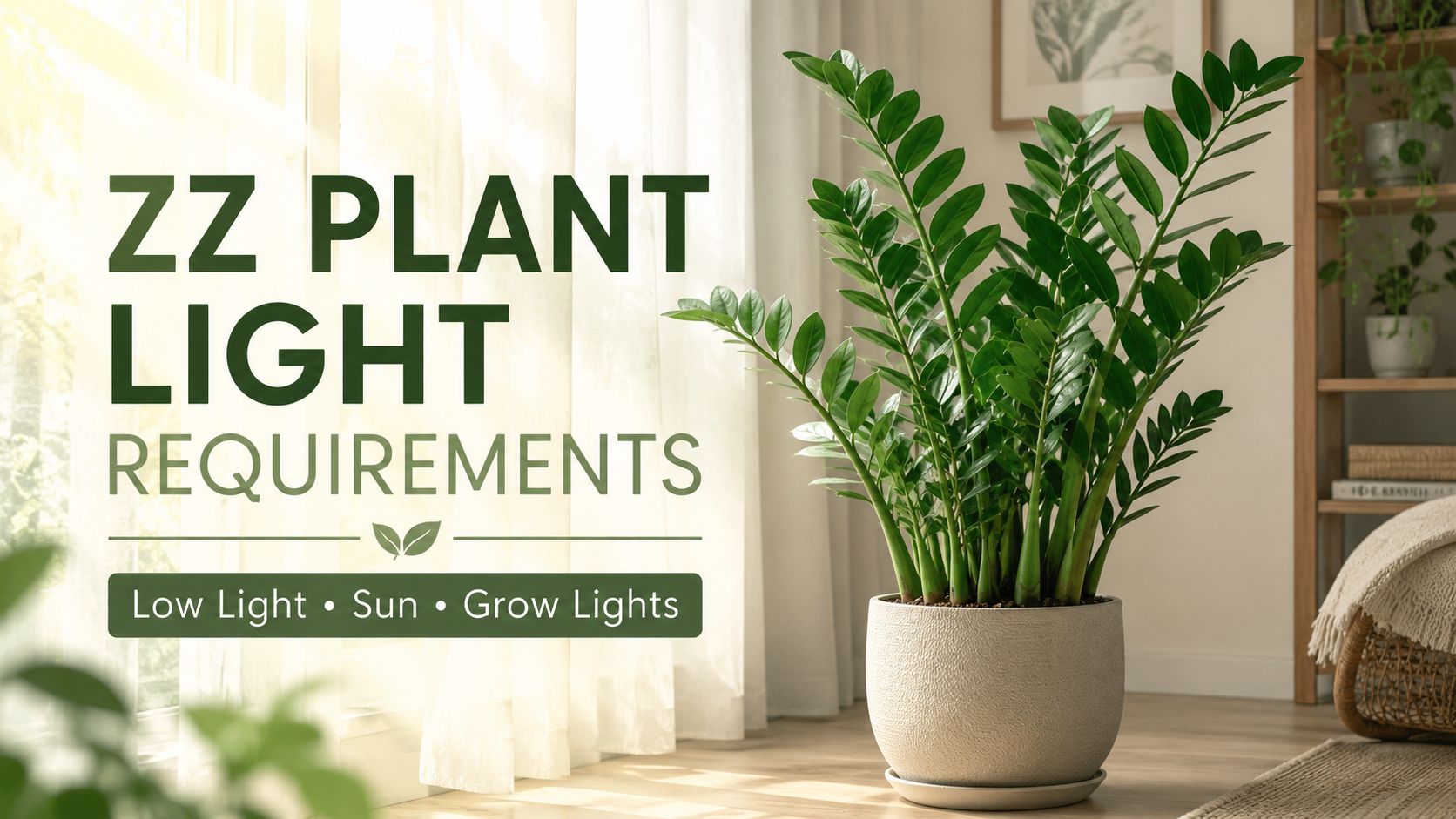

ZZ plants are famous for coping with dim rooms, but “low-light tolerant”does not mean “no light needed.” A ZZ plant (Zamioculcas zamiifolia) generally grows best in bright, indirect light, can remain healthy in lower light, and may be damaged by prolonged harsh direct sun. The best spot is bright enough to support steady growth without strong sunbeams heating or bleaching the leaves.
| Quick answer Give a ZZ plant bright, indirect light when possible. It can tolerate low light, but growth will usually be slower. It does not need direct sunlight, and intense midday or afternoon sun can scorch the foliage. In a windowless or very dim room, a modest full-spectrum grow light can provide the light the plant is missing. |
ZZ Plant Light Requirements at a Glance
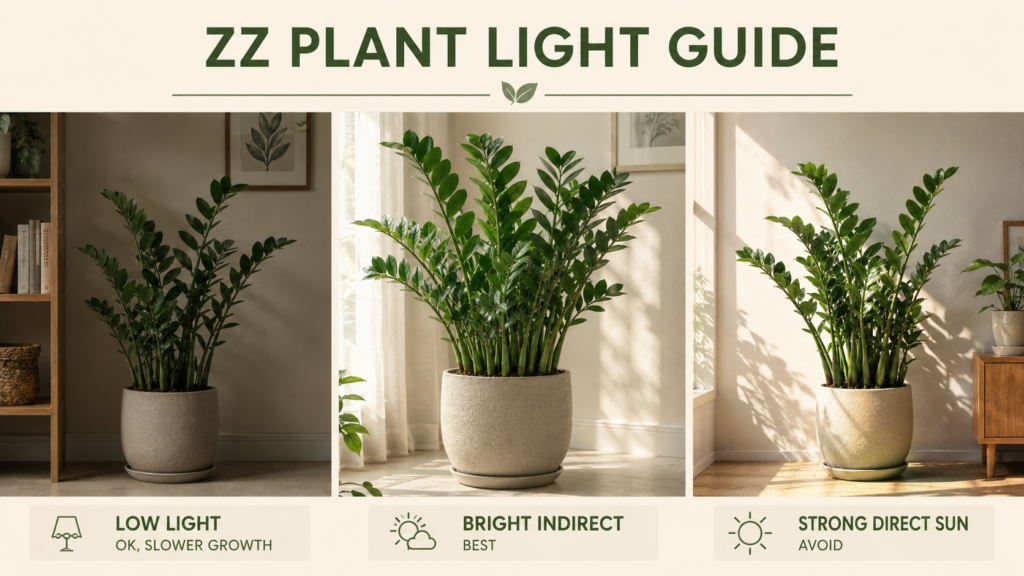
| Light condition | How a ZZ plant usually responds | Recommendation |
| Bright indirect light | Steadier, fuller growth and more new shoots | Best choice |
| Medium indirect light | Healthy growth, usually a little slower | Very good |
| Low light | Can survive and remain attractive, but growth may slow sharply | Tolerated |
| Gentle morning sun | Often tolerated if the plant is acclimated | Usually fine in moderation |
| Strong midday/afternoon direct sun | Risk of bleaching, yellowing or brown scorch | Avoid prolonged exposure |
| Artificial/grow light | Can support growth when natural light is weak | Useful in dim or windowless spaces |
| Complete darkness | Cannot support photosynthesis long term | Not suitable |
What Kind of Light Does a ZZ Plant Need?
The easiest target is bright, indirect light: a bright room where daylight reaches the plant but strong sun is not sitting directly on the leaves for hours. ZZ plants evolved with a reputation for shade tolerance, which is why they can remain presentable in offices and darker rooms where many houseplants decline quickly. However, the plant’s ability to tolerate shade should not be confused with its ideal growing condition.
University horticulture guidance consistently places ZZ plants among adaptable low-light houseplants while also noting better or faster growth in brighter indirect light. That is the practical rule to use at home: choose the brightest safe position available rather than deliberately putting the plant in the darkest corner.
What Does Bright Indirect Light Mean?
Bright indirect light means the room is clearly illuminated for much of the day, but direct rays are filtered, weakened, or do not fall on the foliage for long. You might find it beside an east-facing window, a short distance back from a bright south-facing window, or behind a sheer curtain that softens intense sun.
- You can comfortably read in the area during the daytime without turning on a lamp.
- The plant receives strong ambient daylight but does not sit in a hot beam of afternoon sun.
- Soft shadows are common; deep, barely visible shadows usually indicate much lower light.
- The exact distance from a window varies because window size, glass, curtains, trees, nearby buildings and season all change light intensity.
How Much Light Does a ZZ Plant Need?
There is no single number of daylight hours that works in every home because light intensity matters just as much as duration. Eight hours in a dim hallway is not equivalent to eight hours close to a bright window. A practical goal is to give the plant several hours of useful ambient daylight throughout the day, with bright indirect conditions for as much of that period as your room allows.
Some plant-care guides suggest daily ranges such as 6-8 hours, while others recommend closer to 10-12 hours, especially under artificial light. Treat those figures as scheduling guides rather than a biological minimum. The plant’s response is more useful: if growth is compact and steady, the leaves remain healthy, and the soil does not stay wet for an unusually long time, the light level is probably workable.
| A better rule than counting hours Judge light by intensity + duration + plant response. A ZZ plant receiving moderate-to-bright indirect light for most of the day usually has an easier time growing than one receiving a long day of extremely weak light. |
Can a ZZ Plant Grow in Low Light?
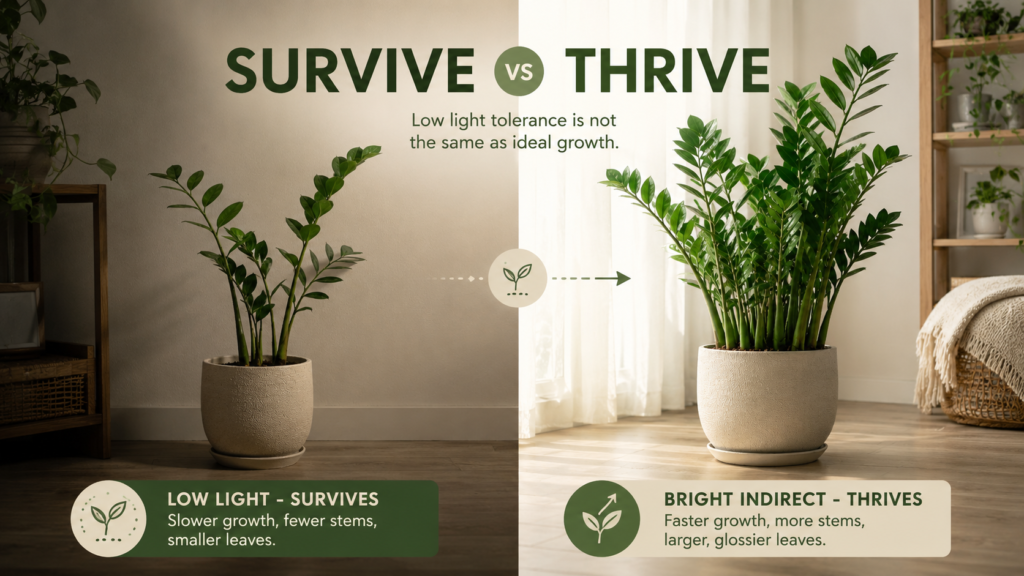
Yes. Low-light tolerance is one of the main reasons ZZ plants are popular in offices, apartments and rooms with limited windows. Research-based extension guidance has documented ZZ plants continuing to produce new leaves under very low interior light levels, which helps explain their reputation as unusually adaptable houseplants.
But the key word is tolerate. A ZZ plant kept in low light may stay alive and look acceptable while producing little visible new growth. If your goal is a fuller plant with more shoots, brighter indirect light is usually a better choice.
Low-Light Tolerant Does Not Mean Low-Light Loving
A plant can survive a condition without performing at its best in that condition. ZZ plants store water and energy in thick underground rhizomes and can operate with a relatively slow growth rate, so they cope with low-light environments better than many common tropical houseplants. That does not mean darkness is beneficial.
What Happens to a ZZ Plant in Low Light?
- New shoots may appear less often.
- Growth may be slower and less dense.
- Stems may lean toward the brightest part of the room.
- New growth may be smaller or more stretched.
- The potting mix may dry more slowly because the plant is using less water.
- A fixed watering schedule becomes riskier because lower light often means the roots need longer between waterings.
How Low Is Too Low?
If the room is so dark that you normally need artificial lighting throughout the daytime, the plant is unlikely to receive enough useful natural light for good long-term growth. A ZZ plant may persist for a while using stored resources, but complete darkness cannot support photosynthesis. In that situation, either move it closer to usable daylight or add a grow light.
Does a ZZ Plant Need Sunlight?
A ZZ plant needs light, but it does not need direct sunlight. This distinction matters because people often use “sunlight” to mean any natural daylight. The plant can photosynthesize from bright indirect daylight without direct sunbeams striking its leaves.
If your ZZ plant is several feet from a window in a bright room, it may still be receiving plenty of indirect light. If it is in a dark interior corridor with almost no daylight, it may need supplemental artificial light even though no direct sun is required.
Can ZZ Plants Take Direct Sunlight?
ZZ plants can tolerate some gentle direct sun, especially weaker morning light, but prolonged intense sun is not necessary and can damage the foliage. A plant that has lived in low light is particularly vulnerable if it is moved suddenly into a strong south- or west-facing window.
Is Morning Sun Safe for a ZZ Plant?
Short periods of early morning sun are usually less intense than afternoon sun and are often tolerated by acclimated plants. Watch the foliage after any change in placement. Healthy leaves should remain firm and evenly colored rather than developing pale, tan or crispy patches.
Why Afternoon Sun Is Riskier
West-facing windows and exposed south-facing windows can produce strong heat and light, particularly in summer. Direct exposure through glass may bleach or scorch the parts of the plant facing the window. A sheer curtain, greater distance from the glass, or a position slightly to the side can reduce that risk.
Acclimate a ZZ Plant to Brighter Light Gradually
If you want to move a ZZ plant from a dark room to a brighter position, do it gradually when possible. Increase exposure over several days or weeks instead of placing the plant immediately in strong direct sun. This is especially important for plants that have spent months in low light.
Signs Your ZZ Plant Needs More Light
Light problems rarely show up as one perfectly diagnostic symptom, so look at the whole pattern rather than one leaf. Signs that may point toward insufficient light include:
- Very slow growth during an otherwise active growing period.
- Long-term absence of new shoots even though watering, temperature and root health are reasonable.
- Stems leaning noticeably toward a window or lamp.
- Sparse, stretched or smaller new growth.
- Soil remaining moist much longer after the plant was moved to a darker position.
Do not assume that every yellow leaf is caused by low light. Yellowing can also be associated with overwatering, root problems, aging foliage and other stresses. Use light level together with watering history and the location of the damaged leaves before making changes.
Signs Your ZZ Plant Is Getting Too Much Light
- Pale or bleached patches on the side facing a bright window.
- Tan or brown scorch marks that become dry and crispy.
- Faded foliage where the green color looks washed out.
- Curling or stress on leaves exposed to intense heat and sun.
- Damage that appears shortly after the plant is moved into stronger direct light.
What Does Sunburn on a ZZ Plant Look Like?
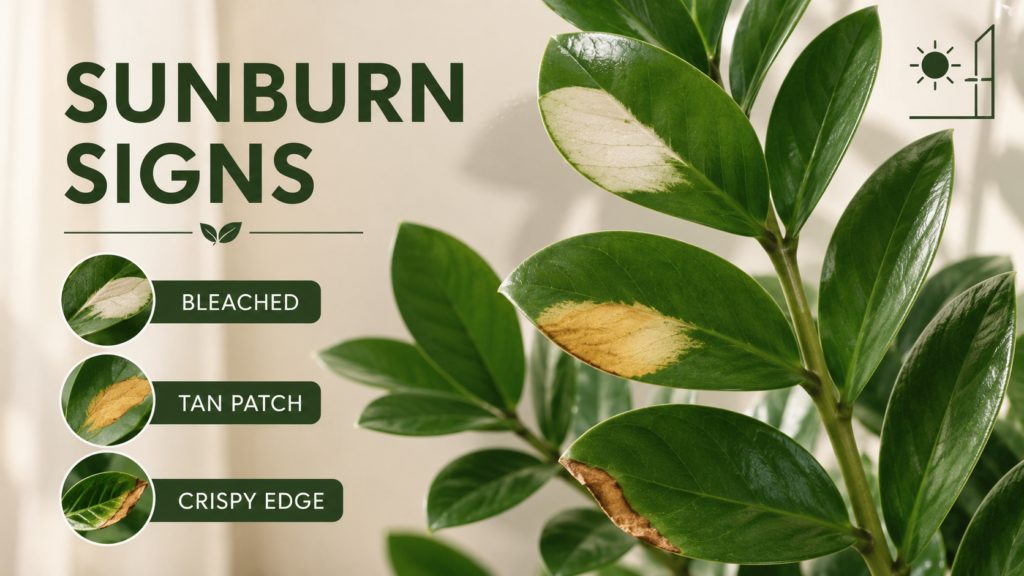
Sunburn usually appears on the foliage receiving the strongest direct exposure. The damage may begin as a bleached, whitish or yellow-tan area and later become brown and dry. Unlike normal shade-related slow growth, sunburn is localized physical damage to leaf tissue and is often most obvious on the window-facing side.
Can Sunburned ZZ Leaves Recover?
Once leaf tissue has been badly scorched, the damaged area will not turn green again. The goal is to stop additional injury and judge recovery by healthy new growth. A leaf with a small cosmetic patch can often remain on the plant if the rest of the leaflet is healthy.
What to Do With a Sunburned ZZ Plant
- Move the plant out of harsh direct sun, but keep it in bright indirect light.
- Use a sheer curtain or increase the distance from the window if the room is extremely bright.
- Avoid moving the plant into deep darkness as an overcorrection.
- Keep watering based on soil dryness rather than trying to ‘treat’ sunburn with extra water.
- Watch the newest growth; healthy new leaves are a better recovery sign than the appearance of already-damaged tissue.
Too Little Light vs. Too Much Light
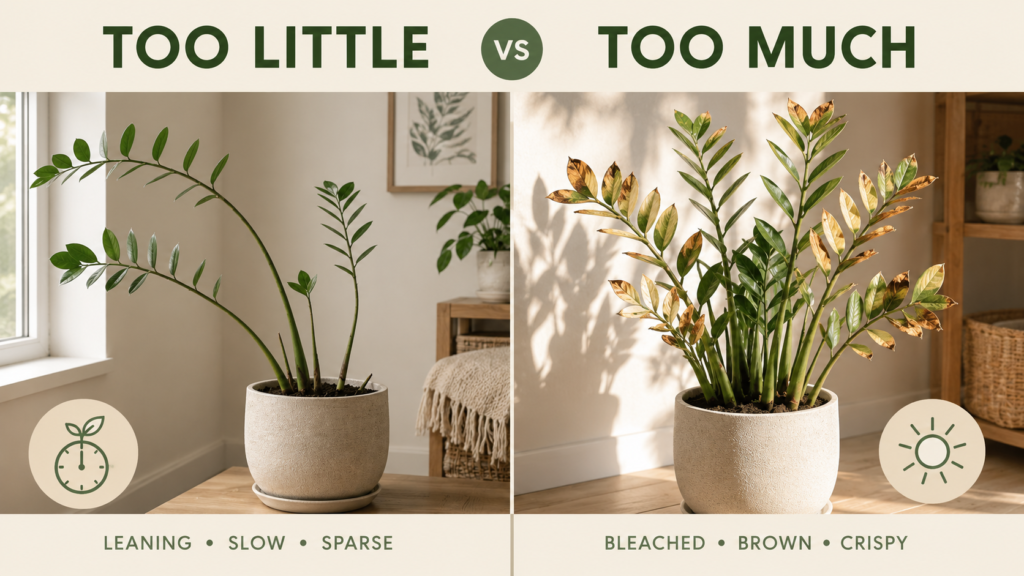
| What you notice | Too little light | Too much light/direct sun |
| Growth | Very slow, sparse or stretched | May slow after stress or scorch |
| Direction | Stems may lean toward the light | Leaves may angle away from intense exposure |
| Leaf color | Often remains green but growth can be weak | Bleached, faded, yellow-tan or brown patches |
| Texture | Usually not crispy from light alone | Dry, crispy scorched areas can develop |
| Soil drying | Often slower | Can dry faster in a hot sunny position |
| Best fix | Move to brighter indirect light or add a grow light | Filter direct sun or move slightly farther back |
What Is the Best Window for a ZZ Plant?
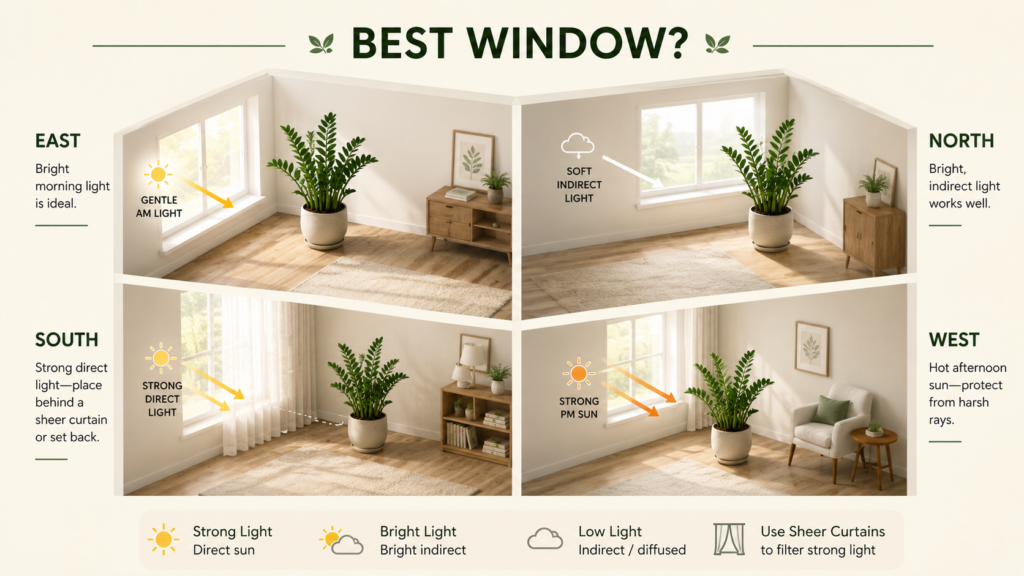
Window direction is useful as a starting point, but it is not a guarantee. A shaded south-facing window can be dimmer than an unobstructed east-facing window, and trees, neighboring buildings, curtains and seasonal sun angles can change the result.
| Window direction | Typical light pattern | How to use it for a ZZ plant |
| East-facing | Bright morning light, gentler direct sun | Often one of the easiest placements; monitor if direct rays are strong |
| North-facing | Lower-intensity indirect light | Usually tolerated; place closer if the room is dim |
| South-facing | Bright light for much of the day | Excellent ambient light, but filter or step back from harsh direct sun |
| West-facing | Strong afternoon light | Keep out of prolonged direct beams; use distance or a sheer curtain |
Where Should You Put a ZZ Plant Indoors?
Living Room
Choose a bright part of the room where the plant is not pressed against hot glass. ZZ plants work well beside windows, between windows, or slightly back from a bright exposure.
Bedroom
A bedroom with an east- or north-facing window can suit a ZZ plant well. If the room is dim and curtains stay closed most of the day, move the plant nearer to the window or provide supplemental light.
Office
ZZ plants are well suited to offices because they tolerate lower light than many houseplants. A desk near a window is ideal, but consistent artificial room lighting can help in spaces where daylight is weak.
Bathroom
A bathroom is suitable only if it has enough light. High humidity does not compensate for darkness. If the bathroom has no window, a grow light is the practical solution.
Hallway or Interior Corner
These positions often look brighter to our eyes than they are to a plant. If the location receives very little daylight, rotate the plant periodically with a brighter spot or, preferably, add supplemental light rather than relying on stored energy indefinitely.
Can a ZZ Plant Grow Under Artificial Light?
Yes. A ZZ plant can grow under artificial light as long as the fixture provides enough usable light for enough hours each day. Artificial lighting is especially helpful in windowless offices, basements, deep interior rooms and winter conditions where natural daylight is extremely limited.
Does a ZZ Plant Need a Grow Light?
Not if the plant already receives adequate natural daylight. A grow light becomes useful when the room is consistently dim, the plant is far from windows, or growth remains extremely slow despite otherwise reasonable care.
What Type of Grow Light Works for a ZZ Plant?
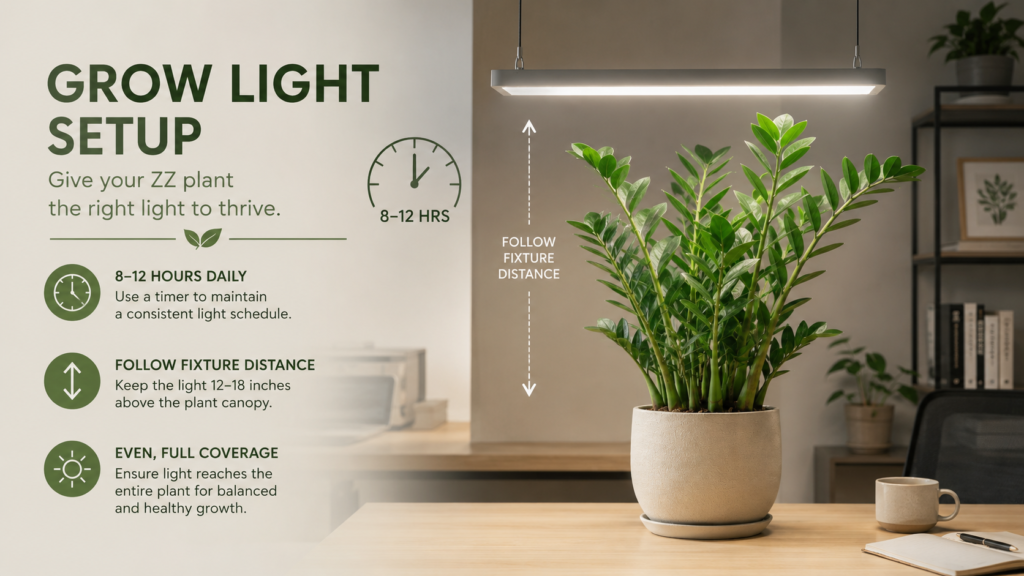
A simple full-spectrum LED grow light is usually sufficient. ZZ plants do not need the intense lighting used for fruiting crops. Choose a fixture designed for houseplants, position it so the whole canopy receives light, and follow the manufacturer’s recommended hanging or placement distance.
How Long Should a Grow Light Stay On?
A common practical schedule is around 8-12 hours per day, often controlled with a timer. The exact duration depends on the lamp’s intensity and how much natural light the plant receives. Avoid leaving the light on 24 hours a day; plants benefit from a regular dark period.
How Close Should the Grow Light Be?
There is no universal distance because grow lights vary greatly in output. A weak desk-style plant lamp may need to be relatively close, while a powerful LED panel can sit farther away. Use the fixture instructions first, then watch the plant for stretching (too weak/far) or bleaching and heat stress (too strong/close).
Do ZZ Plant Light Needs Change With the Seasons?
Summer
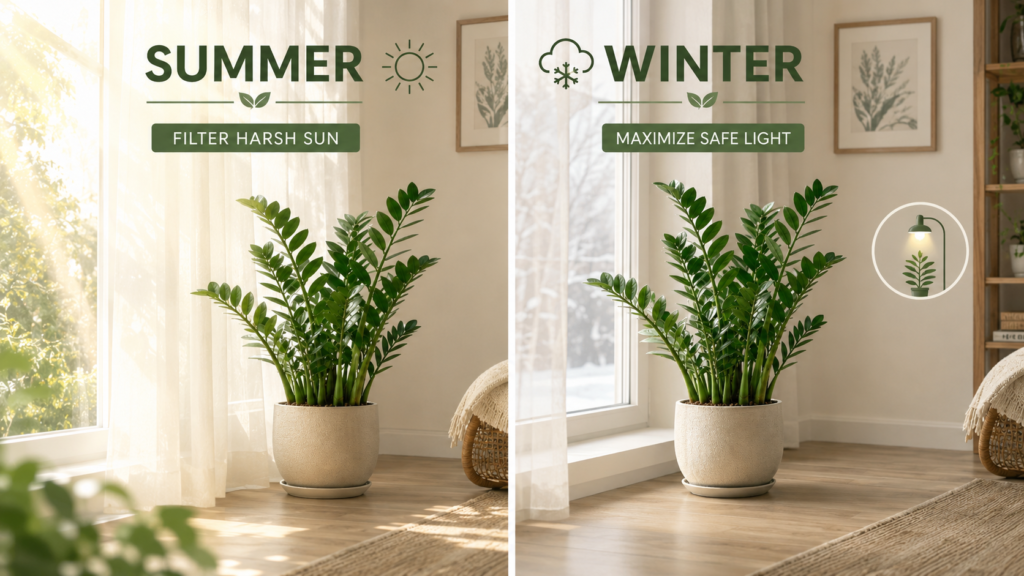
Summer sun can become much stronger and reach farther through windows. A ZZ plant that was safe near a window in winter may receive harsh direct sun in summer, so check the leaf surface and move or filter the plant if necessary.
Winter
Shorter days and lower sun angles can reduce indoor light. Moving the plant a little closer to a bright window or adding a grow light can help. Because growth usually slows, the potting mix may also take longer to dry.
How Light Affects ZZ Plant Watering
Light and watering are connected. In lower light, a ZZ plant generally uses water more slowly, so the potting mix stays moist longer. If you move a plant from a bright room into a dim corner but keep watering on the old schedule, the risk of overwatering increases.
Use soil dryness and the plant’s actual conditions rather than a fixed calendar. Brighter conditions may increase water use, but a brighter location is not a reason to keep the soil constantly wet.
Do Different ZZ Varieties Need Different Light?
Standard Green ZZ
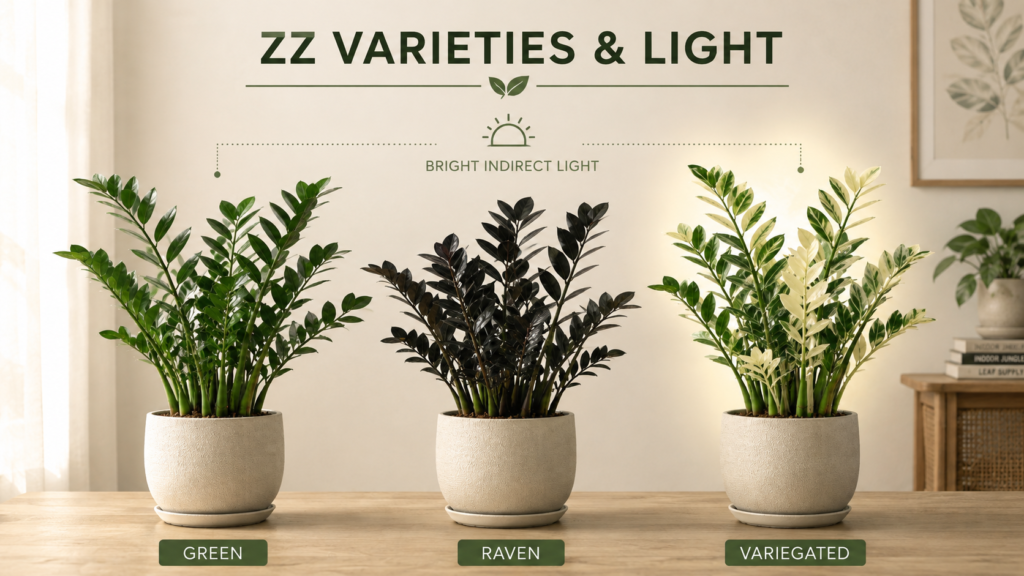
The classic green ZZ is highly adaptable and follows the general rule: bright indirect light for best growth, with good tolerance of lower light.
Raven or Black ZZ
Raven ZZ plants develop very dark mature foliage, but their basic light needs are similar to standard ZZ plants. Bright indirect light supports growth; harsh direct sun can still damage the leaves.
Variegated ZZ
Variegated ZZ plants generally benefit from brighter indirect light because pale sections of the leaves contain less chlorophyll. They still need protection from strong direct sun, which can damage lighter tissue particularly easily.
Does Light Help a ZZ Plant Flower?
ZZ plants can flower, but indoor flowering is uncommon and should not be the main measure of plant health. Mature plants are more likely to bloom when overall conditions are favorable, including sufficient light. Do not move a low-light plant into intense direct sun in an attempt to force flowers.
Frequently Asked Questions About ZZ Plant Light
How much light does a ZZ plant need?
A ZZ plant grows best in bright, indirect light but tolerates medium and low light. Instead of focusing on one exact hour count, provide useful light for much of the day and judge the plant’s response.
Can ZZ plants survive in low light?
Yes. ZZ plants are unusually tolerant of low indoor light, but growth is generally slower and new shoots may appear less often than they would in brighter indirect light.
Does a ZZ plant need sunlight?
It needs light for photosynthesis, but it does not require direct sunlight. Bright indirect daylight is usually ideal.
Do ZZ plants need a lot of light?
No. They can cope with considerably less light than many popular houseplants, although brighter indirect light usually supports stronger growth.
Can a ZZ plant live in a dark room?
It may survive for a time in a very dim room, but complete darkness is not suitable long term. Add a grow light if the space receives almost no daylight.
Do ZZ plants like direct sunlight?
They do not need it. Gentle morning sun may be tolerated, but prolonged intense midday or afternoon sun can bleach or scorch the foliage.
Can a ZZ plant get too much light?
Yes, especially when the light is direct and intense. Bleached, tan or crispy patches on exposed leaves are common warning signs.
Can a ZZ plant live in a windowless office?
Yes, if artificial lighting provides enough usable light. A dedicated full-spectrum grow light is more reliable than ordinary room lighting in a very dark office.
How do I know if my ZZ plant needs more light?
Look for consistently slow growth, leaning toward a window, sparse new growth, and soil that stays wet much longer after the plant was moved to a darker spot.
What window is best for a ZZ plant?
East-facing windows are often easy to manage, but north, south and west windows can all work. The key is bright ambient light without prolonged harsh direct sun.
How long should a grow light be on for a ZZ plant?
A practical starting schedule is about 8-12 hours per day. Adjust based on the lamp’s intensity, natural daylight and the plant’s response.
Can I put my ZZ plant outside?
Yes in suitable warm weather, but place it in bright shade or filtered light and acclimate it gradually. Do not move an indoor ZZ plant directly into strong outdoor sun.
The Bottom Line
The best light for a ZZ plant is bright and indirect. Low light is a strength of the species, not its ideal target, and strong direct sun is more likely to create problems than benefits. If you remember one rule, use this one: give your ZZ the brightest safe spot you have, protect it from prolonged harsh sun, and use a grow light when natural daylight is genuinely inadequate.