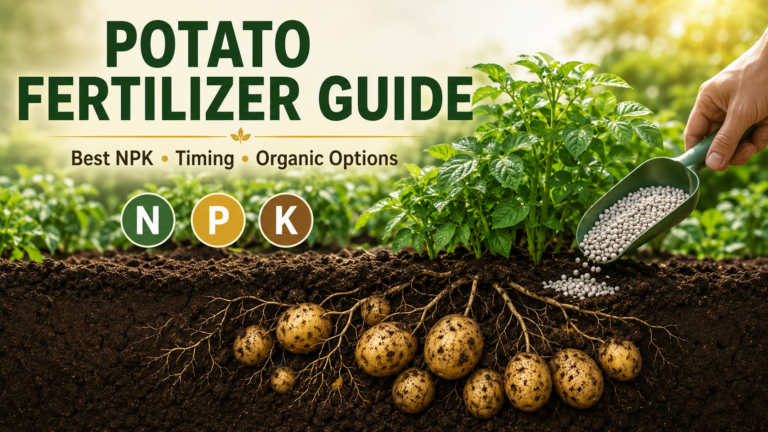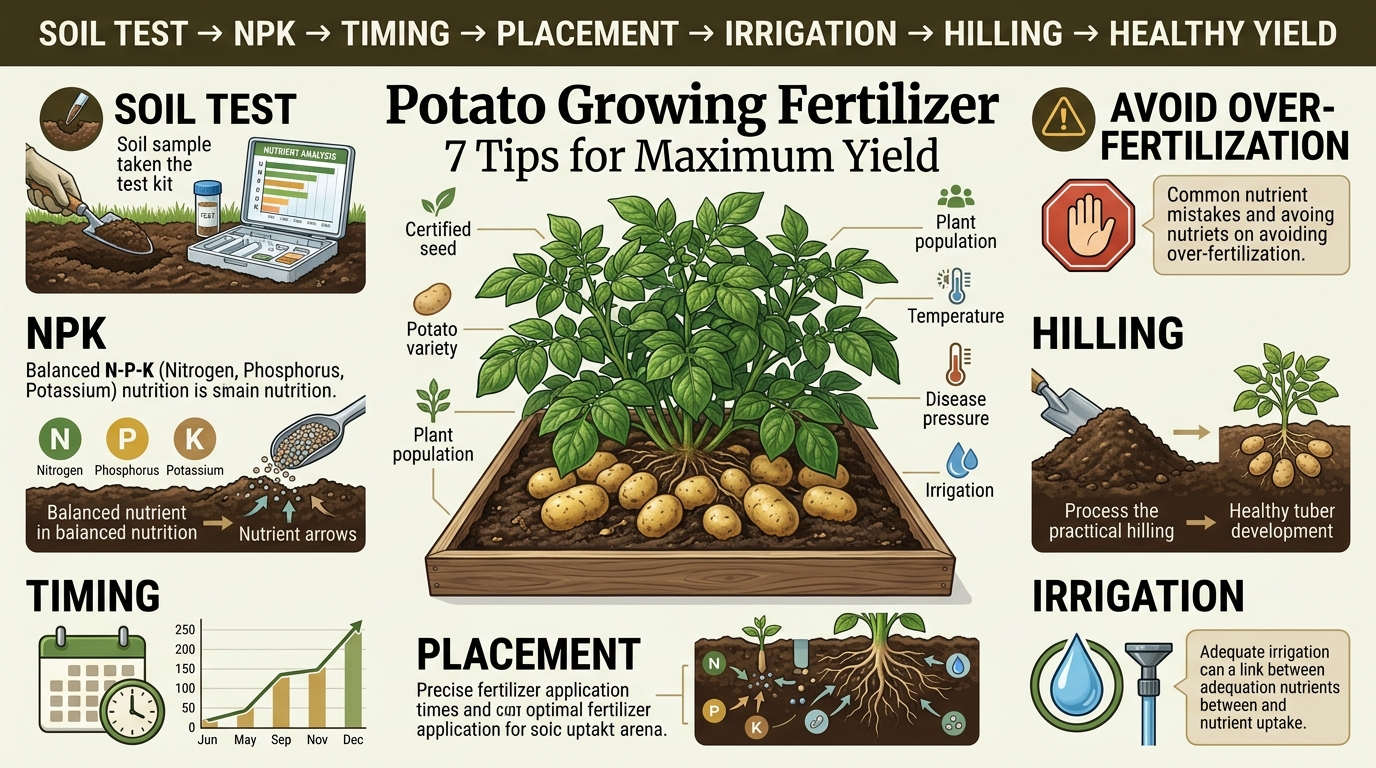

Potatoes can respond strongly to good fertility management, but high yield does not come from simply applying more fertilizer. A productive potato crop needs the right nutrient in the right amount, placed where roots can reach it and timed to the crop’s growth stage. Soil fertility, variety, certified seed, irrigation, hilling, disease pressure, temperature, and plant population all influence how many marketable tubers are harvested.
For home gardeners, market growers, and farmers alike, the most reliable starting point is a soil test. It tells you which nutrients are actually limiting and helps prevent the common mistake of applying nitrogen, phosphorus, or potassium simply because a generic potato-fertilizer chart says to do so. This guide explains the fertilizer principles that matter most, then connects them to potato crop growth, yield per acre, and practical troubleshooting.
| Key principle: High potato yield comes from balanced crop management, not maximum fertilizer. Use local soil-test recommendations as the final authority for nutrient rates. |
Potato Fertilizer at a Glance
| Factor | Practical guidance |
| Best starting point | Soil test and field history |
| Main fertilizer nutrients | Nitrogen (N), phosphorus (P), and potassium (K) |
| Nitrogen | Essential for canopy growth; excess can delay maturity and reduce quality |
| Phosphorus | Important where deficient; soil-test levels should determine need |
| Potassium | Potatoes can have high K demand, but rate still depends on soil supply |
| Placement | Near the developing root zone, not concentrated against seed pieces |
| Timing | Match applications to planting, canopy growth, tuber initiation, and bulking |
| Water | Coordinate irrigation with nutrient supply to improve uptake and reduce losses |
| Yield | Use regional averages as benchmarks, not guarantees |
What Nutrients Does a Potato Crop Need?
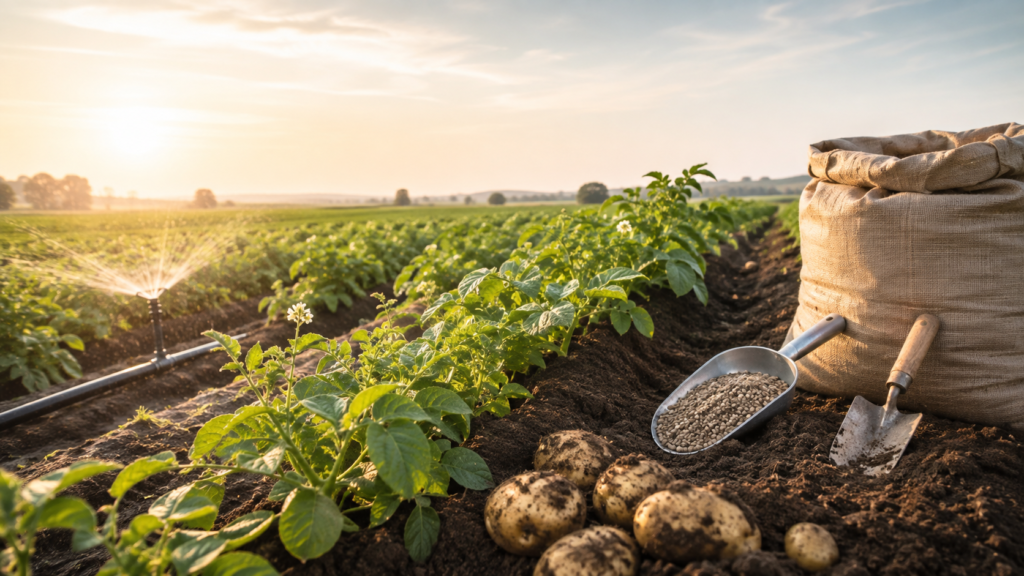
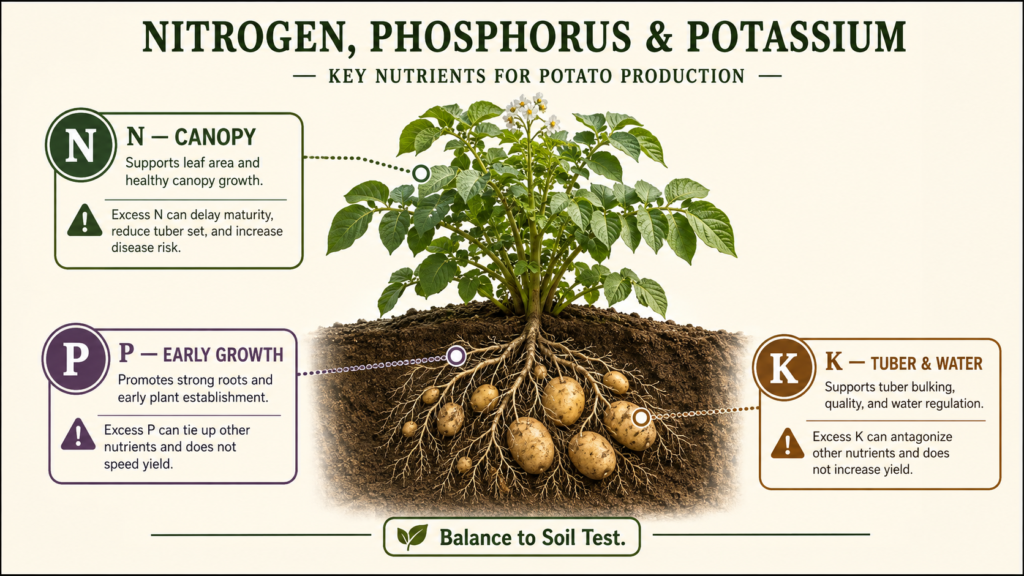
Potatoes need all essential plant nutrients, but nitrogen, phosphorus, and potassium dominate most fertilizer programs because crop demand can be substantial and because deficiencies or excesses can strongly affect growth, maturity, tuber quality, and yield. The correct balance is site-specific.
Nitrogen: Build Enough Canopy, Not Endless Vines
Nitrogen supports leaf area, chlorophyll, and the photosynthetic canopy that supplies carbohydrates to developing tubers. A deficient crop may be pale and weak, but excessive nitrogen is not a shortcut to high yield. Penn State notes that excess nitrogen delays potato maturity, while Oklahoma State warns that too much nitrogen can decrease tuber quality, grade, and yield.
The practical goal is an effective canopy that captures light without keeping the crop in excessive vegetative growth late into the season. Nitrogen therefore needs to be matched to soil supply, cultivar, yield goal, previous crop, manure history, and irrigation—not simply chosen from a fixed “potato NPK” formula.
Phosphorus: Important, but Only When the Soil Needs It
Phosphorus supports energy transfer and early plant development. Because young potato roots initially explore a limited soil volume, phosphorus placement can matter in cold or low-P soils. University of Maine notes that banded phosphorus can improve availability to the young root system in some conditions.
However, phosphorus should not automatically be applied at a high rate just because potatoes form underground tubers. Oklahoma State’s potato recommendations decline as soil-test phosphorus rises and reach zero additional phosphorus when the test level is sufficiently high. This is exactly why soil testing should precede fertilizer selection.
Potassium: High Crop Demand, but Not Unlimited Demand
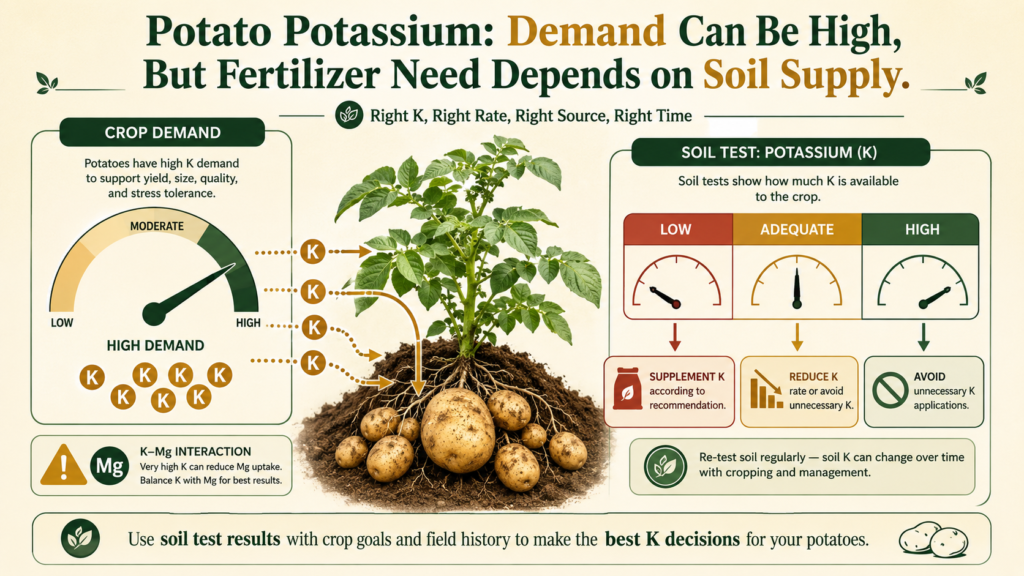
Potassium is heavily involved in water regulation, carbohydrate movement, enzyme function, and overall crop performance. Texas A&M reports that a 400-cwt-per-acre crop can contain about 275 pounds of potassium in the vines and tubers, illustrating the crop’s potentially large K demand.
That figure is nutrient removal, not a universal fertilizer recommendation. Soil can supply part or all of the crop’s need. Penn State also cautions that excessive potassium can interfere with magnesium uptake and reduce potato specific gravity. High demand is a reason to test and manage K carefully—not a reason to apply it without limit.
Secondary Nutrients and Micronutrients
Calcium, magnesium, sulfur, and micronutrients also matter, but they should be treated as diagnosis-driven nutrients. Correct deficiencies shown by soil or tissue analysis rather than routinely adding every nutrient to every field. This keeps the fertilizer program focused, economical, and easier to troubleshoot.
What Is the Best Fertilizer for Potatoes?
There is no single best fertilizer for every potato garden or farm. A bag labeled 5-10-10, 10-10-10, or another ratio may be appropriate in one soil and poorly matched to another. University of Maine, for example, gives a balanced 10-10-10 fallback example for home gardens without a current soil test, but its first recommendation is still to test the soil. Commercial recommendations are even more site-specific.
Choose a fertilizer program by answering five questions:
- What does the soil test say about phosphorus, potassium, pH, and other nutrients?
- How much nitrogen is likely to come from the soil, previous crop, manure, or organic matter?
- What cultivar and market are you growing for, and how long is the season?
- What yield level is realistic for your environment and irrigation system?
- Can the fertilizer be placed and timed so roots can use it efficiently?
| Do not chase a magic ratio: Balanced nutrition does not mean equal numbers on the fertilizer bag. It means matching nutrient supply to the crop and soil. |
7 Powerful Potato Growing Fertilizer Tips for High Yield
Tip 1: Test Your Soil Before Fertilizing
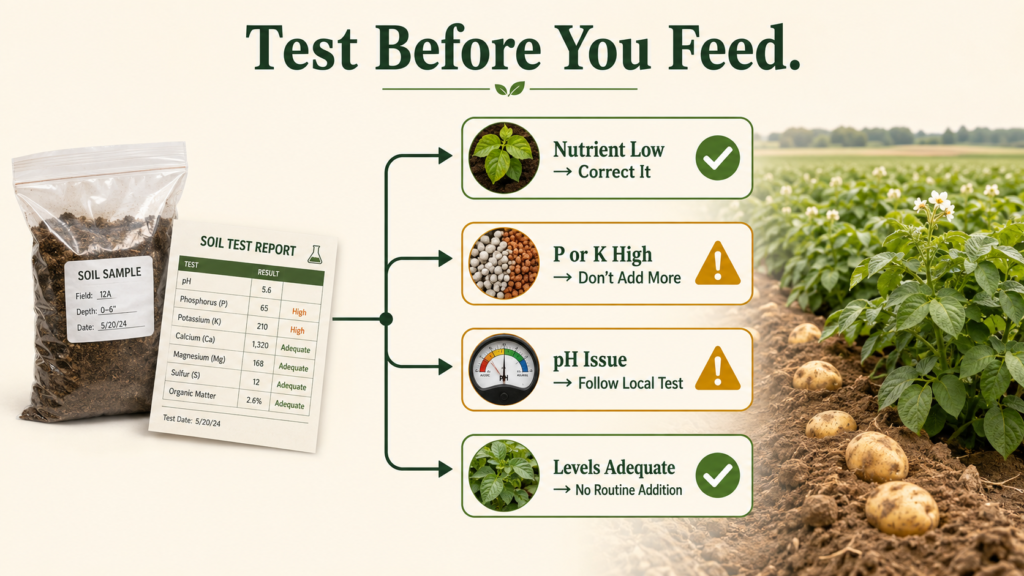
A soil test is the highest-value first step in potato fertilizer planning. Penn State calls annual soil testing the best method for determining lime and fertilizer requirements in potato production. Oklahoma State directly ties phosphorus and potassium rates to soil-test levels.
At minimum, review soil pH, phosphorus, potassium, and any locally recommended nutrient measurements. Also account for previous manure, compost, legume crops, and residual nitrogen. In a heavily amended garden, “more organic fertilizer” can be just as unnecessary as more synthetic fertilizer.
Use the test as a decision tree: correct confirmed deficiencies; avoid nutrients already present at adequate or high levels; and address pH only according to local recommendations. Potatoes often perform well in mildly acidic soil, and pH management also interacts with common scab risk, so liming should not be done casually.
Tip 2: Balance N, P, and K Instead of Guessing
Potato fertilizer decisions should be nutrient-specific. Nitrogen drives canopy growth, phosphorus may be important for early development where soil P is low, and potassium demand can be large during productive cropping. But the correct rate of each nutrient can differ dramatically.
A useful way to think about fertilizer is “deficiency correction + crop demand – soil supply.” That is more accurate than selecting a high-yield formula solely from the three numbers on the bag. It also prevents the common problem of applying phosphorus and potassium every year even when soil tests already show adequate levels.
For farms, use local Extension or crop-adviser recommendations. For gardens, follow a current soil test whenever possible and use package rates only in the context for which they were written.
Tip 3: Put Fertilizer Near the Roots, Not Against the Seed Potato
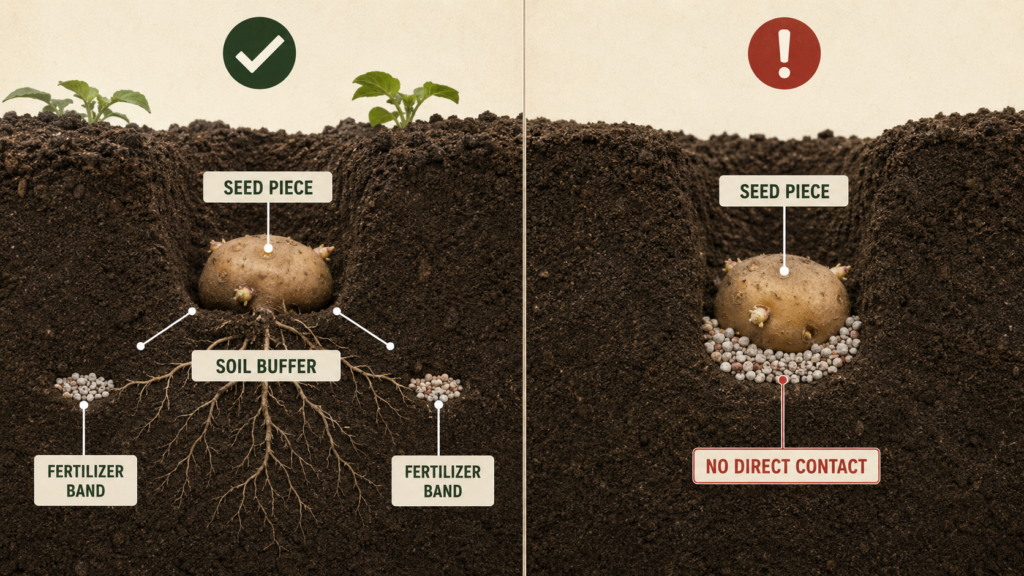
Fertilizer placement can affect both efficiency and seed-piece safety. University of Maine recommends avoiding direct fertilizer contact with seed pieces because concentrated fertilizer can contribute to rapid seed-piece decay. It describes band placement to the sides and below the planting position as one option. [3] Texas A&M also describes banding fertilizer near, rather than on, the seed piece in its regional production guidance. [4]
For a home row, the idea is simple: do not place a concentrated pile of fertilizer directly under or against the cut seed potato. Incorporate broadcast fertilizer evenly when that method is appropriate, or place a band at a safe offset according to local guidance. Later side-dressing should likewise be positioned where active roots can reach nutrients without piling granules against stems.
Tip 4: Match Fertilizer Timing to Potato Growth Stages
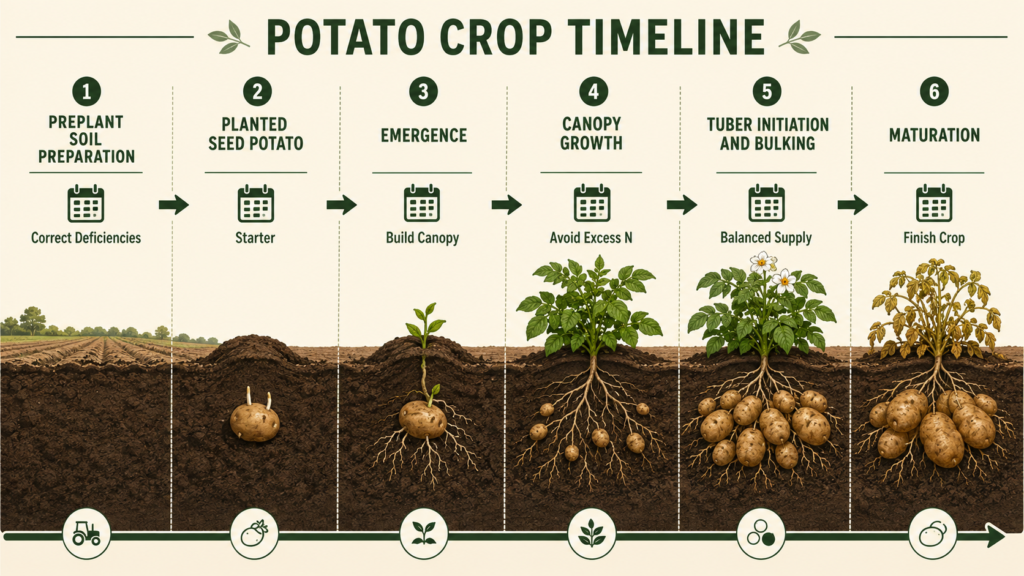
A potato crop changes rapidly from establishment to canopy growth, tuber initiation, bulking, and maturity. Nutrient timing should reflect that progression. Applying the entire season’s nitrogen as one oversized dose at planting can be inefficient, especially on lighter soils or under irrigation.
Penn State describes a regional commercial approach in which approximately one-third of nitrogen is applied at planting, another third four to five weeks later, and the remaining nitrogen is based on petiole nitrate testing around flowering. Oklahoma State also uses split nitrogen timing in its regional program. These examples illustrate the principle of staged nutrition; they are not universal schedules to copy into a different climate or soil.
| Growth stage | Crop priority | Fertility consideration |
| Preplant | Prepare a loose, fertile seedbed | Correct test-confirmed deficiencies and account for previous fertility |
| Planting | Establish roots and shoots | Use appropriate starter/banded nutrition without direct seed contact |
| Emergence & canopy growth | Build enough leaf area | Supply N without pushing excessive vine growth |
| Tuber initiation | Begin forming tubers | Avoid nutrient and moisture stress |
| Tuber bulking | Increase tuber size and dry matter | Maintain balanced nutrient and water supply |
| Maturation | Finish and set skins | Avoid unnecessary late N that delays maturity |
Tip 5: Pay Special Attention to Potassium—Without Overapplying It
Potatoes can remove large amounts of potassium in a high-yield crop. That makes K management important, particularly in sandy or low-K soils. Yet fertilizer need depends on soil supply. Texas A&M notes that some High Plains soils are naturally high in available potassium and may not require added K to maximize yield and quality. [4]
This is a valuable reminder: crop removal and fertilizer requirement are not the same number. If a soil test is high in potassium, applying more K may add cost without yield benefit. Where K is low, the soil-test recommendation should guide the rate and source. Also consider magnesium status when K applications are large, because nutrient interactions can affect quality.
Tip 6: Coordinate Fertilizer With Irrigation and Hilling
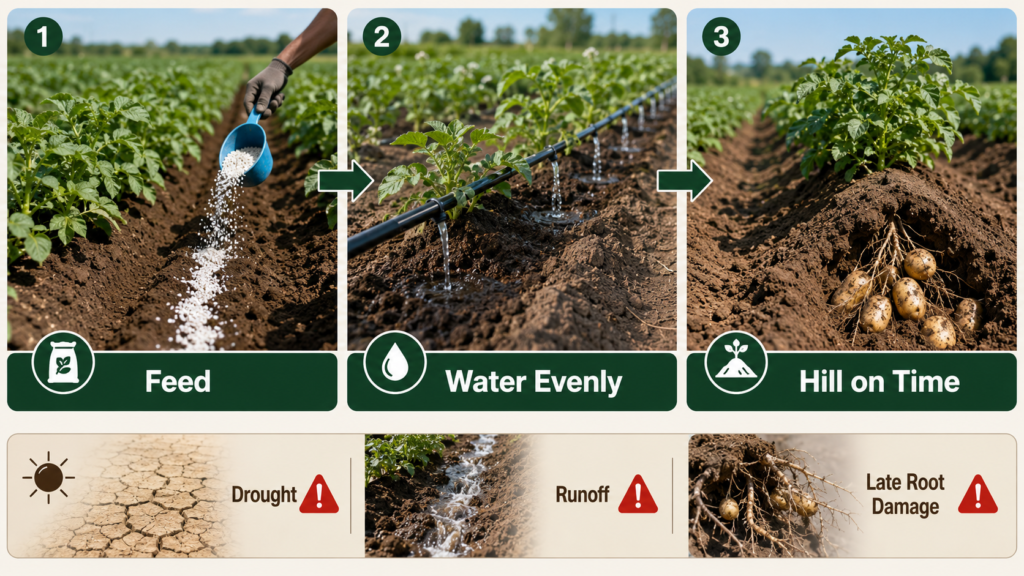
Fertilizer cannot work efficiently if roots alternate between severe drought and saturated soil. Potato roots need oxygen and reasonably consistent moisture. Excess irrigation can move mobile nutrients below the active root zone, while drought reduces nutrient uptake and can interrupt tuber growth.
Coordinate fertilizer and irrigation so nutrients remain available during the period of crop demand. This is particularly important for split nitrogen programs and fertigation systems. Avoid using fertilizer as a response to plants that are simply water-stressed.
Hilling is another part of the same system. Hilling protects developing tubers from light and helps control weeds, but late or aggressive cultivation can damage roots. Penn State recommends completing hilling before bloom in its production system and minimizing root injury if cultivation is delayed. [1]
Tip 7: Manage the Whole Potato Crop, Not Just the Fertilizer
The most important high-yield fertilizer tip is knowing when fertilizer is not the limiting factor. Healthy certified seed, a suitable cultivar, correct planting density, loose well-drained soil, irrigation, temperature, hilling, disease control, and a long enough bulking period all determine the crop’s final yield.
University of Maine and Penn State both emphasize certified seed as a foundation of potato production. [1][3] A high-yield variety planted with poor seed health or exposed to early vine death cannot be rescued by extra fertilizer. Likewise, a crop with strong vines but severe water stress during tuber bulking may produce small potatoes despite adequate soil fertility.
| High-yield rule: Fertilizer helps the potato crop express its yield potential; it does not create that potential by itself. |
How to Apply Potato Fertilizer Correctly
At Planting
Use soil-test recommendations to decide what belongs in the preplant or planting application. If banding fertilizer, keep the concentrated band away from the seed piece. If broadcasting, incorporate it uniformly into the prepared soil as recommended for the product and production system.
Side-Dressing
Side-dressing places fertilizer alongside an established row so roots can access nutrients during active growth. It is commonly used for later nitrogen in systems where split application improves efficiency. Keep fertilizer off foliage and do not place concentrated material directly against stems.
Fertigation
Commercial irrigated systems may deliver soluble nutrients through irrigation. Fertigation can match nutrient delivery closely to crop demand, but it requires calibrated equipment, water management, and local nutrient recommendations. It should not be treated as a reason to increase the total seasonal nutrient rate.
Organic Fertilizer and Compost
Organic production still requires nutrient accounting. Compost, manures, cover crops, and approved organic fertilizers all contribute nutrients, but their release rates and analyses differ. University of Maine’s organic potato guidance emphasizes soil testing and nutrient planning rather than assuming organic amendments are automatically balanced. [7]
Can You Use Manure for Potatoes?
Manure can add organic matter and nutrients, but it is not automatically the best potato fertilizer. University of Maine’s home-garden guidance advises against manure on potatoes because it can encourage common scab in its production context. [3] Manure can also contribute substantial nitrogen, phosphorus, and salts depending on source and rate.
If manure is part of a farm rotation, account for its nutrient contribution, application timing, food-safety requirements, and local disease considerations. Do not add a full fertilizer program on top of manure without crediting the nutrients already supplied.
How Much Fertilizer Does an Acre of Potatoes Need?
There is no universal per-acre fertilizer rate. Regional recommendations can differ substantially because soils, cultivars, irrigation, climate, and yield goals differ. Use the following examples only to understand that range—not as a prescription for your field.
| Regional example | What the source says | How to use the information |
| Penn State, northeastern U.S. | Conventionally grown potatoes typically receive about 150–180 lb N/acre depending on cultivar; P and K are managed with the fertility program. [1] | Illustrates a regional N range and staged application. |
| Oklahoma State | Uses soil-test-based P and K tables and a split-N program; excess N can reduce grade, yield, and maturity. [2] | Shows why soil-test categories matter more than one universal rate. |
| Texas A&M High Plains | Notes that fertilizer rates vary by soil, climate, variety, and existing fertility; some naturally high-K soils need little or no K fertilizer. [4] | Shows why crop nutrient removal does not equal fertilizer requirement. |
| Commercial grower note: If you are managing acres rather than a garden row, use a current local soil test plus regional potato recommendations or a qualified crop adviser. Do not copy another state or country’s fertilizer rate. |
Potato Yield Per Acre: What Is a Good Yield?
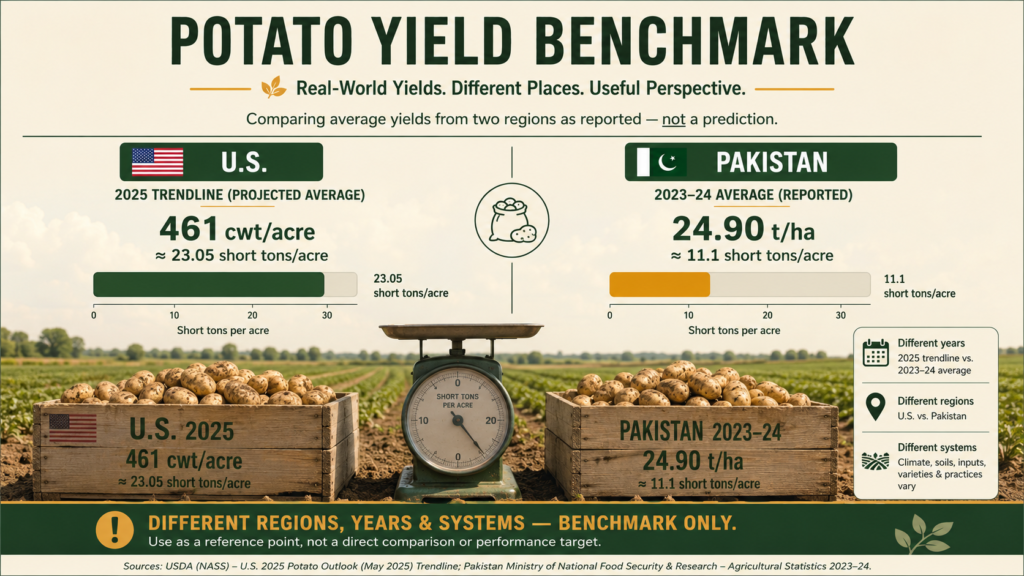
Yield per acre is one of the most searched potato agriculture questions, but it is highly location-specific. Market class, cultivar, irrigation, season length, disease pressure, seed quality, and management can move yields dramatically.
| Benchmark | Reported yield | Approx. acre equivalent | Context |
| U.S. 2025 trendline forecast | 461 cwt/acre | 23.05 short tons/acre | USDA trendline used for 2025 forecast |
| Pakistan 2023–24 average | 24.90 t/ha | ~11.1 short tons/acre | Official national agricultural statistics |
What Actually Determines Potato Crop Yield?
Fertilizer is one part of the yield equation. A useful production checklist is:
- Variety and genetic yield potential
- Certified, disease-free seed and appropriate seed-piece size
- Plant population and in-row spacing
- Loose, well-drained soil and suitable pH
- Balanced nutrient supply based on testing
- Consistent water during tuber initiation and bulking
- Timely hilling and weed management
- Disease and insect control that protects the canopy
- Temperature and length of the growing season
- Harvest timing and maturity
This is why two farms using the same fertilizer can achieve very different yields. The fertilizer program must fit the production system around it.
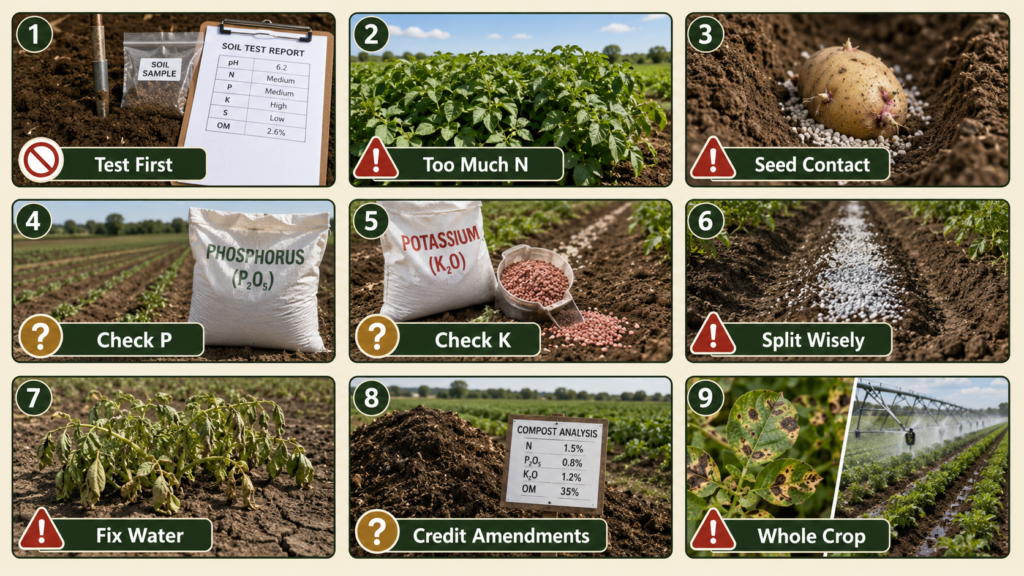
9 Common Potato Fertilizer Mistakes
| Mistake | Possible result | Better approach |
| Skipping the soil test | Wrong nutrient or unnecessary expense | Test first and review field history |
| Too much nitrogen | Excess vines, delayed maturity, quality loss | Match N to crop need and growth stage |
| Fertilizer touching seed pieces | Seed-piece injury or decay risk | Band or incorporate fertilizer away from seed |
| Automatically adding phosphorus | Nutrient buildup without yield benefit | Use soil-test P |
| Assuming more potassium is always better | Cost and possible nutrient imbalance | Use soil-test K and consider Mg status |
| One oversized seasonal application | Poor efficiency and greater loss risk | Split nutrients where locally recommended |
| Fertilizing drought-stressed plants | Does not correct the real problem | Fix water stress and diagnose first |
| Ignoring manure/compost credits | Overapplication of N or P | Account for amendment nutrients |
| Treating fertilizer as the only yield tool | Yield stays limited by seed, water, disease, or variety | Manage the full potato crop |
Troubleshooting Low Potato Yield
Lots of Leaves but Few Potatoes
Excess nitrogen is one possibility, but it is not the only one. Also consider high temperature, variety, plant maturity, excessive shading, disease, spacing, and a short tuber-bulking period. Review the fertilizer history before adding anything else.
Small Tubers
Small potatoes can result from water stress, overly dense plant populations, nutrient imbalance, early vine death, disease, short season, or variety. Check the crop’s water supply and canopy health during tuber bulking before assuming the problem is a lack of fertilizer.
Yellow Leaves
Yellowing can be caused by nutrient deficiency, root stress, waterlogging, drought, disease, or normal senescence as the crop matures. Fertilizing every yellow plant with nitrogen can delay maturity or mask the real issue. Diagnose the pattern, crop stage, and root-zone conditions first.
The Crop Was Fertilized but Yield Is Still Low
Look beyond fertilizer: seed health, stand establishment, variety, soil compaction, irrigation uniformity, diseases, insects, heat stress, and the length of the bulking period are all common yield limitations. A fertilizer program cannot compensate for early loss of the photosynthetic canopy.
How Are Potatoes Produced? A Short Crop Lifecycle
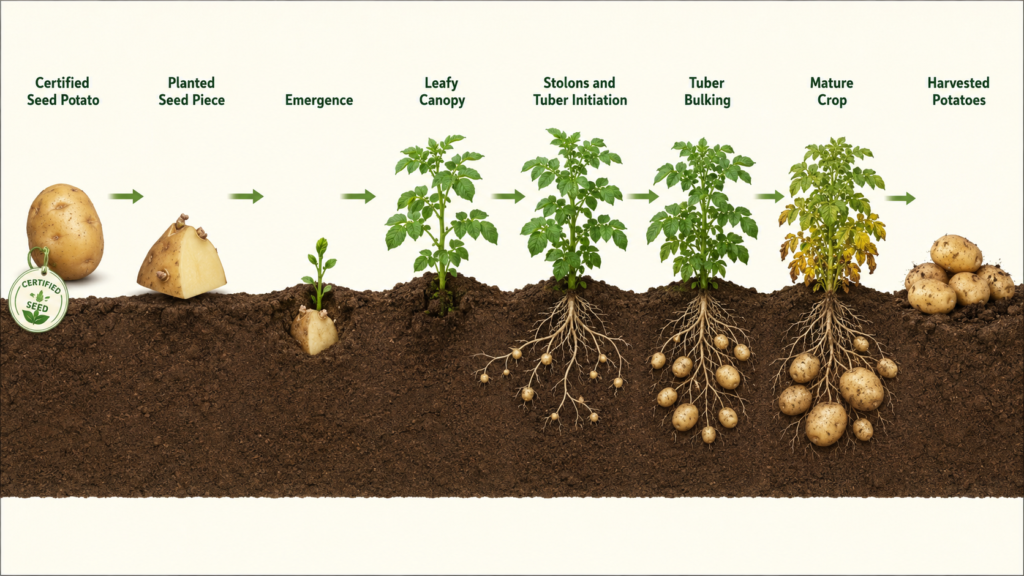
Commercial and garden potatoes are usually produced from whole or cut seed tubers rather than true botanical seed. Certified seed potatoes are planted into prepared soil, sprout to establish stems and leaves, and then form stolons underground. Tubers initiate on those stolons, enlarge during the bulking phase, and mature as the canopy senesces. The crop is hilled to keep developing tubers covered, irrigated according to need, protected from pests and disease, and harvested after reaching the desired maturity and market size.
That lifecycle explains why fertilizer timing matters: early nutrition supports establishment and canopy growth; nutrition and water during tuber initiation and bulking support yield; and excessive late nitrogen can delay maturity. For a complete production guide, this topic should be expanded into a separate potato cultivation article rather than turning a fertilizer page into a full farming manual.
Frequently Asked Questions
What is the best fertilizer for potatoes?
The best fertilizer is the one that corrects the nutrient needs shown by your soil test. There is no universal NPK ratio for every potato crop.
What NPK ratio is best for potatoes?
No single ratio is best everywhere. Potatoes need N, P, and often substantial K, but the required additions depend on soil fertility and crop conditions.
Is 10-10-10 fertilizer good for potatoes?
It can be used as a general home-garden fertilizer in some situations, but an equal-ratio fertilizer may add nutrients your soil does not need. A soil test is preferable.
Do potatoes need a lot of nitrogen?
They need adequate nitrogen for canopy growth, but excessive nitrogen can delay maturity and reduce tuber quality or yield.
Do potatoes need a lot of potassium?
High-yield potato crops can remove substantial potassium, but soil supply varies greatly. Use soil-test recommendations rather than assuming every field needs a large K application.