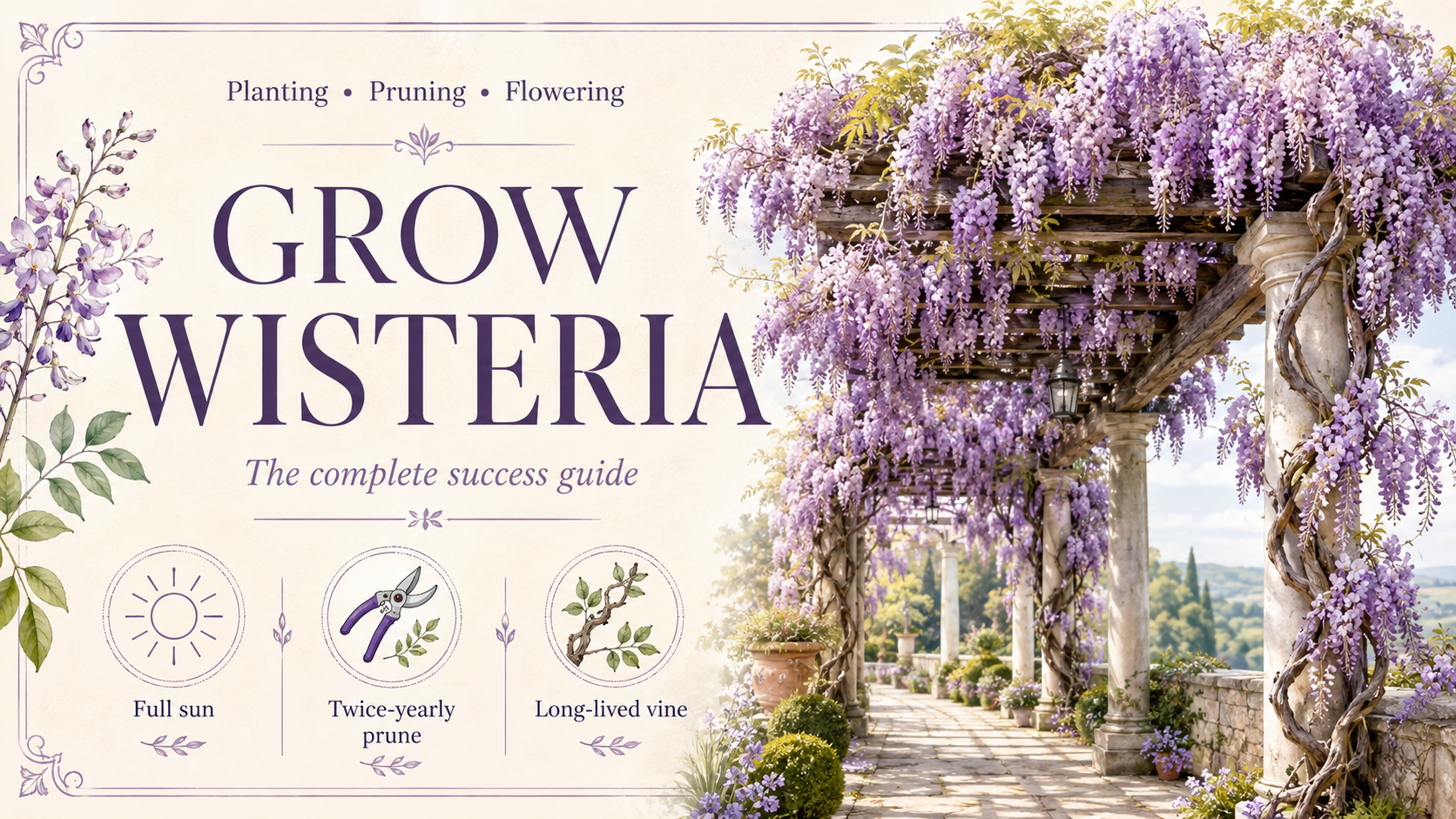
Everything you need to know about growing spectacular wisteria — from choosing the right species to mastering the two-prune system that triggers abundant blooms.
What Is Wisteria?
Wisteria is a genus of vigorous, deciduous climbing vines in the pea family (Fabaceae), famous for producing long, cascading clusters of fragrant flowers in spring. These dramatic racemes — which can reach up to 90 cm (3 feet) on Japanese varieties — make wisteria one of the most visually spectacular flowering plants in temperate gardens.
Native to East Asia and parts of North America, wisteria is a long-lived woody vine that twines around supports and can eventually develop a trunk-like main stem. Mature plants may live well over 100 years and become extraordinarily heavy, which is why choosing the right support structure from the start is essential.
🌸 The world’s largest known wisteria covers nearly an acre at Sierra Madre, California. Planted in 1894, it produces an estimated 1.5 million blossoms each spring.
Wisteria Species Compared
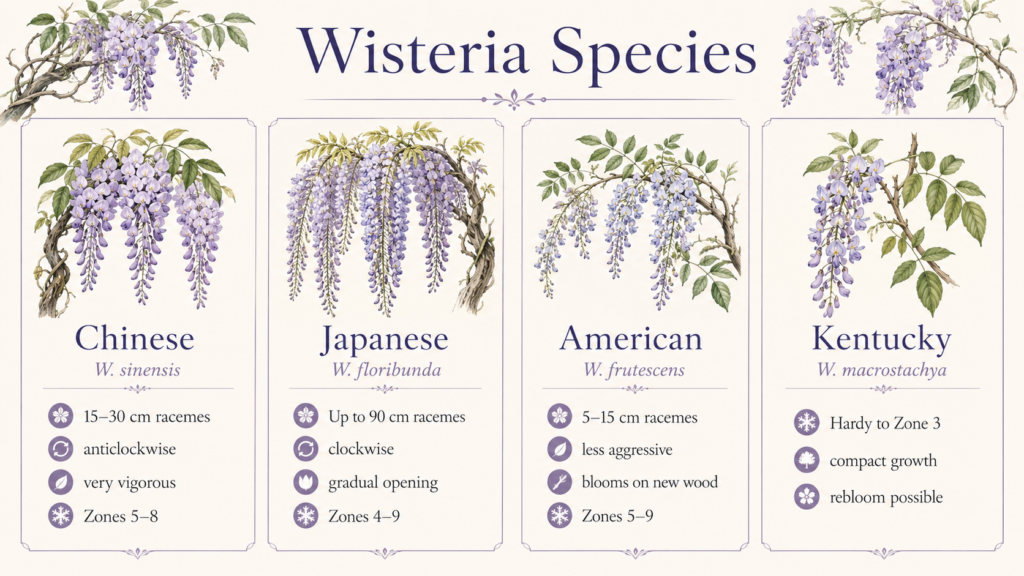
Choosing the right species is your most important early decision. Asian types produce the longest flower clusters but can become invasive. Native American species are more restrained and better suited to smaller gardens.
Chinese Wisteria
Wisteria sinensis
Extremely vigorous. Flower clusters 15–30 cm long, all opening simultaneously. Fragrant. Twines anticlockwise. Can be invasive in warmer regions. Zones 5–8.
Japanese Wisteria
Wisteria floribunda
Produces the longest racemes — up to 90 cm on selected cultivars. Flowers open gradually from base to tip. Twines clockwise. Very vigorous. Zones 4–9.
American Wisteria
Wisteria frutescens
Native to southeastern US. Shorter flower clusters (5–15 cm) but much less aggressive. Good choice where invasiveness is a concern. Blooms on new wood. Zones 5–9.
Kentucky Wisteria
Wisteria macrostachya
The hardiest species — tolerates Zone 3. Compact flower clusters, manageable growth. ‘Blue Moon’ cultivar can rebloom in summer. Excellent for colder climates.
Where & How to Plant Wisteria
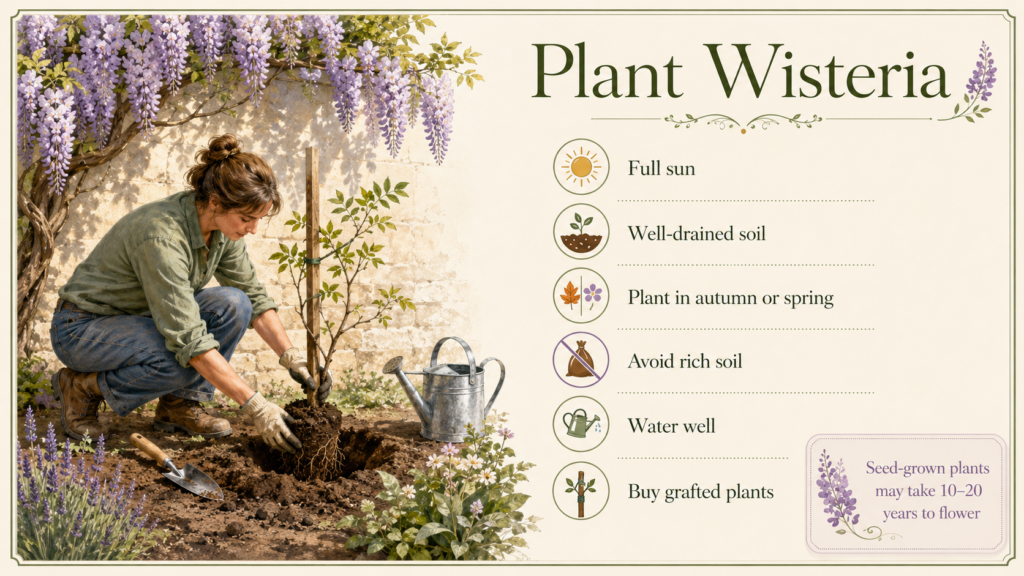
Wisteria demands full sun — at least 6 hours of direct sunlight daily. A south- or west-facing wall is ideal in cooler climates. Insufficient light is one of the most common reasons wisteria fails to flower, so never plant in shade.
Soil should be moderately fertile and well-drained. Wisteria tolerates most soil types but dislikes waterlogging. Avoid overly rich soil or heavy nitrogen fertilising — excess nitrogen pushes leafy growth at the expense of flowers.
Plant in autumn or early spring. Dig a hole twice the width of the rootball, plant at the same depth it grew in its pot, water well, and mulch around (but not against) the stem. Always buy grafted or cutting-grown plants — seed-grown wisteria can take 10–20 years to flower.
Training & Support Structures
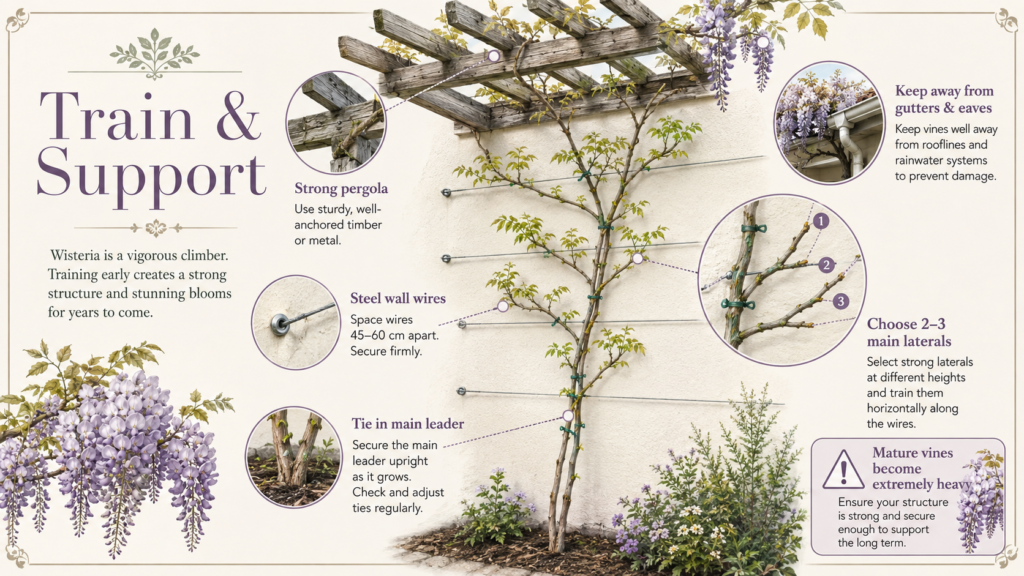
Wisteria becomes extremely heavy with age — a mature vine can weigh several tonnes. Train it only on substantial structures: a sturdy pergola with posts at least 10×10 cm, galvanised steel wires fixed to masonry with vine eyes, or a purpose-built metal arch. Lightweight wooden trellises and plastic supports are almost always inadequate.
During the first two years, focus on developing a strong framework. Tie the main leader upwards and select 2–3 lateral branches to form the permanent skeleton. Remove all other growth. Once the framework reaches the top of your support, pinch the leader to encourage lateral development.
⚠️ Important: Wisteria can damage gutters, lift roof tiles, and crush weak fences. Keep it at least 30 cm away from window frames and never allow it to grow under roof eaves unsupervised.
Pruning Wisteria for Maximum Flowers
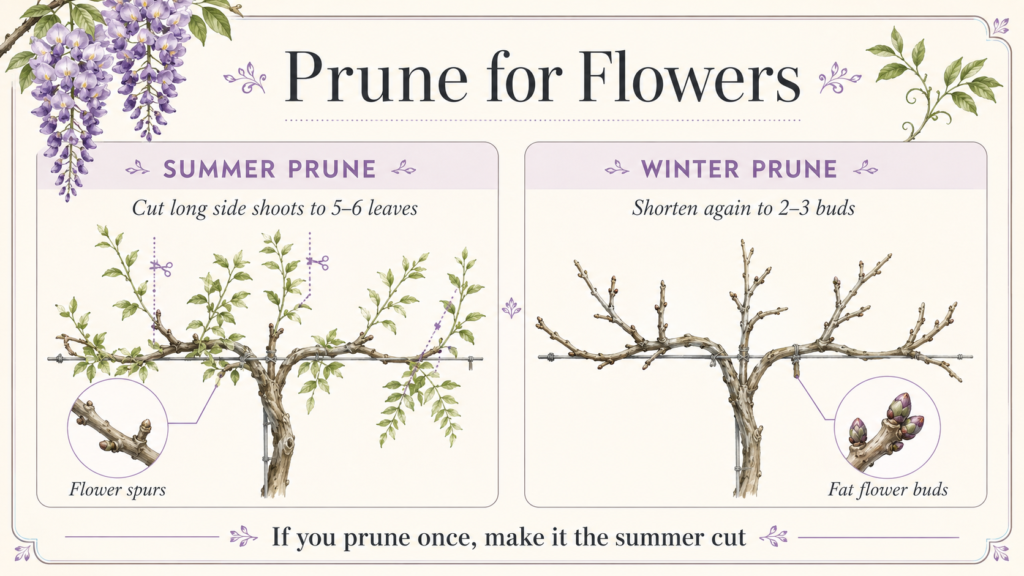
Pruning is the single most important factor in getting wisteria to flower reliably. The goal is to develop short flowering spurs along the main framework — and this requires pruning twice per year.
Summer pruning (July–August): Cut back all the long, whippy side shoots to 5–6 leaves (about 15–20 cm) from the main framework. This redirects energy from rampant vegetative growth into developing flower buds for next spring.
Winter pruning (January–February): Shorten those same shoots again to 2–3 buds (about 5–8 cm) from the main stem. You’ll be able to see the fat, round flower buds distinctly — they’re plumper than the slim, pointed leaf buds. Cut just above a flower bud wherever possible.
✂️ Key rule: If you only prune once, make it the summer cut. Restricting vegetative growth in July–August is the most effective single action for triggering flower bud formation.
Why Wisteria Won’t Bloom (Troubleshooting)
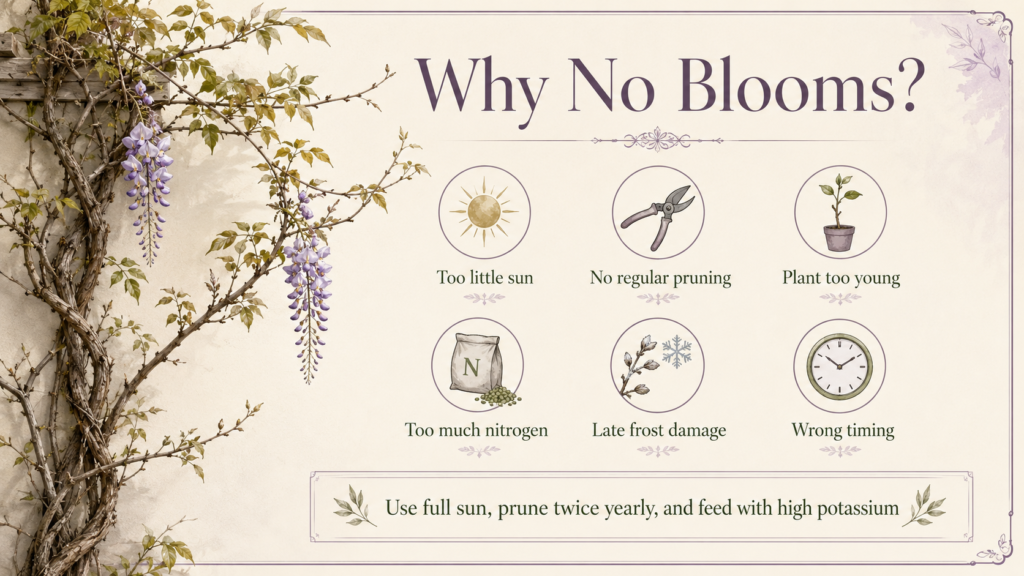
This is the most common frustration with wisteria. A healthy vine producing masses of foliage but no flowers usually has one or more of these issues: too little sunlight (needs 6+ hours), no regular pruning (unpruned shoots won’t develop flower spurs), the plant is still immature (grafted plants may take 3–5 years; seed-grown plants 10–20 years), or excess nitrogen fertiliser.
Other potential causes include severe late frost damaging flower buds, pruning at the wrong time and accidentally removing buds, or planting in an exposed windy site. Try root pruning in autumn — push a spade vertically into the ground in a half-circle about 60 cm from the trunk. This mild stress can trigger flowering.
Be patient but proactive: ensure full sun, prune twice yearly, avoid nitrogen feeds (use a high-potassium fertiliser like tomato feed instead), and give a young grafted plant 3–5 years to establish before expecting a heavy display.
Ongoing Care: Water, Feed & Containers
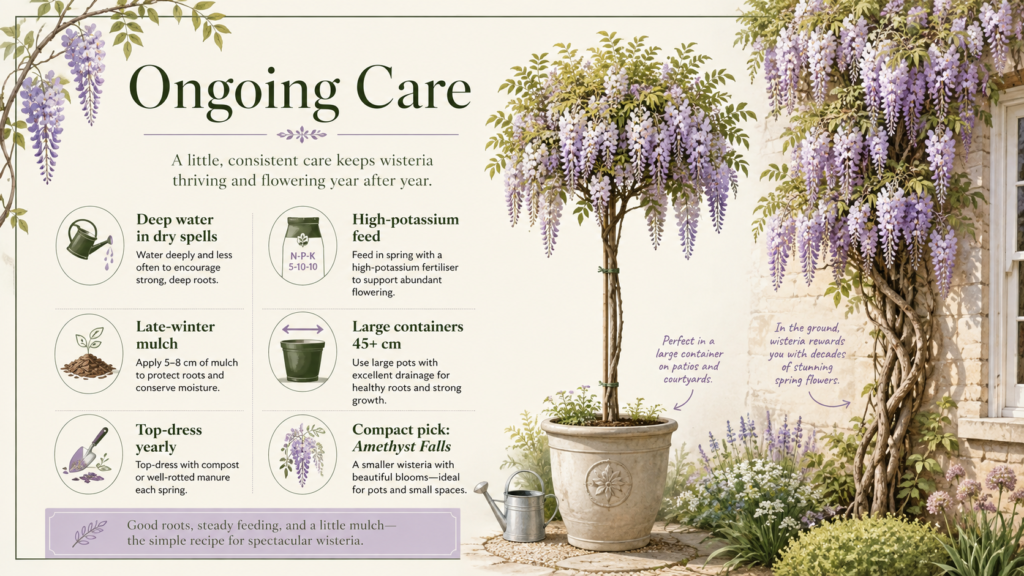
Established wisteria is drought-tolerant but benefits from deep watering during prolonged dry spells, especially in spring when flower buds are developing. Avoid overhead watering. Feed annually in spring with a high-potassium fertiliser — never a high-nitrogen lawn feed. Mulch in late winter to retain moisture.
Wisteria can be grown in large containers (at least 45 cm wide) and trained as a standard or bonsai form. Container-grown plants need more frequent watering, annual repotting or top-dressing, and the same twice-yearly pruning. Choose a compact cultivar like ‘Amethyst Falls’ (W. frutescens) for the best results in pots.
Safety, Toxicity & Invasiveness
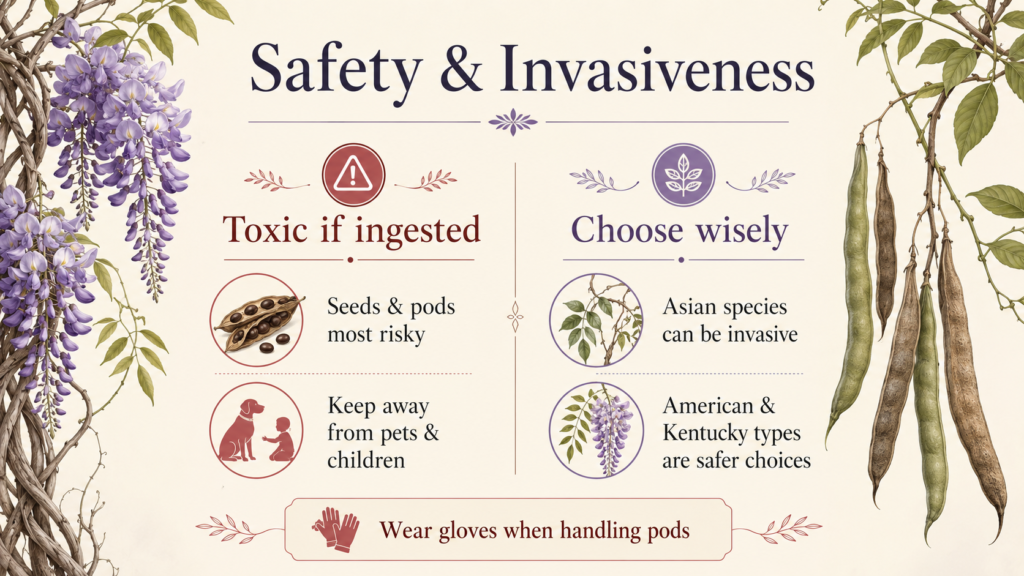
All parts of wisteria are toxic if ingested — especially the seeds and pods, which contain lectins and wisterin glycoside. Symptoms include nausea, vomiting, and abdominal pain. Keep pods away from children and pets. Contact your local poison control centre if ingestion is suspected.
Chinese and Japanese wisteria are classified as invasive in parts of the eastern United States, where they can escape gardens and smother native trees. If you garden in these regions, choose American wisteria (W. frutescens) or Kentucky wisteria (W. macrostachya) instead — they offer similar beauty with far less aggressive growth.
Frequently Asked Questions
How fast does wisteria grow?
Wisteria can grow 1–3 metres (3–10 feet) per year once established. Asian species are the fastest; American types grow more moderately at 1–2 metres per year.
When does wisteria bloom?
Most wisteria blooms in mid to late spring (April–May in the Northern Hemisphere). Chinese wisteria flowers slightly earlier than Japanese. The display typically lasts 2–3 weeks.
Can wisteria damage my house?
Yes — mature wisteria is extremely powerful. It can crush drainpipes, lift tiles, and force apart window frames. Train it on a freestanding structure or on wires fixed 15–20 cm away from the wall, and keep it regularly pruned.
Is wisteria poisonous to dogs and cats?
Yes. All parts are toxic to pets, with seeds and pods being the most dangerous. Ingestion can cause vomiting, diarrhoea, and lethargy. Seek veterinary advice immediately if your pet eats any part of the plant.
Should I grow wisteria from seed?
It’s not recommended for most gardeners. Seed-grown wisteria can take 10–20 years to flower, and the results are unpredictable. Always buy a named cultivar propagated by grafting or cuttings from a mature flowering plant.