
A beginner-friendly, season-long guide to growing healthy, productive blackberries, from choosing a blackberry bush to planting, training canes, pruning with confidence, and picking fruit at its sweetest.
When should you plant blackberries?
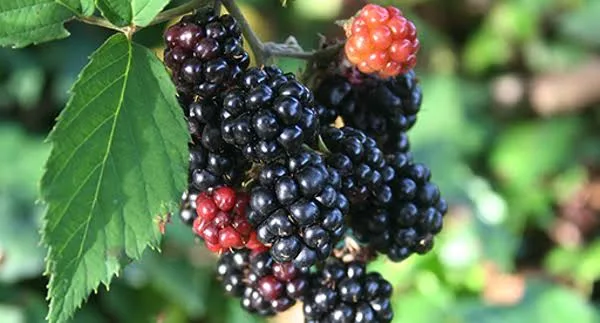
Plant blackberry bushes during their dormant season whenever your ground is workable—typically late fall through early spring. In colder places, spring planting after the soil has thawed is often easiest. Avoid planting into frozen, waterlogged ground, and keep newly planted roots consistently moist as they settle.
Choose a variety suited to your climate and space. Erect blackberries stand more upright and may need less support, while trailing types usually need a trellis. Ask whether your variety fruits on second-year floricanes, new primocanes, or both; this determines when and how you prune.
Give a blackberry bush full sun and room to breathe
Blackberries are adaptable, but their fruit quality improves in a sunny, open position. Pick a site that receives at least six hours of direct light and has enough space for canes to be tied in, picked easily, and kept from becoming a tangled thicket.
Sun requirement
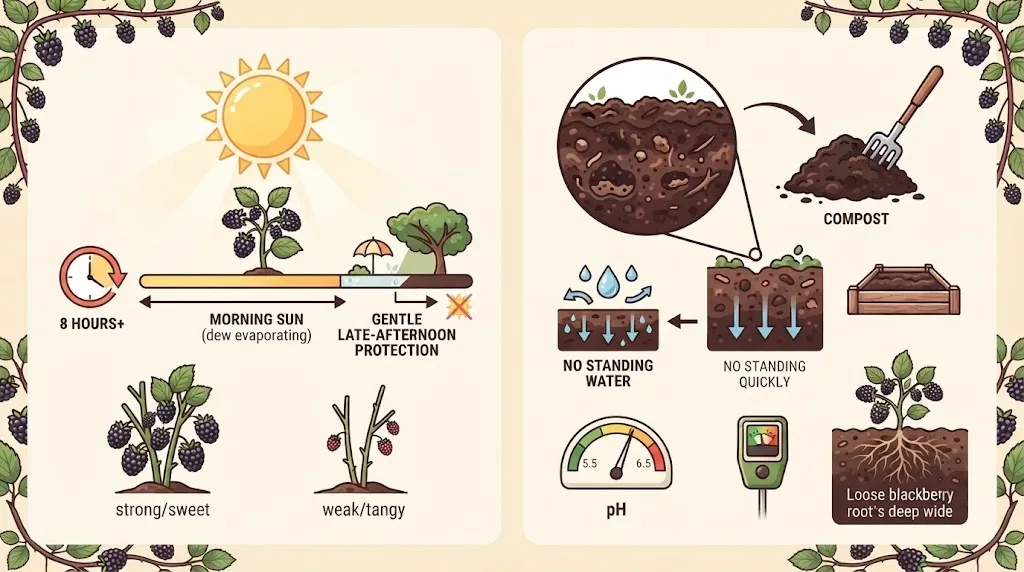
Aim for 6–8 hours of direct sun daily. More sun generally means stronger canes and sweeter berries, though plants in very hot regions can appreciate gentle late-afternoon protection.
Soil requirement
Use fertile, well-drained soil enriched with compost. Blackberries dislike standing water; raised beds are useful where drainage is poor. A slightly acidic soil around pH 5.5–6.5 is a helpful target.
How to plant a blackberry bush for a strong start
A little preparation helps your blackberry plant stay manageable for years. Keep it away from wild brambles when possible, give it a permanent support plan before it gets large, and leave enough room for airflow around every cane.
- Remove weeds and loosen the planting area. Mix compost into the top layer of soil, especially if the ground is sandy or low in organic matter.
- Space plants according to the variety label. Many home-garden blackberry bushes need roughly 3–5 feet (90–150 cm) between plants, with wider spacing for vigorous or trailing types.
- Set the plant at the same depth it grew in its nursery container. Spread bare-root plants gently in the hole, backfill, and firm the soil without compacting it heavily.
- Water thoroughly and add a 2–3 inch layer of mulch, keeping mulch a few inches away from the crown. Install a trellis or wire support now if your variety will need one.
Water steadily, train the canes, and prune with a purpose
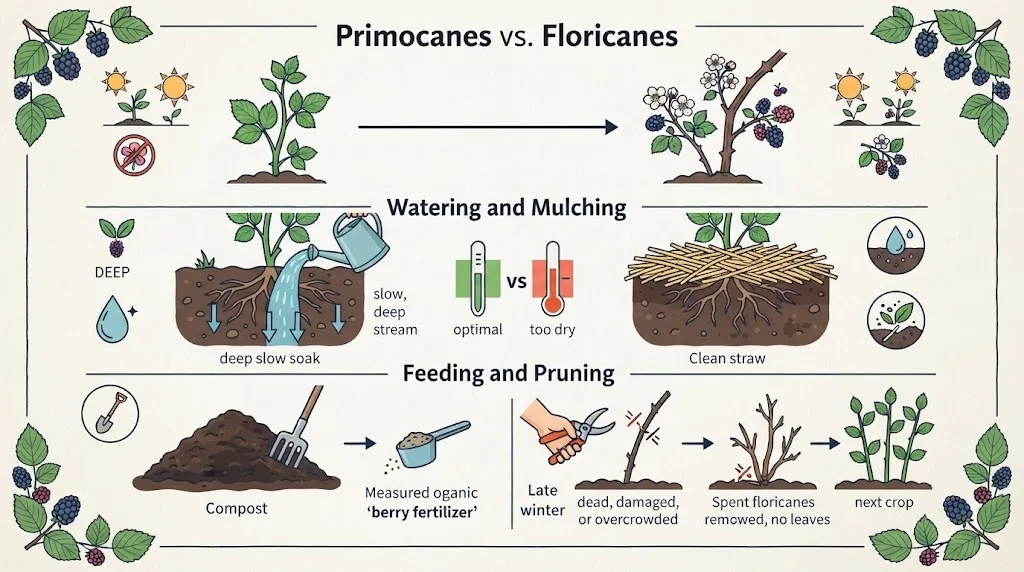
The secret to growing blackberries is not constant fussing, it is learning what each cane is for. Primocanes are fresh new shoots, usually green and vigorous. Floricanes are older canes that flower and fruit on traditional summer-bearing varieties. After a floricane finishes fruiting, it will not fruit again and can be removed.
Watering and mulch
Water deeply during dry spells, especially while berries are forming and ripening. Keep moisture even rather than swinging from drought to saturation. Mulch helps conserve water, suppress weeds, and keep splashing soil off the leaves.
Feeding and pruning
Use compost as a yearly foundation and follow local recommendations before adding fertilizer. In late winter, remove dead, damaged, or overcrowded canes. After summer harvest, cut spent floricanes at ground level while keeping healthy new canes for the next crop.
Common blackberry problems and practical first checks
Before reaching for a treatment, inspect the whole plant. Look at cane age, soil moisture, sunlight, crowding, leaf symptoms, and whether berries were picked before they had time to ripen. Keeping the patch open and promptly removing damaged or finished canes is one of the simplest ways to support healthier growth.
| What you see | Likely cause | What to do |
|---|---|---|
| Lots of leaves, few or no berries | The plant may be too young, shaded, overfed with nitrogen, improperly pruned, or carrying only new canes on a floricane-fruiting variety. | Check the variety’s fruiting habit, improve sunlight, and keep this season’s healthy primocanes. Avoid heavy nitrogen feeding until you identify the cause. |
| Small, dry, or sour berries | Uneven watering, drought during fruit development, crowding, or berries picked before they are fully ripe. | Water deeply during dry weather, thin crowded canes, and wait until berries are evenly dark, plump, and release easily with a gentle pull. |
| Spotted leaves or dying cane tips | Cane disease, poor airflow, wet foliage, damaged canes, or pest activity may be involved. | Prune out affected material with clean tools, dispose of it rather than composting it, improve airflow, and consult a local extension service if symptoms continue. |
Know when blackberries are truly ready to pick
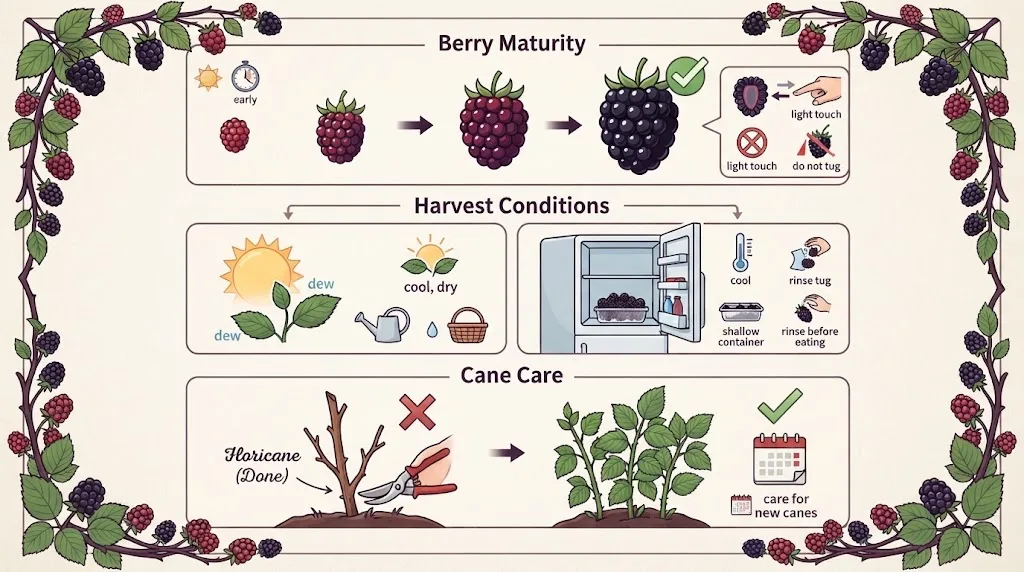
Blackberries do not sweeten much after picking, so patience matters. Pick only berries that are fully colored, plump, and glossy. A ripe berry should release from its core with a light touch; if you need to tug, leave it for another day or two.
Pick in the cool part of the day when berries are dry. Refrigerate them unwashed in a shallow container, then rinse just before eating. Once harvest ends, remove any canes that have finished fruiting if your variety produces on floricanes, and continue caring for the new canes that will make next year’s crop.
Four beginner mistakes worth avoiding
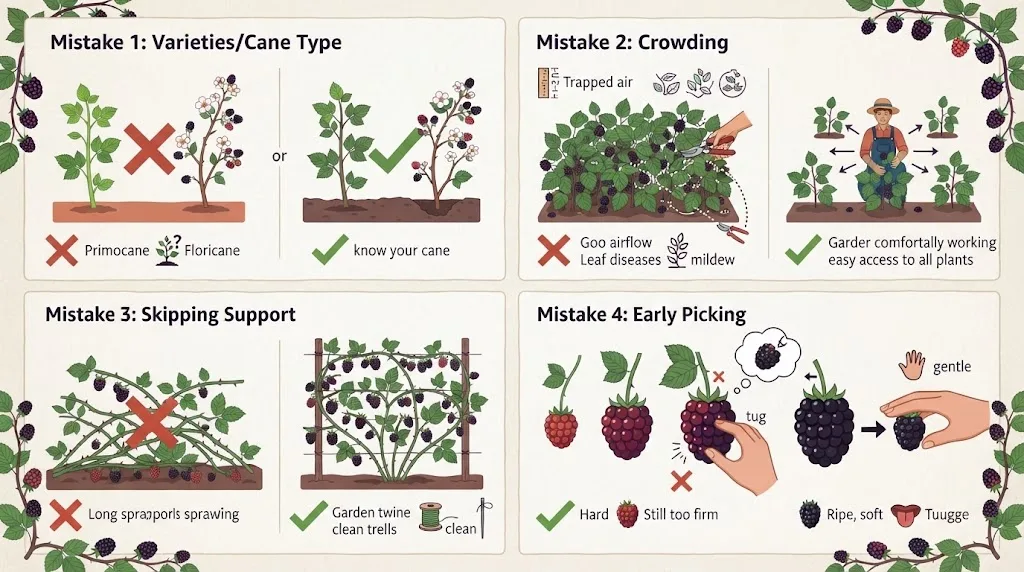
- Treating all blackberry varieties as if they fruit on the same type of cane.
- Planting too close together, then struggling to reach, prune, and harvest the middle of the patch.
- Skipping a support plan until long, thorny canes are already sprawling across the ground.
- Picking berries when they are only black in color instead of waiting until they are plump, soft enough, and easy to release.
Blackberry growing FAQs
Is a blackberry a bush or a tree?
Despite searches for a “blackberry tree,” garden blackberries are not true fruit trees. They are perennial bramble plants: the crown and roots live for years while individual canes grow, fruit according to the variety, and are eventually removed.
Do blackberries need a trellis?
Trailing blackberries need a trellis. Erect plants can sometimes stand on their own, but a simple support still makes training, pruning, harvesting, and disease prevention easier. Follow the guidance supplied with your named variety.
Can I grow blackberries in containers?
Yes—compact or thornless varieties are usually the easiest choice. Use a large container with drainage holes, fresh potting mix, and a support if required. Containers dry out faster than garden soil, so check moisture more often in warm weather.