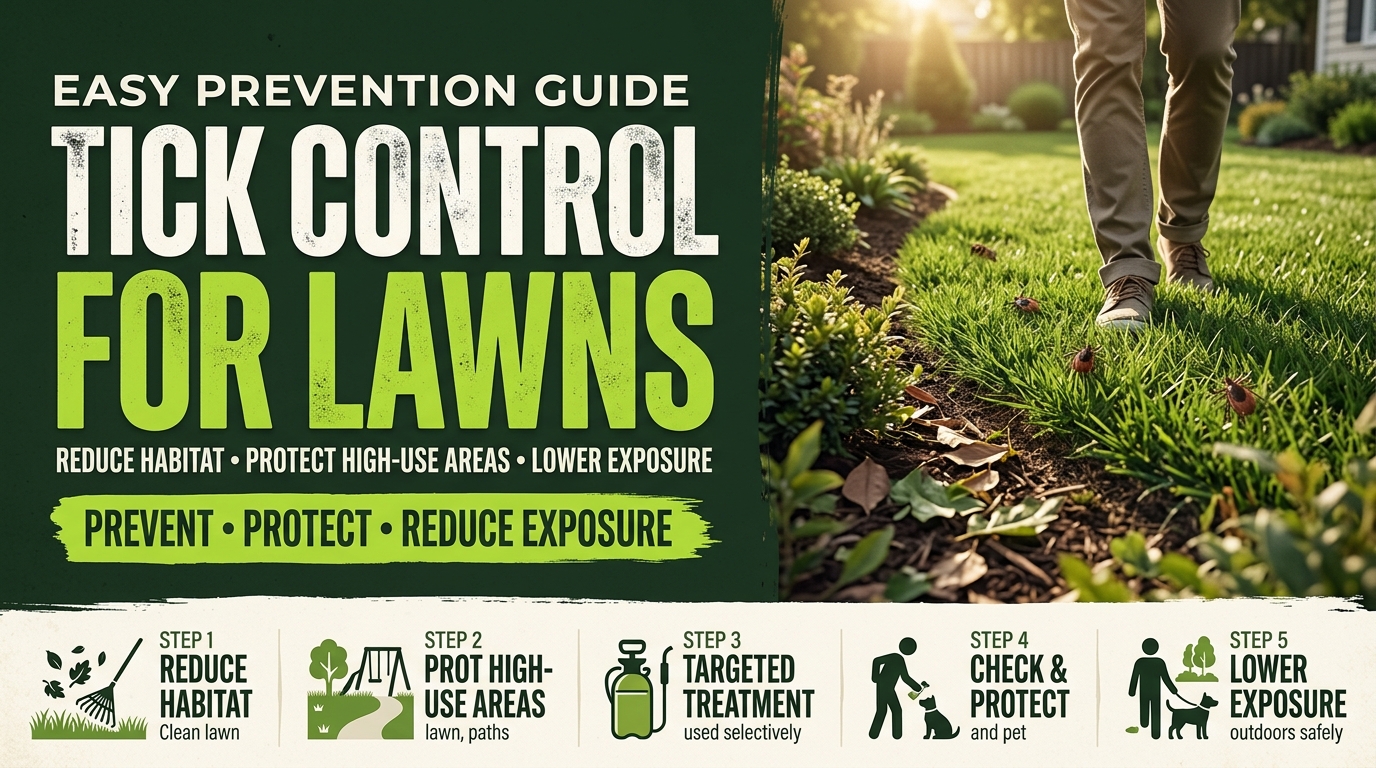

How to reduce tick habitat, protect high-use areas, use targeted treatment when justified, and lower exposure for people and pets.
Quick Answer
The most effective yard tick control starts with habitat management, not blanket spraying. Ticks survive best in humid, shaded places such as leaf litter, brush, tall vegetation, wooded edges, wildlife routes and sheltered resting areas. Mowing, removing leaf litter, clearing brush, increasing sunlight and separating high-use lawn areas from woods can reduce exposure. If pesticide treatment is needed, it is usually more useful to target tick habitat and edges than to spray every square foot of maintained lawn. Personal protection and veterinarian-approved pet prevention still matter because no yard can be guaranteed tick-free.
Core principle: Aim to reduce tick encounters in the parts of the yard people and pets actually use. Complete eradication is usually unrealistic because ticks can be reintroduced by wildlife, pets and neighboring habitat.
Tick Control at a Glance
| Question | Practical answer |
| Best first step | Reduce humid, shaded tick habitat. |
| Main hot spots | Leaf litter, brush, wooded edges, tall vegetation and wildlife-use areas. |
| Spray the whole lawn? | Usually not automatically; focus on confirmed habitat and high-risk edges. |
| Wood-chip or stone barrier | A 3-foot border can help separate managed lawn from wooded habitat. |
| Wildlife role | Deer, rodents and other animals can transport or support ticks. |
| Essential-oil sprays | May have short-term effects, but should not be treated as proven long-term control. |
| Personal protection | Still necessary even in a well-managed yard. |
| Goal | Lower exposure and encounters, not promise zero ticks. |
Why Tick Control Matters
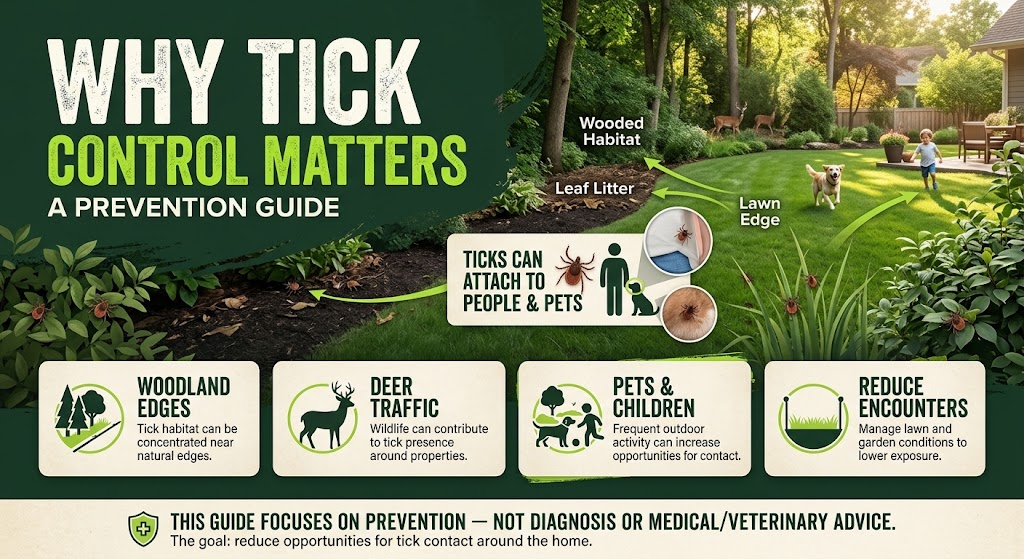
Ticks are blood-feeding arachnids that can attach to people and animals. Some species can transmit pathogens, so reducing encounters around homes is worthwhile, especially where wooded edges, deer traffic, pets or children increase exposure.
The goal of this guide is not to diagnose tick-borne disease or replace medical or veterinary advice. It focuses on the lawn-and-garden decisions that can reduce the chance of contact.
Where Ticks Hide in Lawns and Gardens
Ticks are not distributed evenly across a property. Maintained sunny lawn is often less favorable than cool, moist and protected edge habitat. The highest-risk areas are usually places that hold humidity and are used by animal hosts.
- Leaf litter under trees, shrubs and fence lines
- Brushy or overgrown borders
- Tall grasses and weeds
- Wooded edges and shaded paths
- Rock walls, wood piles and rodent shelter
- Pet resting areas and wildlife trails
- Dense vegetation that stays humid near the ground
How to Make Your Yard Less Tick-Friendly
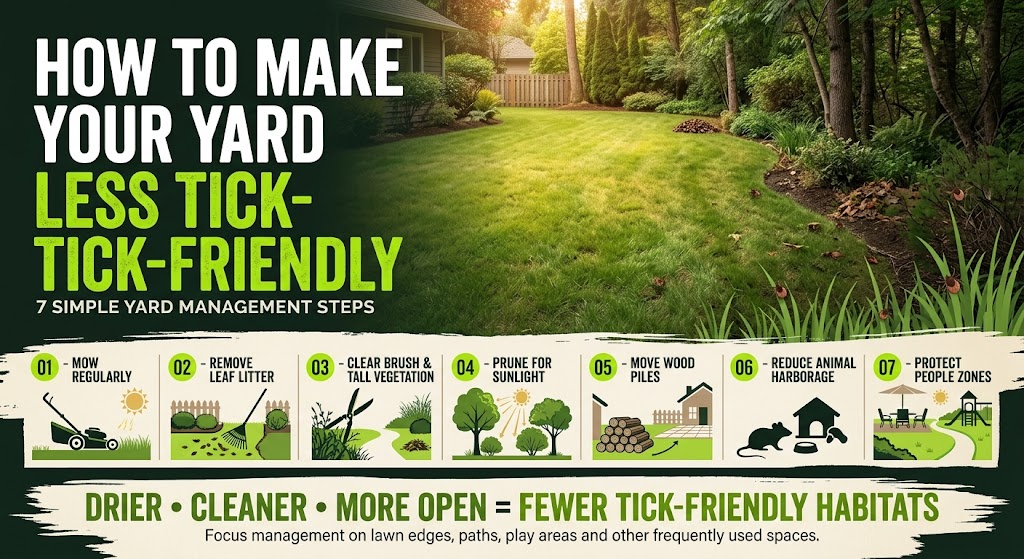
Mow regularly: Keep managed lawn reasonably short so it dries faster and is less favorable to questing ticks.
Remove leaf litter: Rake or collect accumulations along lawn edges, fences, shrubs and shaded garden borders.
Clear brush and tall vegetation: Reduce dense understory growth around paths, play areas and frequently used spaces.
Prune for more sunlight: Where appropriate, open dense shrub or low-tree growth so the ground dries more quickly.
Move wood piles: Keep stacked firewood and similar rodent shelter away from patios, play areas and the house when practical.
Reduce animal harborage: Limit food, cover and nesting opportunities that repeatedly attract rodents and wildlife into high-use zones.
Keep people zones away from unmanaged edges: Place seating, play equipment and frequent-use paths in sunnier, open areas when the property layout allows.
Create a Tick-Safe Zone Around High-Use Areas
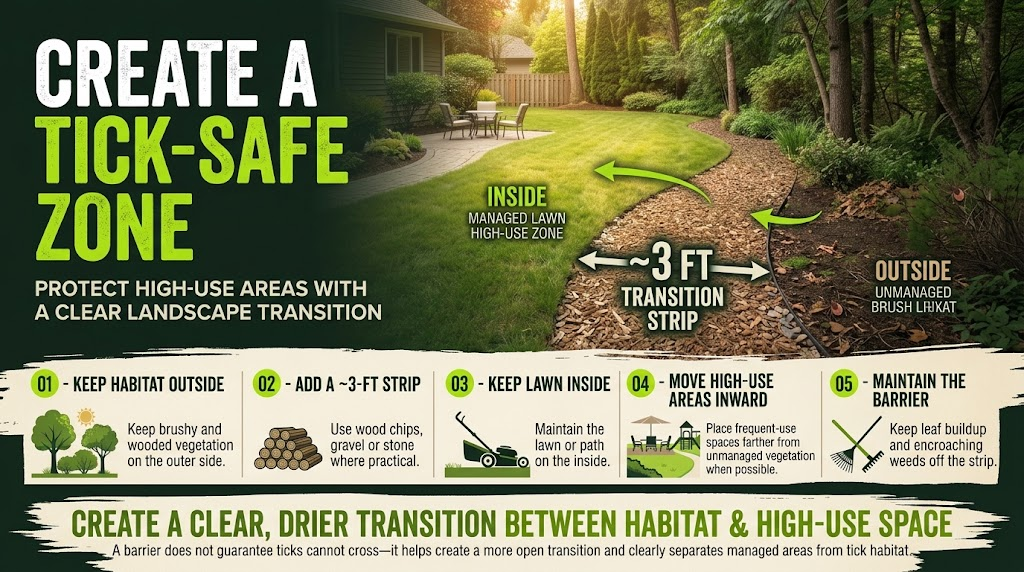
One of the most useful landscape strategies is to create a visible transition between unmanaged tick habitat and the places people use most. Extension guidance commonly recommends a wood-chip or stone strip between lawn and wooded or brushy edges. A barrier does not guarantee that ticks cannot cross it, but it helps create a drier, more open transition and reminds people where higher-risk habitat begins.
- Keep the wooded or brushy edge on the outside.
- Use roughly a 3-foot strip of wood chips, gravel or stone where practical.
- Keep the managed lawn or path on the inside of the barrier.
- Place patios, play equipment, seating and frequently used garden paths farther from unmanaged vegetation when possible.
- Keep the barrier itself free of leaf buildup and encroaching weeds.
How Wildlife Affects Tick Numbers
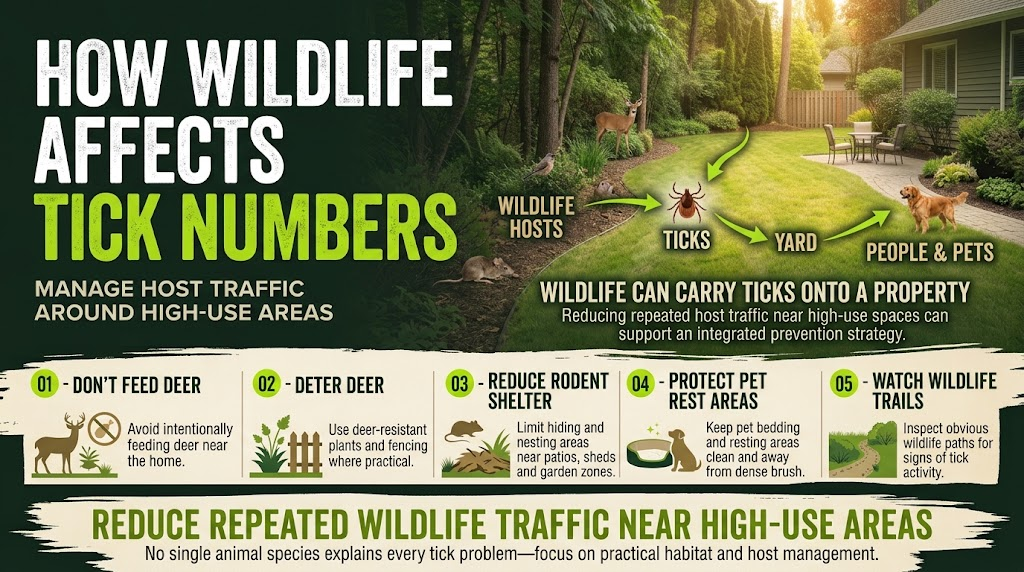
Ticks depend on animal hosts during their life cycle. Deer, rodents, birds, pets and other wildlife can carry ticks into a property. That does not mean one animal species is responsible for every tick problem, but reducing repeated host traffic around high-use spaces can be part of an integrated strategy.
- Do not intentionally feed deer near the home.
- Use deer-resistant plants and fencing where appropriate and practical.
- Reduce rodent shelter near patios, sheds and garden-use zones.
- Keep pet bedding and resting areas clean and away from dense brush.
- Monitor obvious wildlife trails that cross the yard; these can be useful places to inspect for tick activity.
Tick Control in Vegetable and Flower Gardens
Vegetable and flower beds are not automatically the highest-risk tick habitat. Risk often comes from nearby shade, leaf litter, dense border vegetation, rodents, deer and wooded edges. For gardens, the most useful first steps are usually clean paths, reduced leaf buildup, open borders and good separation from brushy areas.
Avoid treating blooming plants or edible crops simply because ticks have been found somewhere on the property. If a pesticide is considered, the exact site and use must be permitted on the label, and pollinator and harvest precautions must be followed.
Should You Spray the Whole Lawn for Ticks?
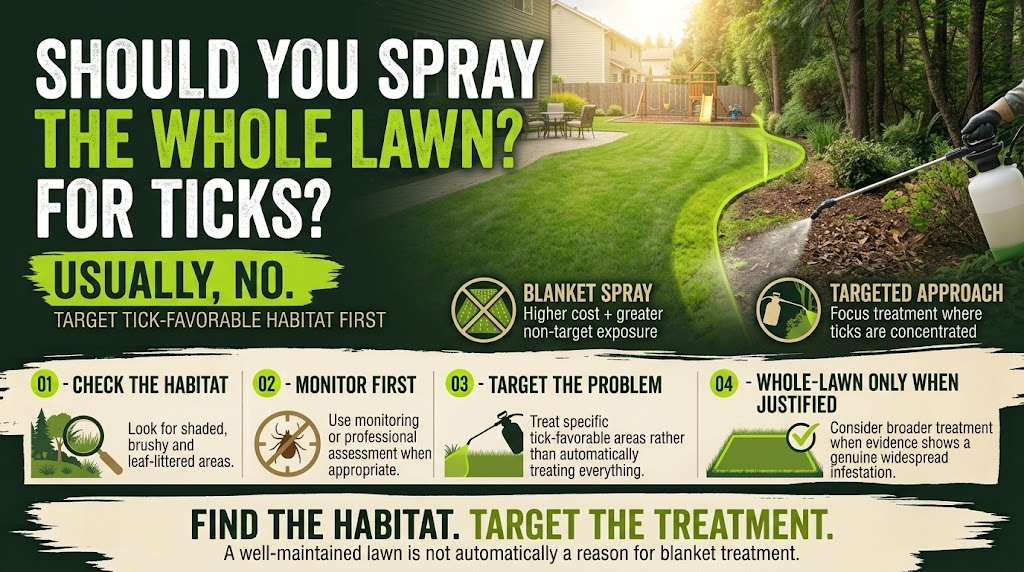
Usually not automatically. Short, sunny, regularly maintained lawns are often less favorable to ticks than wooded margins and brushy edges. Blanket treatment can increase cost and non-target exposure without necessarily addressing the places ticks are concentrated.
Whole-lawn treatment may be considered when monitoring or professional assessment shows a genuine widespread infestation, but the starting assumption should be to find and target the habitat rather than treat every area equally.
Where Targeted Tick Treatments Are Most Useful
- Wooded and brushy lawn edges
- Trails or paths through tick habitat
- Wildlife-use areas and game trails
- Pet resting or kennel-adjacent zones when the label permits
- Foundation or landscape edges where tick habitat meets human-use areas
- Tall, weedy vegetation that remains after habitat cleanup
| Practical rule: Treat the habitat ticks use, not simply the largest visible green area on the property. |
Tick Spray vs. Granules
| Form | Typical strength | Main caution |
| Targeted spray | Can reach vegetation and edge habitat where ticks quest or shelter. | Drift, pollinators, runoff and exact label site matter. |
| Granules | Convenient for some lawn/soil uses when labeled. | May be less relevant where ticks are primarily on vegetation; often require watering as directed. |
| Professional perimeter treatment | Can focus on defined high-risk zones. | Should still be habitat-based, label-compliant and integrated with landscape changes. |
Do not assume a product labeled for lawn insects is automatically appropriate for ticks. Check the target pest, site, active ingredient, application method and environmental directions on the current label.
Chemical Tick Control: When It Makes Sense
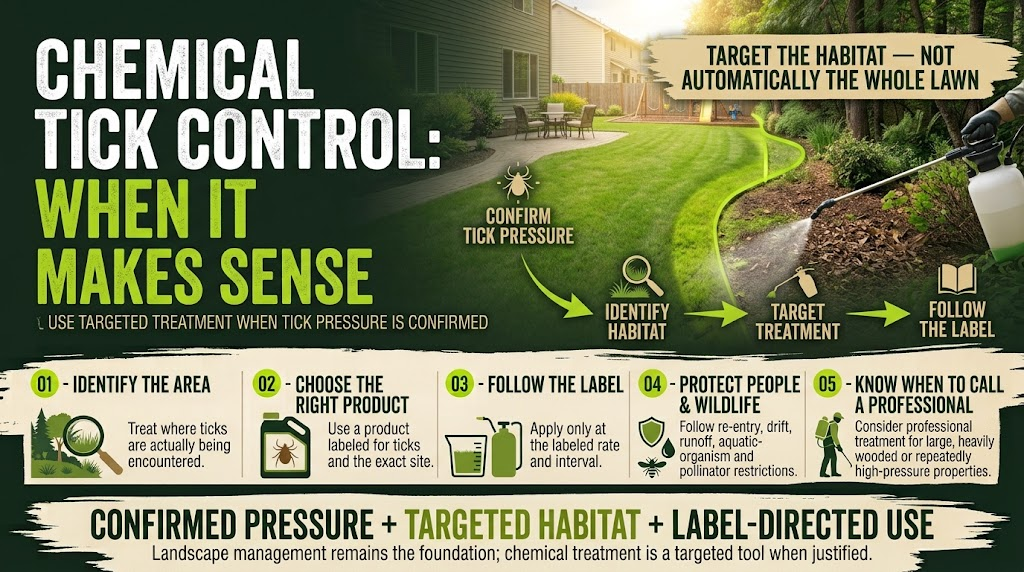
Acaricides can reduce free-living ticks when applied to the right habitat and at the right time. They are most useful when tick pressure is confirmed and landscape changes alone are not sufficient for a high-use area.
- Identify the area where ticks are actually being encountered.
- Choose a product labeled for ticks and the exact site being treated.
- Apply only at the labeled rate and interval.
- Follow re-entry, drift, runoff, aquatic-organism and pollinator restrictions.
- Consider professional treatment when the property is large, heavily wooded or repeatedly produces high tick pressure.
Do Natural Tick Sprays Work?
Botanical products containing cedar, rosemary, peppermint or other essential oils are widely marketed for yard tick control. Some may repel or kill ticks for a short period under certain conditions, but short-term activity is not the same as reliable long-term population suppression.
Do not assume a product is harmless because it is plant-derived. Essential-oil products can still irritate people or animals and may affect non-target organisms. Treat them as pesticides when they are sold for pest control: read the label and judge them by demonstrated performance, not by the word “natural.”
Biological Tick Control
Ticks have natural enemies, including some birds, arthropods and microorganisms, but these biological forces generally do not provide predictable yard-level control on their own. Research into fungal pathogens and other biological approaches continues, yet homeowners should not rely on predators or backyard wildlife as a stand-alone tick-control program.
Protect Pollinators and Other Beneficial Organisms
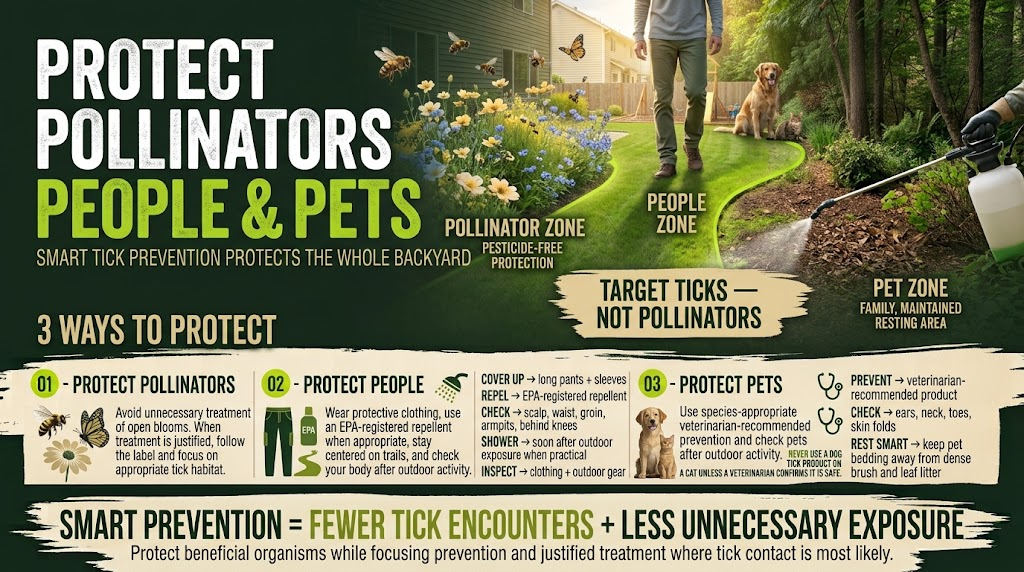
Many broad-spectrum tick-control pesticides can also affect insects and other organisms that were not the target. Avoid unnecessary treatment of flowers, especially open blooms visited by bees and butterflies. When treatment is justified, concentrate it in the lowest-value pollinator habitat that still intercepts tick movement or shelter, such as leaf-littered edges and brushy transitions, while following the label.
Tick Prevention for People
- Wear long pants, long sleeves and closed footwear in high-risk habitat.
- Use an EPA-registered repellent according to its label when appropriate.
- Walk in the center of trails and avoid brushing against tall vegetation where practical.
- Check the entire body after outdoor activity, including scalp, waist, groin, armpits and behind the knees.
- Shower soon after outdoor exposure when practical and inspect clothing and gear.
Tick Prevention for Pets
Yard treatment is not a substitute for animal-specific prevention. Dogs and cats can encounter ticks during walks, wildlife contact or time near untreated edges and then bring ticks indoors.
- Use veterinarian-recommended tick prevention appropriate to the animal species.
- Never use a dog tick product on a cat unless a veterinarian specifically confirms it is safe.
- Check pets after outdoor activity, especially around ears, neck, toes and skin folds.
- Keep pet resting areas away from dense brush and leaf-littered edges when practical.
What to Do If You Find an Attached Tick
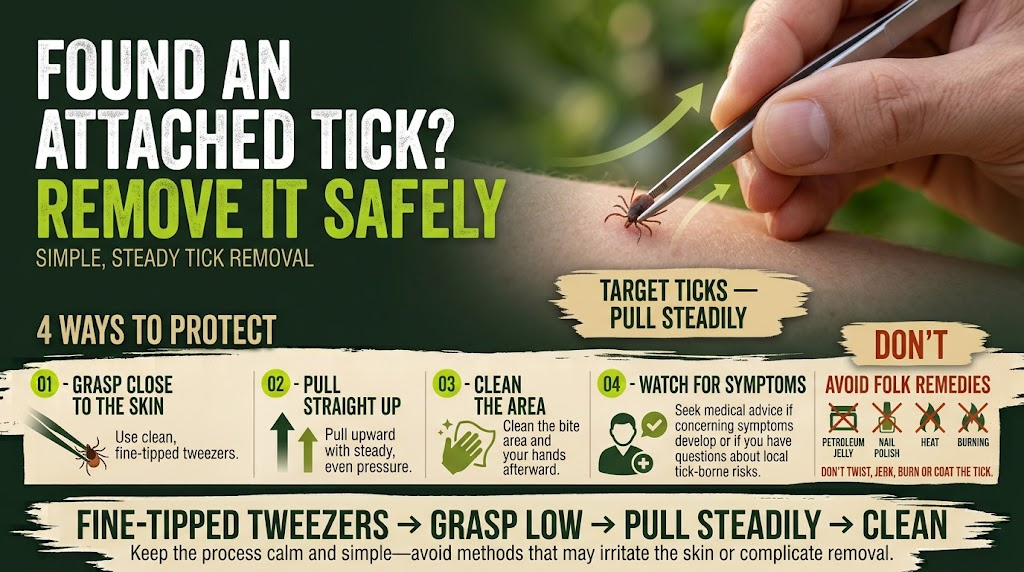
- Use clean, fine-tipped tweezers.
- Grasp the tick as close to the skin surface as possible.
- Pull upward with steady, even pressure. Do not twist or jerk.
- Clean the bite area and your hands afterward.
- Avoid folk-remedy methods such as petroleum jelly, nail polish, heat or burning the tick.
Seek medical advice if you develop concerning symptoms after a tick bite or if you have questions about local tick-borne disease risk. This lawn-and-garden guide is not a substitute for medical care.
Common Tick-Control Mistakes
| Mistake | Why it causes problems | Better approach |
| Spraying the entire yard automatically | Can increase cost and non-target exposure while missing habitat hot spots. | Inspect and target edges and shelter. |
| Ignoring leaf litter | Leaves maintain the humid refuge ticks need. | Remove buildup in high-use zones and borders. |
| Treating lawn but not brushy edges | The most favorable habitat may remain untouched. | Prioritize wooded and brushy transitions. |
| Assuming natural oils provide lasting control | Short-term activity may not suppress the population. | Use evidence-based IPM and verify performance. |
| Leaving wood piles beside patios or play areas | Can provide shelter for rodents and other hosts. | Move them away from high-use areas. |
| Feeding deer near the home | Encourages repeated host traffic. | Avoid intentional feeding. |
| Ignoring pet prevention | Pets can carry ticks into the home. | Use veterinarian-approved prevention. |
| Expecting a tick-free yard | Reinvasion can occur from wildlife and neighboring habitat. | Aim to reduce encounters. |
| Using a pesticide on an unlabeled site | Can be unsafe and unlawful. | Follow the current product label. |
Frequently Asked Questions
What is the best way to control ticks in a yard?
Start by reducing tick habitat: remove leaf litter, mow maintained lawn, clear brush, open shaded borders and create separation between woods and high-use areas. Add targeted pesticide treatment only when tick pressure justifies it.
Do ticks live in lawns?
They can, but short, sunny maintained lawn is often less favorable than humid leaf litter, brush and wooded edges. Lawn edges are usually more important than the center of an open lawn.
Should I spray my entire lawn for ticks?
Usually not automatically. Target confirmed hot spots and habitat edges first unless monitoring shows a widespread infestation.
Where should I spray for ticks?
When a labeled treatment is justified, focus on wooded edges, brushy borders, paths, animal-use areas and other confirmed tick habitat rather than treating everything equally.
Do wood chips help control ticks?
A wood-chip or stone strip can create a drier transition between woods and lawn and help define a lower-risk use zone, but it does not act as an impenetrable barrier.
Does mowing reduce ticks?
Regular mowing can make managed lawn less favorable by reducing tall humid vegetation, but mowing alone will not solve a tick problem if leaf litter and brushy edges remain.