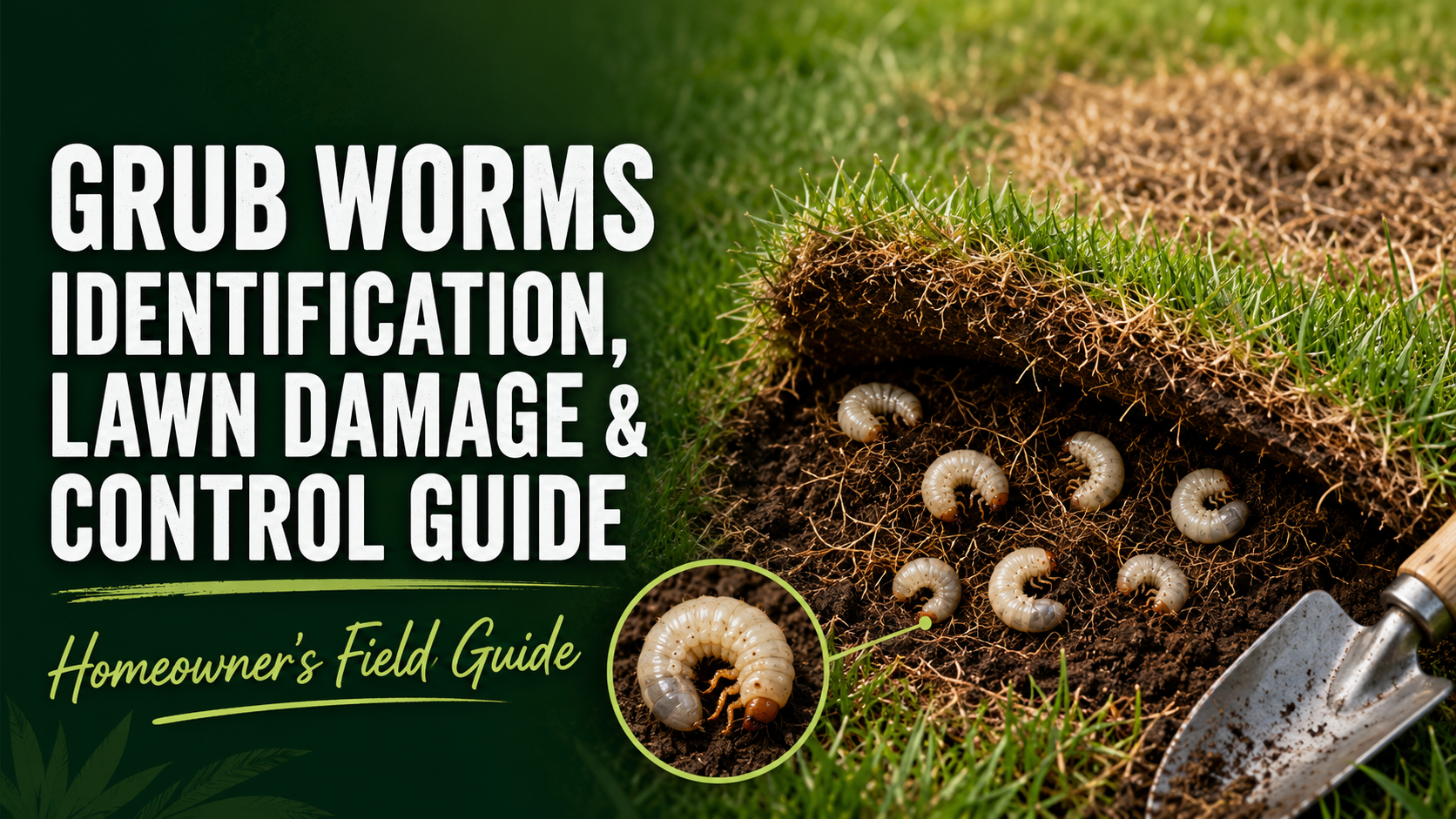

How to confirm white grubs, judge whether they are actually damaging your lawn, choose the right control timing, and repair turf afterward.
Quick Answer
“Grub worm” is the common name many homeowners use for white grubs, the C-shaped larvae of several scarab beetles. They live in the soil and can feed on grass roots, causing irregular thinning, brown patches and turf that pulls up easily when root damage is severe. But brown grass, animal digging or finding one grub does not prove you have a treatment-worthy infestation. The best approach is to lift a small section of sod, count the grubs, inspect the roots and compare the result with local Extension thresholds before choosing a control method.
Grub Worms at a Glance
| Feature | Quick answer |
| What are they? | Larvae of several scarab beetles |
| Typical appearance | Creamy white, C-shaped body, brown head, three pairs of legs |
| Where are they found? | In the soil around the turf root zone |
| Main lawn injury | Feeding on grass roots |
| Classic severe-damage clue | Sod loosens and may peel back like carpet |
| Does one grub mean trouble? | No. Low populations are often tolerated |
| Best diagnosis | Lift turf, inspect roots and count grubs |
| Best treatment time | Depends on grub age, season, product and region |
What Are Grub Worms?
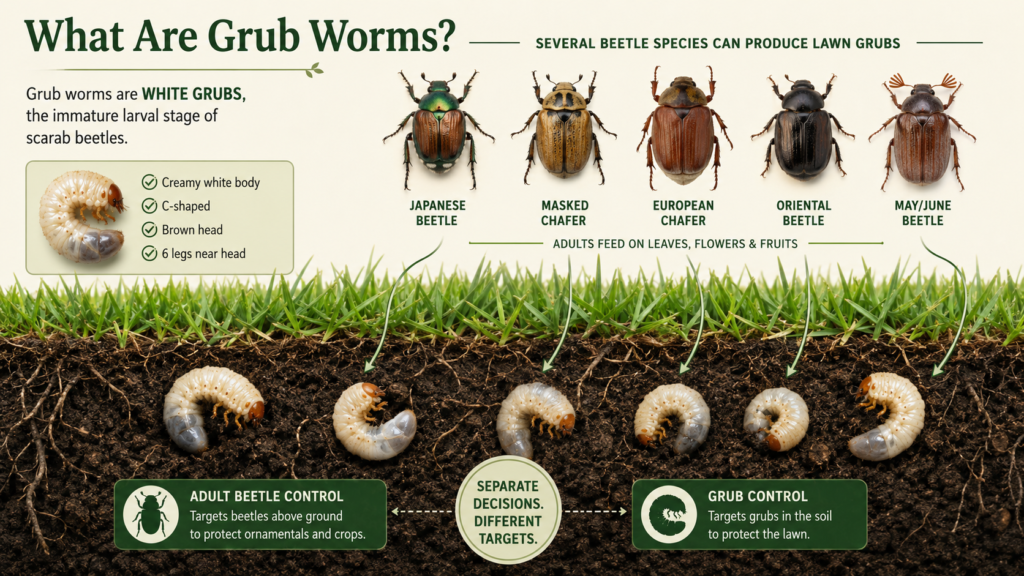
Grub worms are the immature larval stage of scarab beetles. In lawns they are more accurately called white grubs. Several beetle species can produce root-feeding grubs, including Japanese beetles, masked chafers, European chafers, Oriental beetles and May or June beetles. Because the exact species differs by region, a homeowner should avoid assuming that every white grub will become the same adult beetle.
Most lawn damage occurs while the larvae are underground feeding around the root zone. The adult beetles may later emerge and feed, mate or lay eggs above ground, but adult-beetle control and grub control are separate management decisions.
What Do Grub Worms Look Like?
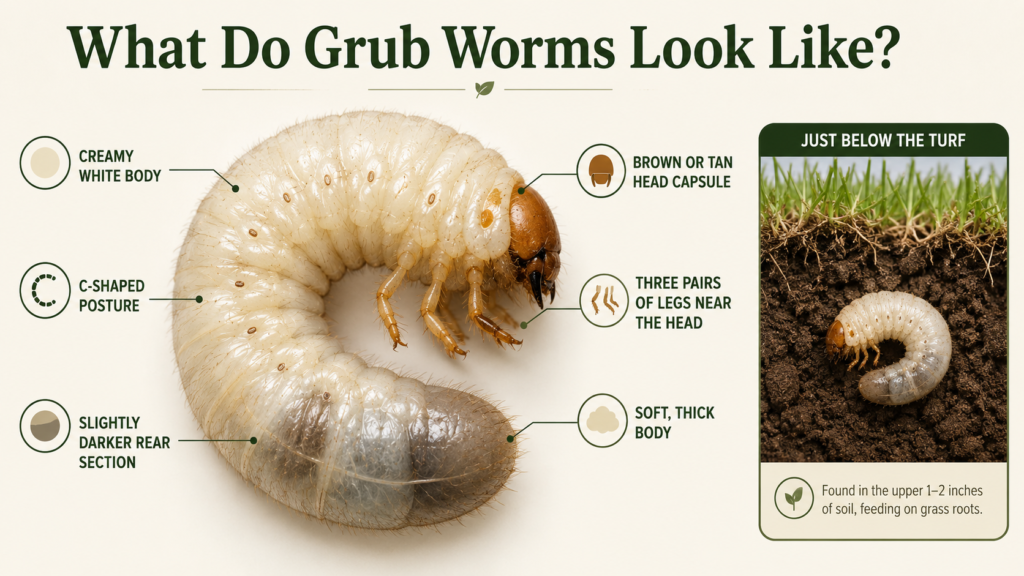
- Creamy white to off-white body
- Characteristic C-shaped posture when disturbed
- Brown or tan head capsule
- Three pairs of legs near the head
- Soft, thick body with a darker rear section in some species
- Usually found just below the turf when actively feeding
Size varies with species and larval stage, so size alone is not a dependable identification method. Experts can sometimes separate species by the raster—the pattern of hairs and spines near the rear of the grub—but most homeowners only need species-level identification when local management recommendations differ significantly.
What Beetles Do Lawn Grubs Become?
| Adult beetle group | Why it matters |
| Japanese beetle | Larvae can damage turf; adults may also feed on ornamentals. |
| Masked chafer | A common turf-grub group in parts of North America. |
| European chafer | Can be highly damaging where established. |
| Oriental beetle | Another scarab whose larvae may feed on turf roots. |
| May/June beetles | Some species have longer or multi-year larval cycles. |
Grub Worm Life Cycle
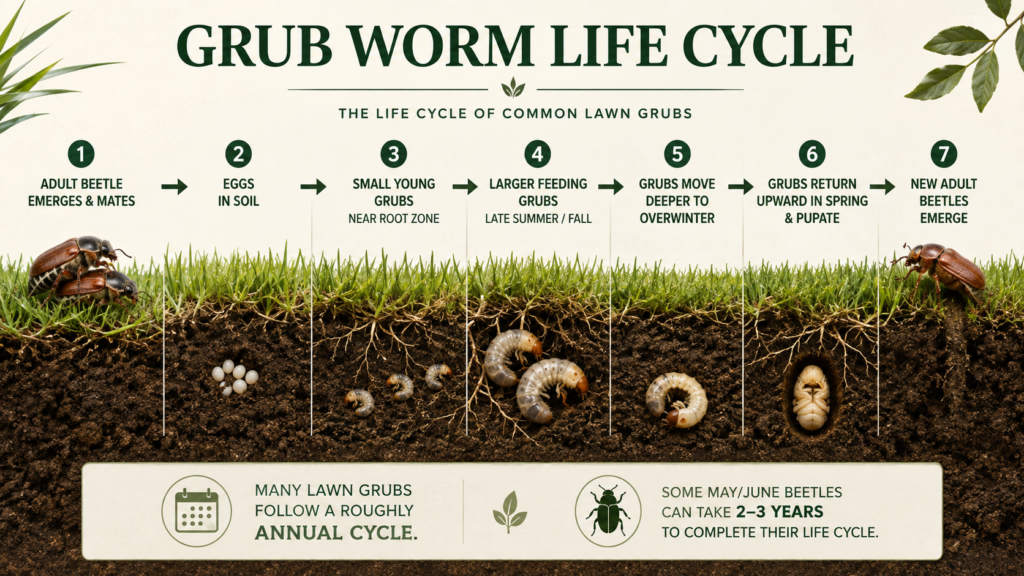
Many important lawn grubs follow a roughly annual cycle, but not every species does. The practical reason to understand the life cycle is that treatment effectiveness changes as larvae grow.
- Adult beetles emerge and mate.
- Females lay eggs in soil.
- Eggs hatch into small young grubs near the root zone.
- Grubs feed and grow through late summer and fall.
- As soils cool, many grubs move deeper to overwinter.
- They move upward again in spring, feed for a period, then pupate.
- New adult beetles emerge and the cycle begins again.
Some May/June beetle grubs can take more than one year to complete development, so regional species identification can matter when damage patterns do not fit the typical one-year timeline.
What Do Grub Worms Eat?
In lawns, damaging white grubs feed primarily on grass roots. As root systems are pruned away, turf becomes less able to absorb water and nutrients and may lose its attachment to the soil. This is why severe grub injury can resemble drought at first but eventually produces loose sod with visibly reduced roots.
What Does Grub Damage Look Like?
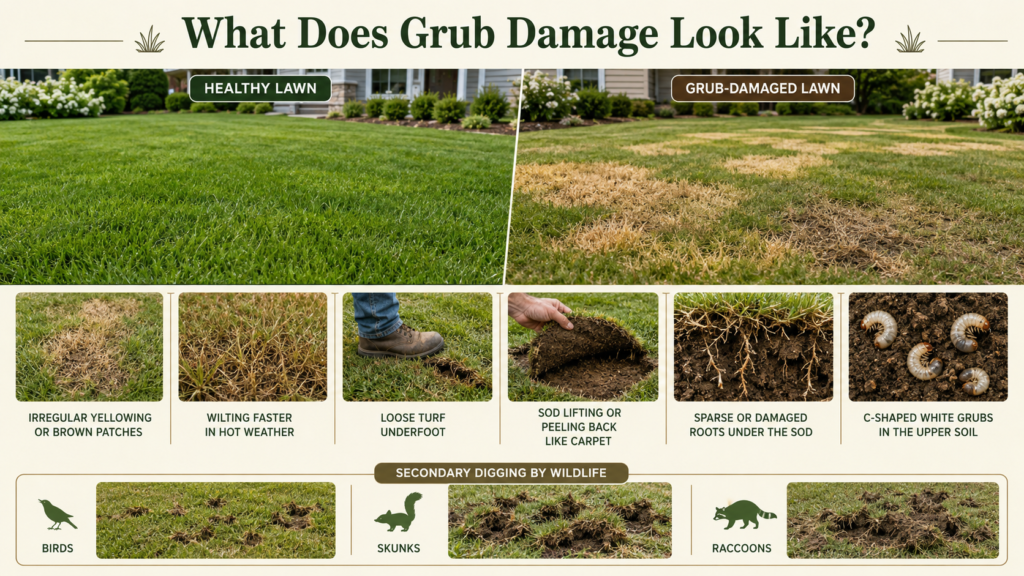
- Irregular yellow, thinning or brown patches
- Grass that wilts faster during hot or dry weather
- Turf that feels loose underfoot
- Sod that lifts or rolls back unusually easily
- Few healthy roots beneath the damaged patch
- C-shaped grubs visible in the upper soil
- Secondary digging by birds, skunks, raccoons or other animals
The classic severe-damage clue is turf that peels back “like carpet” because much of the root system has been eaten. However, animal digging or a brown patch alone is not diagnostic. Those symptoms can occur for other reasons.
How to Tell Grub Damage From Other Lawn Problems
| Problem | Brown/thin turf? | Does sod pull up easily? | Grubs present? | Useful clue |
| Grub injury | Yes | Often when severe | Yes | Root system visibly pruned or missing |
| Drought stress | Yes | Usually remains rooted | No | Dry soil and widespread wilt; roots remain attached |
| Fungal leaf disease | Yes | Usually no | No | Leaf lesions or characteristic patch pattern |
| Root disease | Yes | May loosen | No | Root decline without visible white grubs |
| Chinch bugs / other surface pests | Yes | Usually no | No | Insects found around crowns/thatch rather than as white grubs |
If the cause is uncertain, physically examine the turf and soil before applying an insecticide. Treating the wrong problem wastes money and may harm beneficial insects.
How to Check Your Lawn for Grubs
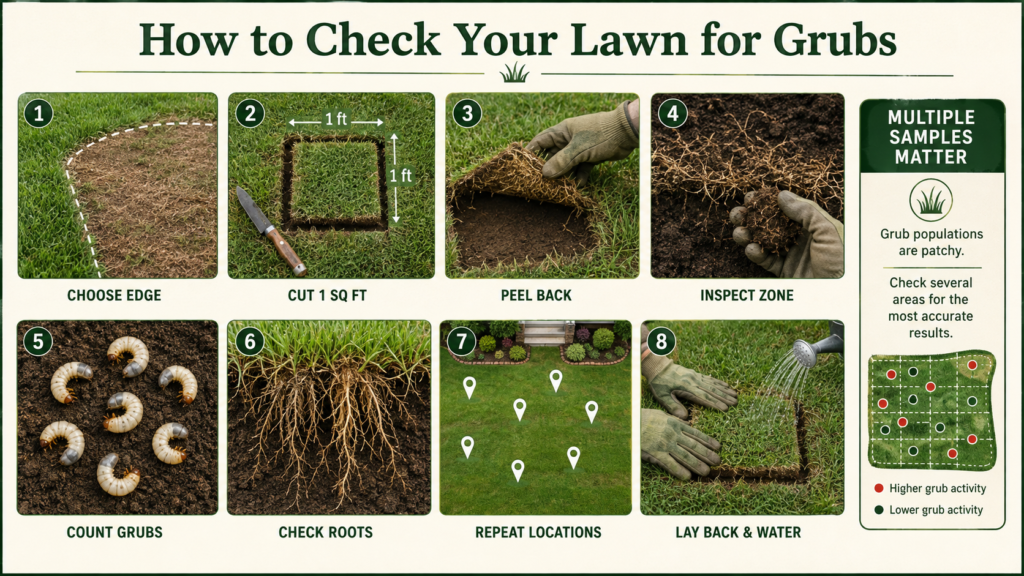
- Choose the edge of a suspicious patch where some living turf remains.
- Cut a section of turf about 1 square foot in size.
- Peel the sod back carefully.
- Look through the upper soil and root zone for C-shaped white grubs.
- Count the grubs in that square-foot sample.
- Check the roots and note whether they are dense and healthy or badly reduced.
- Repeat in several locations because grub populations can be patchy.
- Lay the sod back down, press it into contact with the soil and water if needed.
| Why multiple samples matter A lawn can have a concentrated grub pocket next to an area with few or none. One sample gives useful evidence; several samples give a much better picture. |
How Many Grubs Per Square Foot Is Too Many?
There is no universal number that applies to every lawn. Published thresholds vary by turf species, grub species, soil moisture, lawn health and region. Some regional recommendations begin considering injury at roughly the mid-single digits per square foot, while others tolerate counts into the low teens when turf is healthy.
| Finding | Practical interpretation |
| One or a few grubs | Often normal; treatment is usually not automatically justified. |
| Moderate counts with healthy roots | Monitor and compare with local thresholds. |
| Moderate to high counts plus obvious root loss | A control decision is more likely to be justified. |
| High counts and loose/peeling turf | Strong evidence of a damaging infestation; use local recommendations for timing and treatment. |
Use grub counts together with visible lawn injury. A vigorous lawn with a strong root system may tolerate more feeding than drought-stressed or shallow-rooted turf.
Do Skunks, Moles or Birds Mean You Have Grubs?
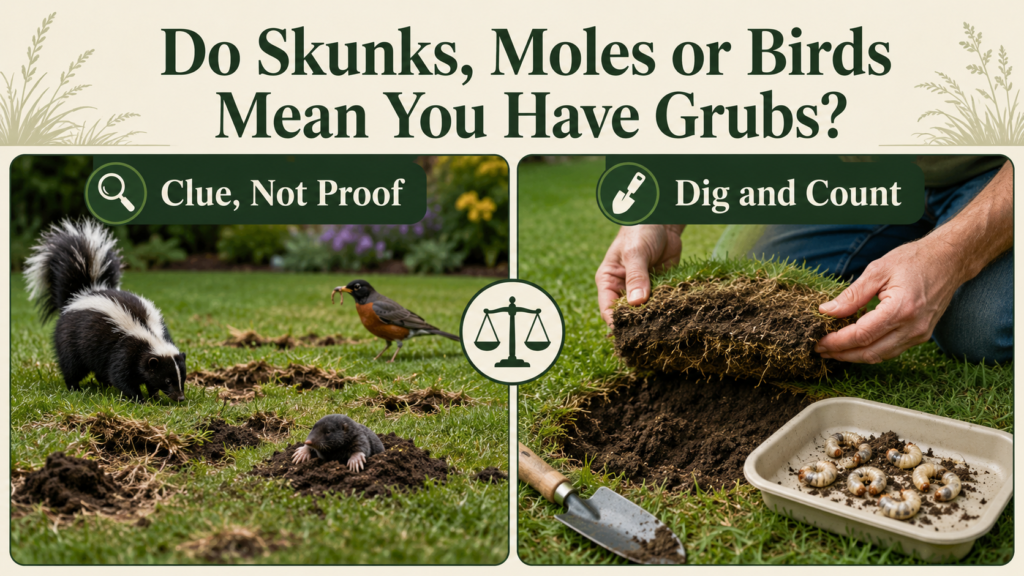
Not necessarily. Animals that dig lawns may be feeding on grubs, but they also eat earthworms and many other soil organisms. Animal activity is a reason to inspect the lawn—not a diagnosis by itself. Dig and count before deciding that insecticide treatment is needed.
When Are Grubs Most Active?
For many one-year white-grub species, eggs hatch during summer and young larvae feed near the turf root zone through late summer and early fall. As temperatures drop, they move deeper. In spring they may move upward and feed again before pupating. Timing varies by climate, species and weather, so local Extension calendars are more reliable than a single national treatment date.
Preventive vs. Curative Grub Control
| Approach | When it is used | Main goal | Important limitation |
| Preventive | Before serious damage, timed for eggs or very young larvae | Stop a historically predictable infestation before larvae become large | Should not be applied automatically to every lawn every year |
| Curative | After damaging grubs are confirmed | Reduce an existing population | Older/larger grubs can be harder to control; product choice and timing matter |
The words “grub killer” on a package are not enough. Check the active ingredient and label to determine whether the product is preventive, curative, or appropriate for the grub stage present at that time of year.
When Is the Best Time to Treat Grub Worms?
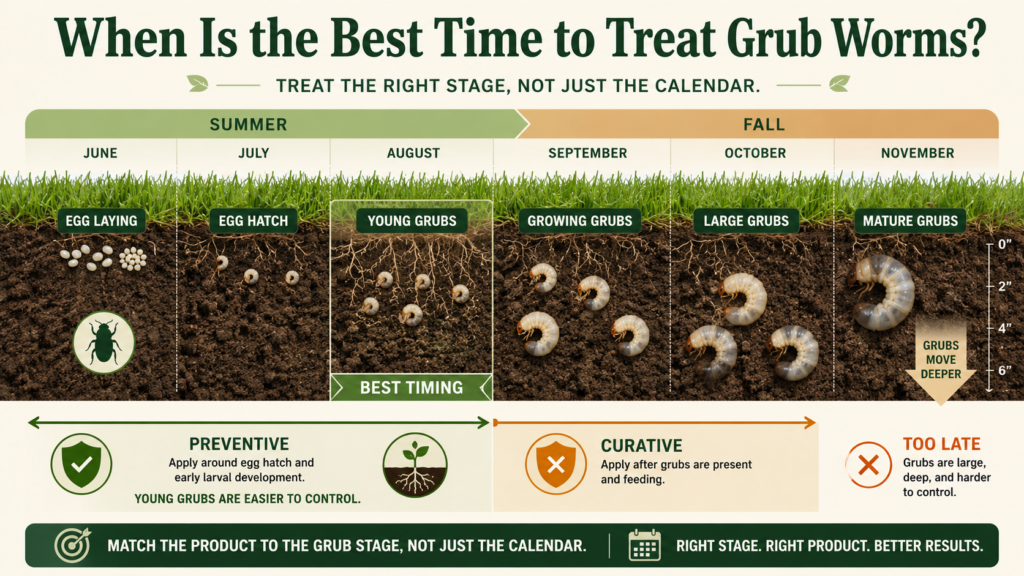
In general, young grubs are easier to control than large mature larvae. Preventive treatments are usually timed before or around egg hatch and early larval development, while curative treatments are used after grubs are present and actively feeding. Exact dates vary regionally and by product. Treating very late, after larvae have grown large or moved deep into the soil, can produce disappointing results.
| Key timing rule Match the product to the grub stage—not just the calendar. If the label and your local Extension timing do not match the stage in your lawn, wait or choose another strategy. |
How to Control Grub Worms
- Confirm that grubs—not drought, disease or another insect—are causing the injury.
- Sample several locations and count grubs.
- Consider whether the lawn is healthy enough to tolerate the population.
- Use biological options where they fit the species and conditions.
- If treatment is justified, select a product labeled for the site and grub stage.
- Follow the label for application rate, personal protection and irrigation.
- Recheck the lawn and repair damaged turf after control.
Avoid routine broad-spectrum treatment simply because adult beetles were seen nearby or because one grub was found. Integrated pest management starts with diagnosis and treatment thresholds.
Natural and Biological Grub Control
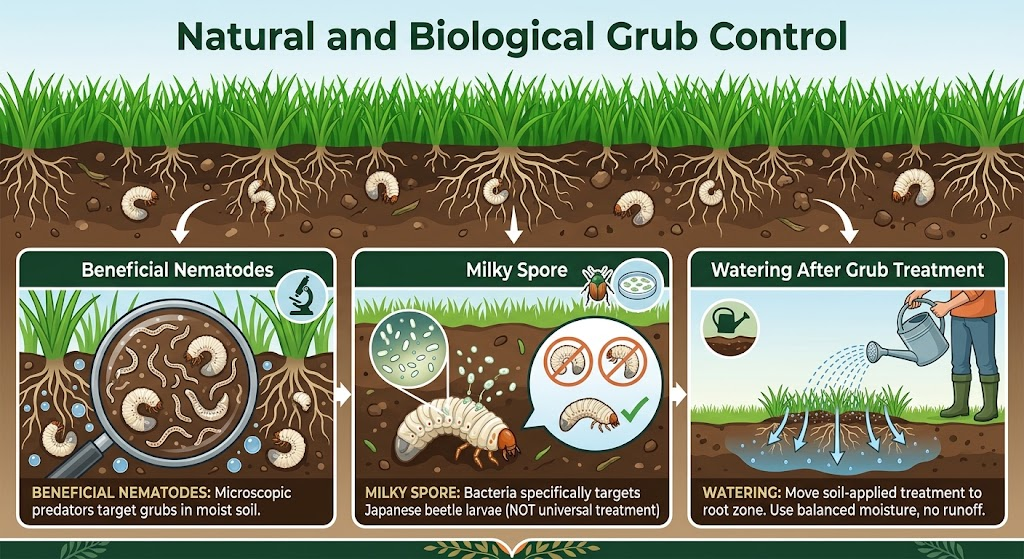
Beneficial Nematodes
Certain insect-parasitic nematodes can infect white grubs when the correct nematode species is selected and applied under suitable soil-moisture and temperature conditions. They are living organisms, so storage, application timing and post-application moisture strongly affect performance. Follow supplier directions and local Extension recommendations rather than assuming all nematodes work equally well against all grubs.
Milky Spore
Milky spore is frequently marketed as a natural grub control, but it is primarily relevant to Japanese beetle larvae rather than every white-grub species. If the lawn is being damaged by another scarab grub, milky spore should not be treated as a universal solution.
Watering After Grub Treatment
Because white grubs live in the root zone, many soil-applied treatments must be moved off the turf surface and into the upper soil. Follow the specific product label for irrigation amount and timing. Too little water may leave material above the target zone, while excessive irrigation can increase runoff or move some products too deeply. Do not substitute a generic “water it in” rule for the label.
Should You Treat Grubs Every Year?
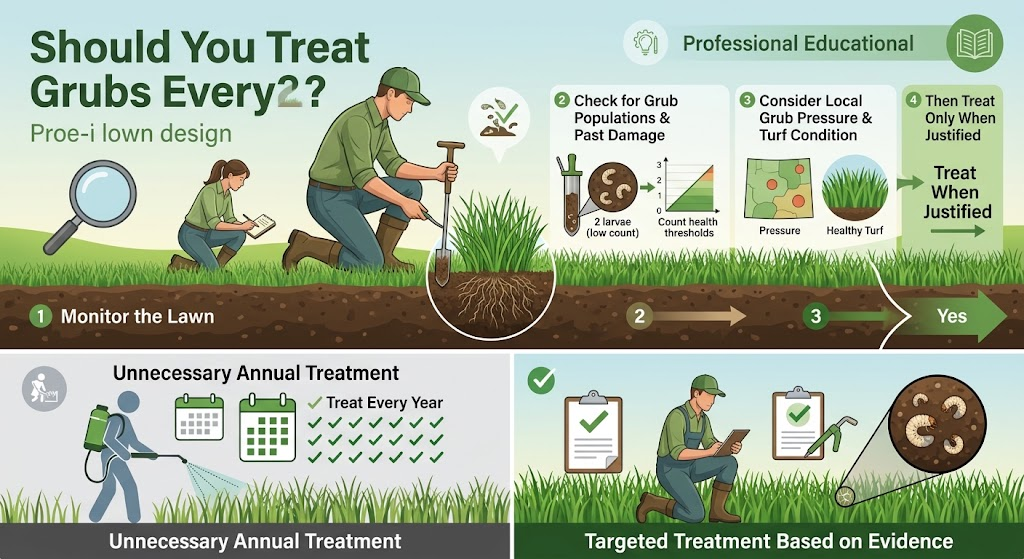
Usually not automatically. Preventive treatment may be reasonable for lawns with a documented history of damaging infestations in regions where specific grub species are predictable, but blanket annual treatment can waste money and expose beneficial organisms unnecessarily. Base the decision on monitoring, past damage, local grub pressure, turf condition and regional guidance.
Adult Beetles vs. Lawn Grubs
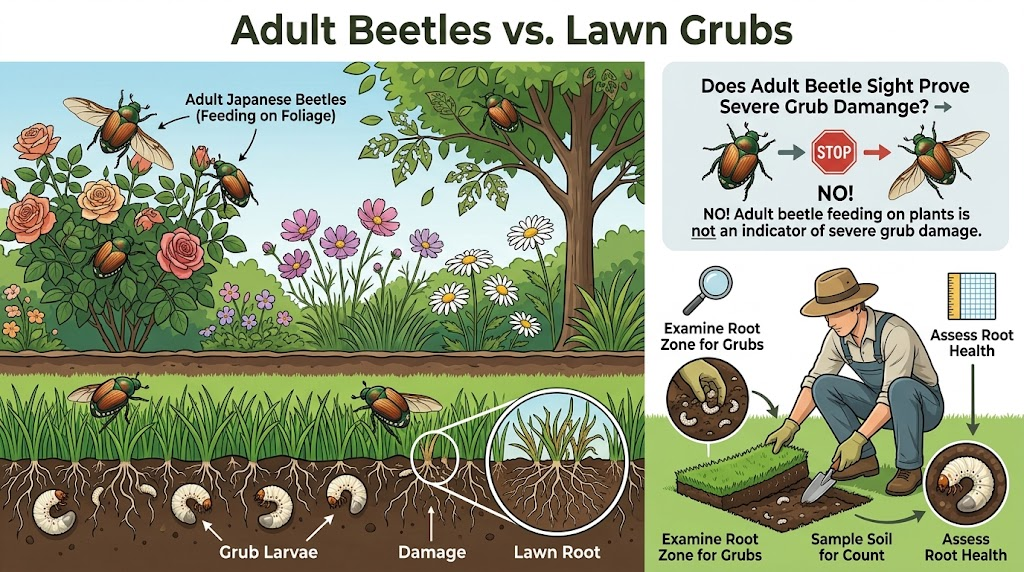
Seeing Japanese beetles or other scarab adults on roses, flowers or trees does not prove the lawn has a damaging grub population. Adults can move considerable distances, and the best approach to underground grubs is still soil sampling. Manage adult plant-feeding beetles according to the plants they are damaging; manage lawn grubs according to root-zone counts and injury.
How to Repair a Lawn After Grub Damage
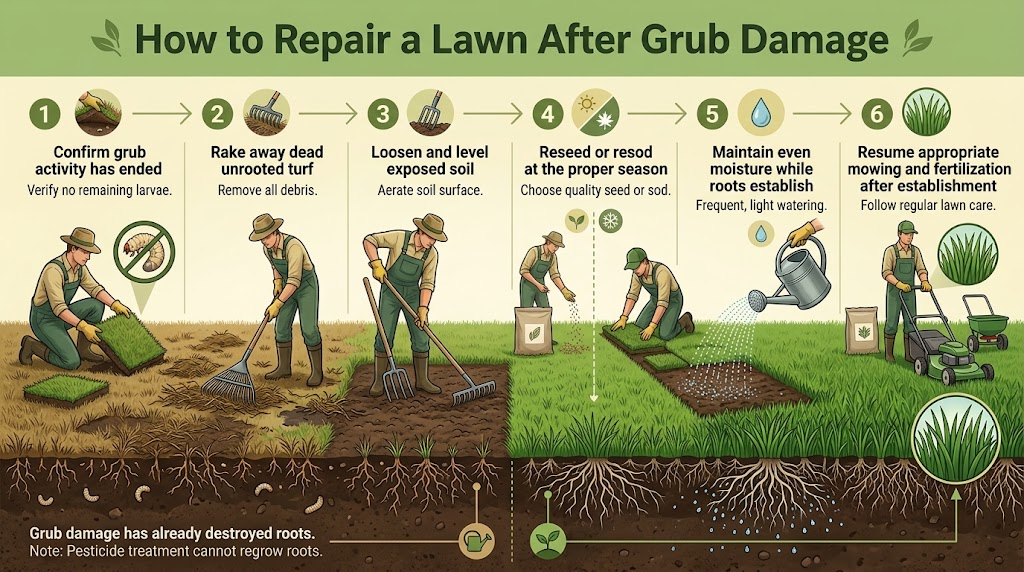
- Confirm that grub activity has ended or been controlled before major renovation.
- Rake away turf that is dead and no longer rooted.
- Loosen and level the exposed soil surface.
- Reseed or resod at the appropriate season for your grass type.
- Maintain even moisture while new roots establish.
- Resume appropriate mowing and fertility once the new turf is established.
Pesticide control cannot regrow roots that have already been destroyed. Lawn recovery requires restoring soil contact, moisture and healthy turf growth after the pest pressure is reduced.
Common Grub-Control Mistakes
| Mistake | Why it causes problems | Better approach |
| Treating every brown patch | Many lawn problems mimic grub injury | Dig and inspect first |
| Treating because animals are digging | Animals also feed on other soil life | Use digging only as a scouting clue |
| Treating after finding one grub | Low populations are common | Count several samples |
| Using the wrong seasonal product | Some active ingredients work best only on specific grub stages | Match product to lifecycle and label |
| Treating too late | Large or deep grubs can be harder to control | Use local timing guidance |
| Ignoring irrigation directions | Treatment may not reach the target zone | Follow the label exactly |
| Assuming all white grubs are Japanese beetles | Many scarab species produce lawn grubs | Identify species if it changes management |
| Using milky spore for every grub | It is not a universal white-grub treatment | Confirm Japanese beetle relevance |
| Expecting pesticide to restore dead turf | Killing grubs does not replace lost roots | Repair and re-establish turf afterward |
Frequently Asked Questions
What is a grub worm?
A grub worm is the common name for a white grub—the C-shaped larval stage of several scarab beetles that can feed on turf roots.
What do grub worms look like?
They are usually creamy white, C-shaped, brown-headed larvae with three pairs of legs near the head.
What do grub worms turn into?
Depending on species, they can become Japanese beetles, masked chafers, May/June beetles, Oriental beetles or other scarab beetles.
Do grubs kill grass?
High populations can remove enough roots to thin or kill patches of turf, especially when the lawn is already stressed.
How can I tell if my lawn has grubs?
Cut and lift a small section of sod, inspect the root zone, count visible grubs and look for root loss.
How many grubs per square foot is too many?
There is no universal cutoff. Local thresholds vary by grass species, grub species and turf condition, so combine counts with visible root injury.