Learn to spot mealybugs early, understand the damage they cause, and choose the least-disruptive treatment that actually works.
Key Takeaways
- Mealybugs look like tiny white cottony clumps on stems, leaf joints, and undersides of leaves.
- They weaken plants by sucking sap and excreting honeydew that attracts sooty mould.
- Rubbing alcohol on a cotton swab is the simplest first-line treatment for small infestations.
- Quarantine new plants for two weeks — this single habit prevents most mealybug introductions.
What Are Mealybugs?
Mealybugs are soft-bodied, sap-sucking insects in the family Pseudococcidae. They get their name from the white, mealy (powdery) wax coating that covers their bodies. There are around 2,200 species worldwide, but only a handful regularly trouble home gardeners — the citrus mealybug (Planococcus citri) and the longtailed mealybug (Pseudococcus longispinus) are the most common.
Unlike fast-moving pests, mealybugs are sedentary once they settle on a feeding site. They cluster in sheltered spots — leaf axils, under bark, along stems — and reproduce quickly in warm conditions. A light infestation is easy to miss; a heavy one can seriously weaken or kill a plant.
How to Identify Mealybugs
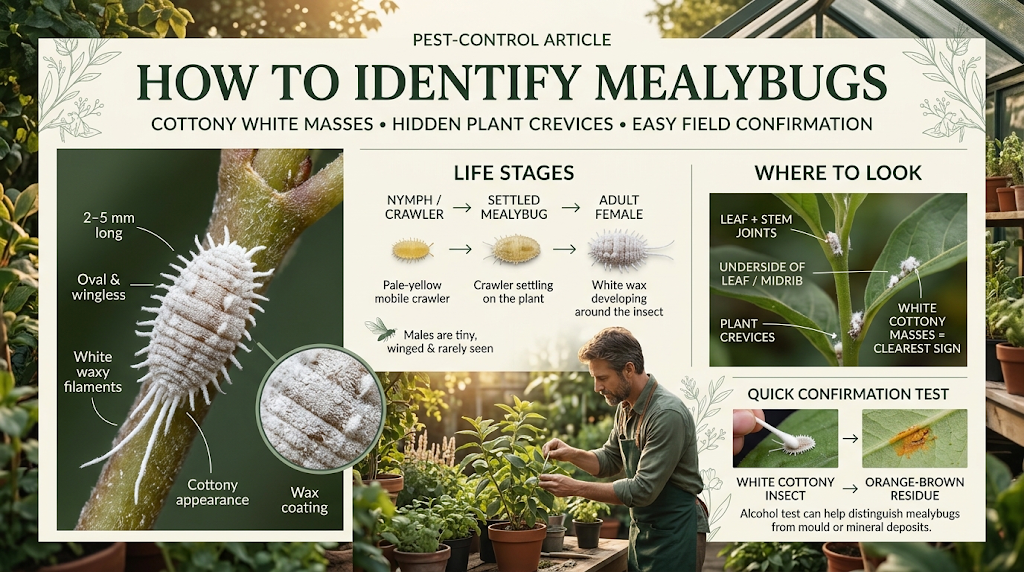
Adult female mealybugs are 2–5 mm long, oval, wingless, and covered in white waxy filaments that give them a cottony appearance. Males are tiny, short-lived, winged insects rarely seen. Nymphs (crawlers) are pale yellow and mobile for a brief period before settling down and producing wax.
Check where leaves meet stems, along midribs on the leaf underside, and in any crevice on the plant. The white cottony masses are the clearest sign. If you dab one with a cotton swab dipped in rubbing alcohol, it will turn orange-brown — confirming it is a mealybug, not mould or mineral deposit.
Signs of Mealybug Damage
Mealybugs pierce plant tissue and suck phloem sap, causing yellowing leaves, stunted growth, and wilting. Heavily infested plants may drop leaves or fail to flower. New growth often appears distorted or curled where feeding is concentrated.
They excrete honeydew — a sticky, sugary liquid that coats leaves and nearby surfaces. Sooty mould (a black fungus) grows on honeydew, blocking light and further stressing the plant. Ants are often attracted to the honeydew and may actively protect mealybugs from predators, worsening the problem.
Lifecycle & Habitat
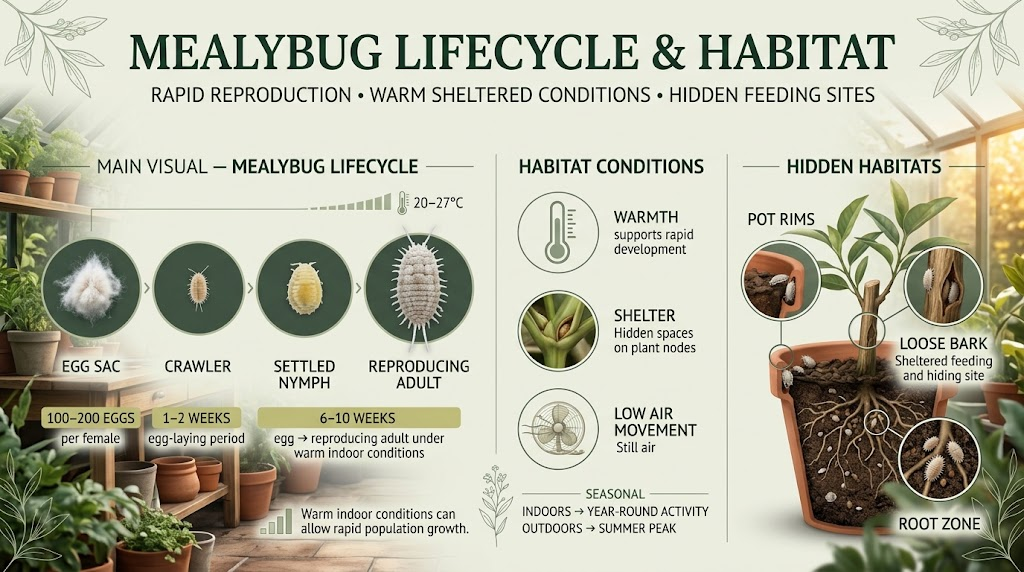
Females lay 100–200 eggs inside a cottony egg sac over 1–2 weeks. Eggs hatch into mobile crawlers that disperse to new feeding sites. Under warm indoor conditions (20–27 °C), the lifecycle from egg to reproducing adult takes 6–10 weeks, so populations can build rapidly in heated homes and greenhouses.
Mealybugs thrive in warm, sheltered environments with low air movement. Indoors, they are active year-round. Outdoors in temperate climates, they are most problematic in summer. They hide in hard-to-reach crevices — inside pot rims, under loose bark, and even in the root zone (root mealybugs).
Common Host Plants
Mealybugs are generalists with a wide host range. Houseplants most frequently affected include orchids, succulents, cacti, fiddle-leaf figs, pothos, hoyas, and citrus. In the garden, they attack hibiscus, gardenias, frangipani, grapes, and soft-stemmed ornamentals. Any stressed or over-fertilised plant with lush, soft growth is particularly vulnerable.
Lookalikes: What Else Could It Be?
Woolly aphids produce similar white waxy coverings but are found mainly on woody plants and have visible legs and antennae when the wax is removed. Scale insects are another relative — they form hard or waxy bumps that don’t move, lack the cottony filaments, and are usually brown or tan. White powdery residue on leaves is more likely powdery mildew (a fungus) if it wipes off as a dry dust rather than a waxy smear. Cottony cushion scale looks very similar but is larger and typically found on citrus and woody shrubs outdoors.
Control Methods (Least-Disruptive First)
1. Physical Removal (Light Infestations)
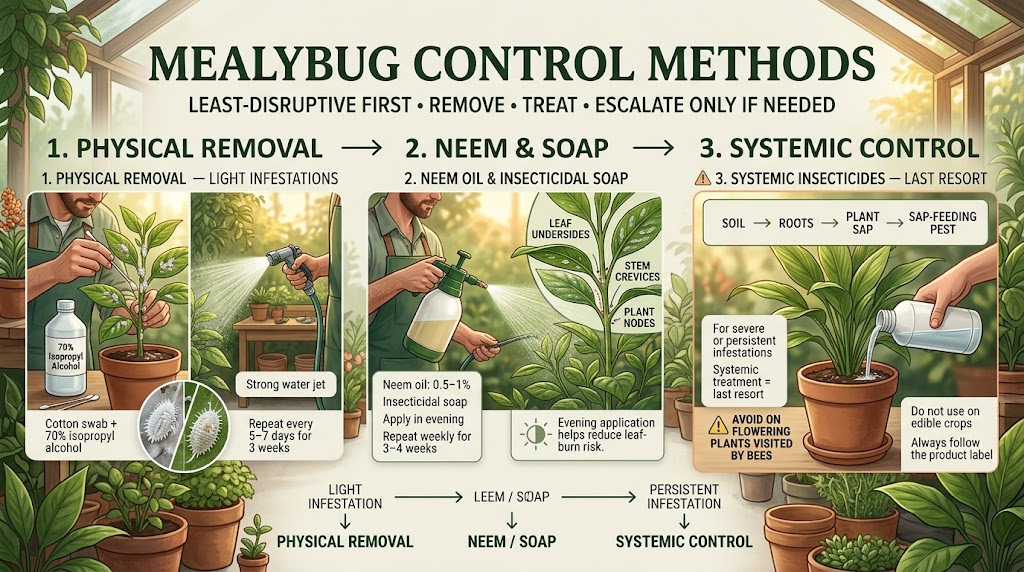
Dip a cotton swab or small brush in 70% isopropyl alcohol and dab each visible mealybug — the alcohol dissolves their waxy coating and kills on contact. For larger clusters, use a strong jet of water from a hose or shower head to dislodge them. Repeat every 5–7 days for three weeks to catch newly hatched crawlers.
2. Neem Oil & Insecticidal Soap
Spray the entire plant — including undersides of leaves and stem crevices — with neem oil (0.5–1% concentration) or insecticidal soap. These suffocate mealybugs and disrupt their reproduction. Apply in the evening to avoid leaf burn and reapply weekly for 3–4 weeks. These are safe for most plants and break down quickly in the environment.
3. Systemic Insecticides (Severe or Persistent Infestations)
For heavy infestations that resist topical treatment, a systemic insecticide containing imidacloprid can be applied as a soil drench. The plant absorbs it and any sap-feeding insect is killed. Use this as a last resort — systemics are harmful to pollinators, so never use them on flowering plants visited by bees. Always follow the label rate and do not apply to edible crops.
Prevention
Quarantine every new plant for at least two weeks before placing it near your collection — inspect stems, leaf undersides, and the soil surface carefully. Avoid over-fertilising with nitrogen, which produces soft growth mealybugs prefer. Improve air circulation around plants and avoid crowding pots together. Wipe leaves regularly and inspect during watering. Introduce natural predators like ladybirds or the mealybug destroyer (Cryptolaemus montrouzieri) in greenhouses.
When to Escalate
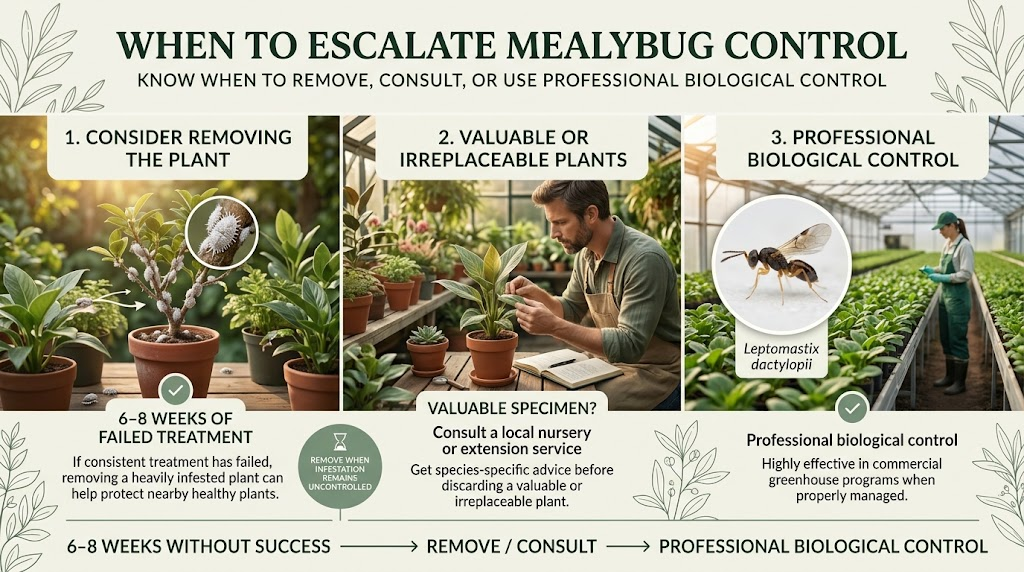
Consider discarding a heavily infested plant if treatment has failed after 6–8 weeks of consistent effort — keeping it risks spreading mealybugs to healthy plants nearby. For valuable or irreplaceable specimens, consult a local nursery or extension service for species-specific advice. In commercial greenhouse settings, biological control with parasitic wasps (Leptomastix dactylopii) is highly effective and worth professional guidance.
Frequently Asked Questions
Can mealybugs spread to other plants?
Yes. Crawlers are mobile and can walk to adjacent plants, hitch a ride on hands or tools, or be blown by fans. Isolate any infested plant immediately and inspect neighbours within a 1-metre radius.
Are mealybugs harmful to humans or pets?
No. Mealybugs do not bite, sting, or transmit diseases to humans or animals. They are strictly plant pests. The main concern is damage to your plants and the sticky honeydew mess they leave behind.
Why do mealybugs keep coming back?
Eggs and crawlers hide in crevices that sprays miss — pot rims, drainage holes, bark fissures, and even roots. A single missed egg sac can restart the population. Consistent weekly treatment for at least three full weeks (covering one complete lifecycle) is essential to break the cycle.
Does dish soap work as well as insecticidal soap?
Diluted dish soap (a few drops per litre) can kill mealybugs on contact, but it may also damage sensitive plant leaves because it contains degreasers and fragrances not designed for foliage. Purpose-made insecticidal soap is formulated to be effective against soft-bodied insects while minimising plant damage — it is the safer choice.