Learn how to spot armyworms in your lawn, understand the damage they cause, and choose the most effective — and least harmful — control method.
Key Takeaways
- Armyworms are moth caterpillars that feed in large groups, often devastating lawns overnight — early detection is critical.
- Brown patches that expand rapidly and grass blades chewed to the crown are the signature signs of armyworm damage.
- Bt (Bacillus thuringiensis) and spinosad are effective, low-impact treatments when applied to young larvae.
- A healthy, properly mowed lawn recovers quickly — most lawns regrow within 3–4 weeks after treatment.
What Are Armyworms?
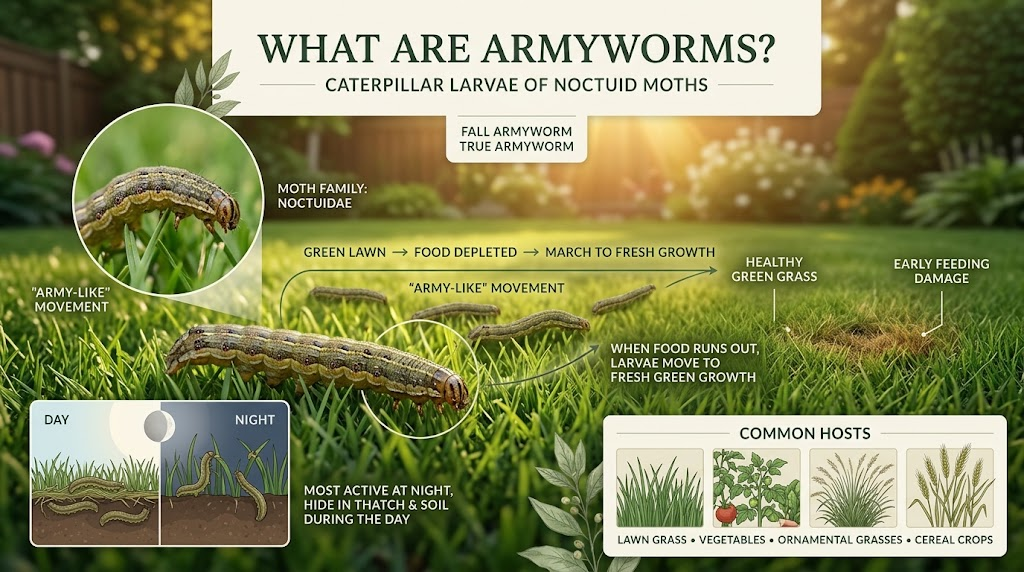
Armyworms are the caterpillar larvae of several moth species in the family Noctuidae, most commonly the fall armyworm (Spodoptera frugiperda) and the true armyworm (Mythimna unipuncta). They get their name from their behaviour: when food runs out in one area, the entire population marches together — army-like — to the next patch of green.
In home lawns, armyworms feed primarily on grass blades, but they’ll also attack vegetable gardens, ornamental grasses, and cereal crops. They feed mostly at night or on overcast days, hiding in thatch and soil during bright sunlight — which is why homeowners often wake up to sudden, unexplained brown patches.
How to Identify Armyworms
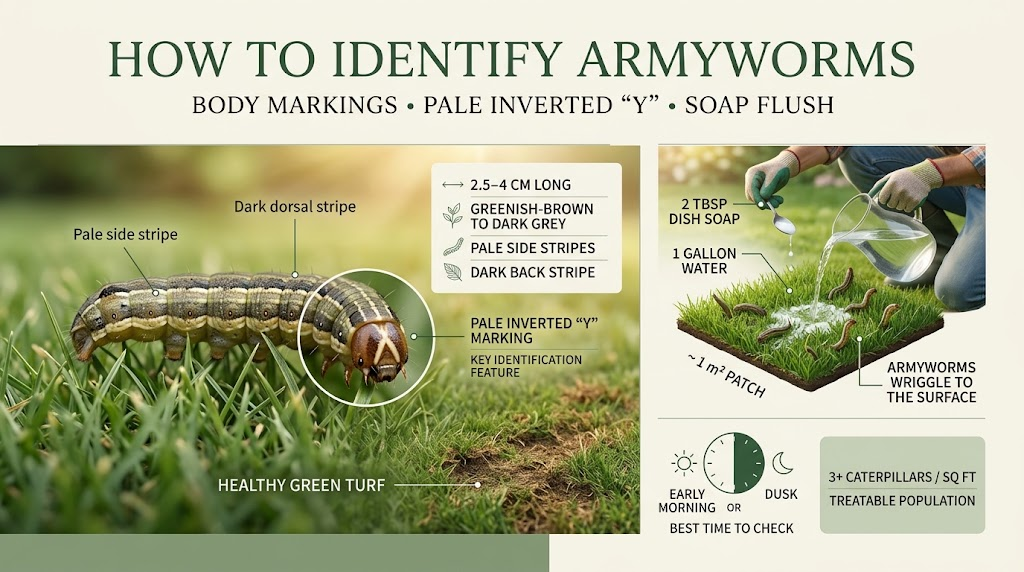
Armyworm caterpillars are 2.5–4 cm long when mature. They’re typically greenish-brown to dark grey with distinctive lengthwise stripes: a pale stripe down each side and a darker stripe along the back. The head capsule is brown with a prominent pale inverted “Y” marking — this is the single most reliable identification feature.
To confirm their presence, do a “soap flush”: mix 2 tablespoons of dish soap in a gallon of water and pour it over a 1 m² patch of lawn at the edge of a damaged area. Within minutes, armyworms will wriggle to the surface. Check at dusk or early morning for the most accurate count. Finding 3+ caterpillars per square foot indicates a treatable population.
Lifecycle & Habitat
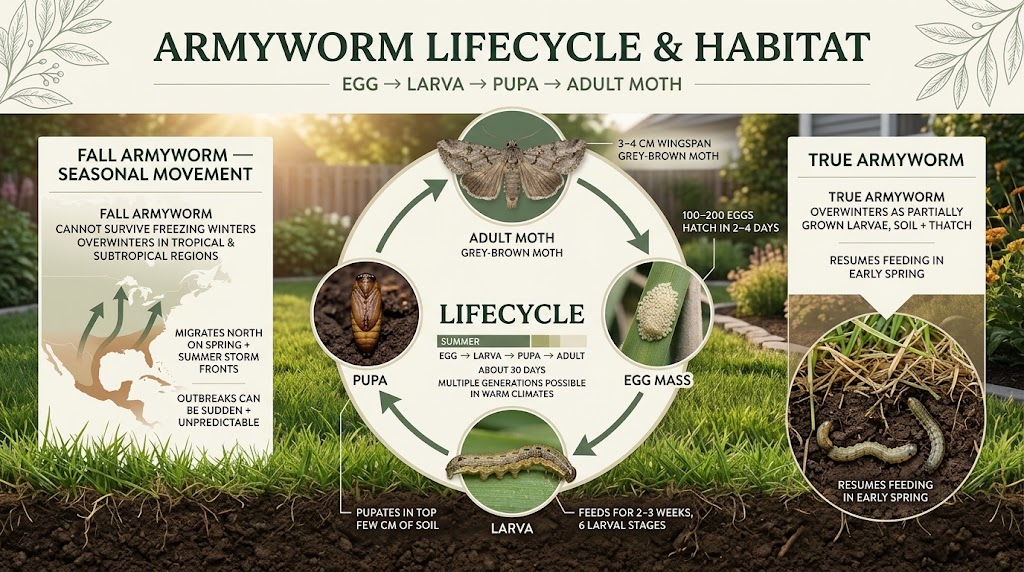
Adult moths are nondescript grey-brown with a 3–4 cm wingspan. Females lay egg masses of 100–200 eggs on grass blades or nearby structures, often covered in a fuzzy scale layer. Eggs hatch in 2–4 days during warm weather. Larvae feed for 2–3 weeks, pass through six instars, then pupate in the top few centimetres of soil. The entire cycle takes about 30 days in summer, allowing multiple generations per year in warm climates.
Fall armyworms cannot survive freezing winters — they overwinter only in tropical and subtropical regions and migrate northward each spring and summer on storm fronts. This means outbreaks in temperate areas are unpredictable and often sudden. True armyworms overwinter as partially grown larvae in soil and thatch, resuming feeding in early spring.
Host Plants & Damage
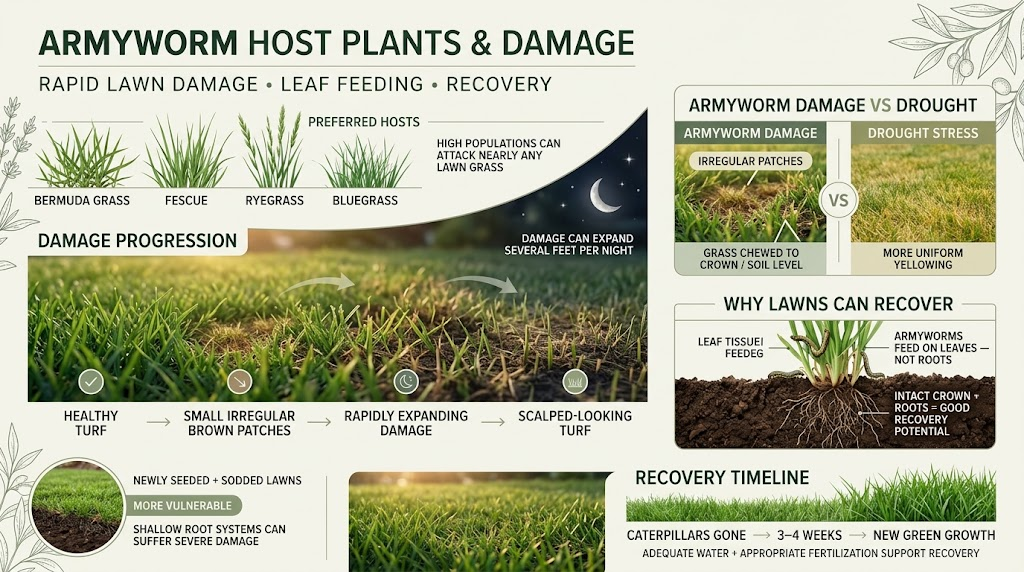
Armyworms prefer Bermuda grass, fescue, ryegrass, and bluegrass but will attack nearly any lawn grass when populations are high. Damage starts as small, irregular brown patches that expand rapidly — often several feet per night. Grass blades are chewed down to the crown or soil level, giving the lawn a scalped appearance quite different from drought stress (which yellows uniformly).
The good news: armyworms eat leaves, not roots. If the crown and root system remain intact, most lawns recover fully within 3–4 weeks with adequate watering and fertilisation after the caterpillars are gone. Newly seeded or sodded lawns are more vulnerable because their root systems are shallow — severe feeding can kill young turf.
Lookalikes: What Else Could It Be?
Sod webworms are smaller (under 2 cm), pale green or beige, and build silk-lined tunnels in thatch — you’ll see small moths zig-zagging low over the lawn at dusk. Cutworms are stockier, curl into a C-shape when disturbed, and cut seedlings at the base rather than eating blades. Grubs (white curl larvae) feed on roots underground — the turf lifts like carpet. Chinch bugs cause brown patches too but are tiny insects (3–4 mm), not caterpillars. If the caterpillar has a pale inverted Y on its head and clear lengthwise stripes, it’s almost certainly an armyworm.
Control Methods (Least-Disruptive First)
1. Monitor & Let Nature Help
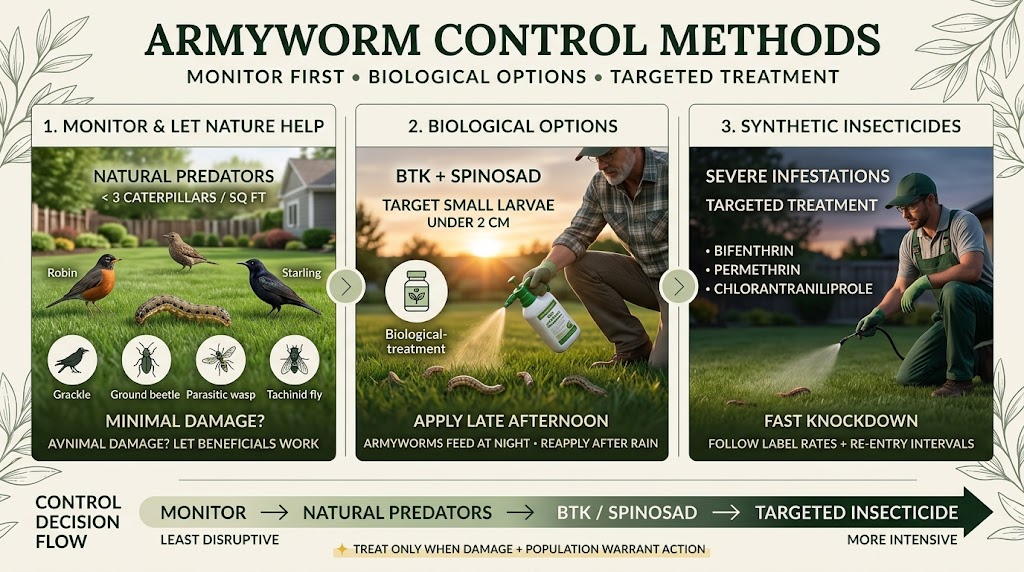
Birds (starlings, grackles, robins), ground beetles, parasitic wasps, and tachinid flies are voracious armyworm predators. If you find fewer than 3 caterpillars per square foot and damage is minimal, natural enemies may keep the population below damaging levels. Avoid broad-spectrum insecticides that kill these beneficial organisms.
2. Bt or Spinosad (Biological Insecticides)
Bacillus thuringiensis var. kurstaki (Btk) and spinosad are organic-certified options that target caterpillars specifically — safe for people, pets, bees, and earthworms. Apply in the late afternoon (armyworms feed at night) when larvae are small (under 2 cm). Water the lawn lightly beforehand to bring caterpillars closer to the surface. Reapply after rain. These products break down in sunlight within days, so timing matters more than coverage.
3. Synthetic Insecticides (If Needed)
For severe infestations where the lawn is being consumed faster than biologicals can work, bifenthrin, permethrin, or chlorantraniliprole provide fast knockdown. Apply at dusk and water in lightly. Chlorantraniliprole (e.g., Acelepryn) is the most selective — it targets caterpillars and grubs with minimal impact on bees and beneficial insects. Always follow label rates and reentry intervals.
Prevention
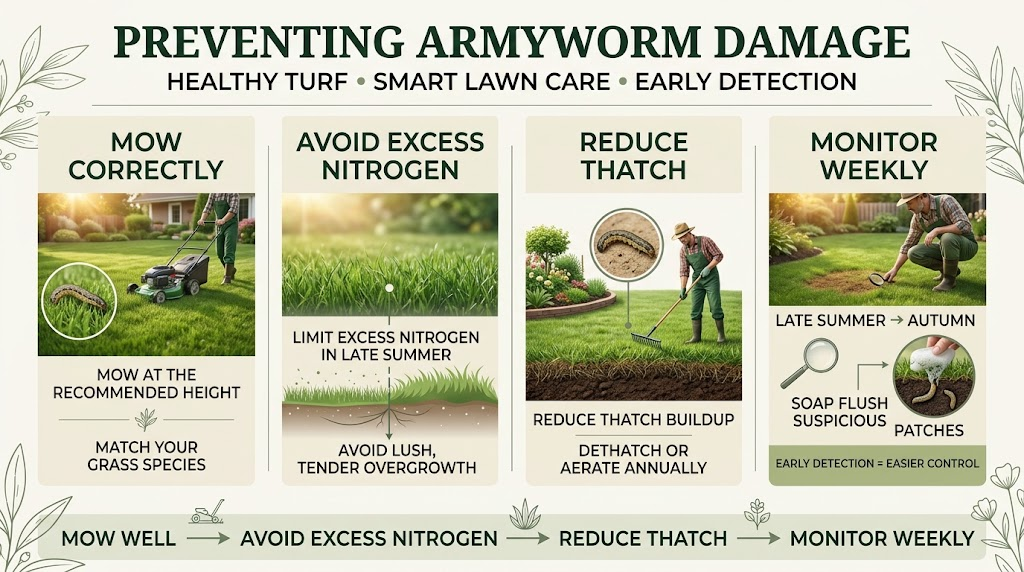
Mow at the recommended height for your grass species — taller turf hides eggs and small larvae from predators less effectively. Avoid excessive nitrogen fertilisation in late summer, which produces the lush, tender growth armyworms prefer. Reduce thatch buildup (dethatch or aerate annually) so larvae have fewer hiding spots. Monitor your lawn weekly during peak season (late summer through autumn) — a quick soap flush at the edge of any suspicious brown patch catches infestations early when they’re easiest to treat.
When to Call a Professional
Contact a licensed pest management professional if: the infestation covers more area than you can treat in one evening; you’ve applied a biological product and damage is still spreading after 48 hours; you’re unsure whether the pest is armyworms or something else; or you want a preventive programme (granular chlorantraniliprole applied in early summer) for properties with recurring annual outbreaks. A professional can confirm the species and calibrate application rates for your lawn size.
Frequently Asked Questions
Are armyworms harmful to people or pets?
No. Armyworms don’t bite, sting, or produce toxins. They’re harmless to handle. The only concern is the damage to your lawn and plants — the caterpillars themselves pose no health risk to humans or animals.
Will my lawn grow back after armyworm damage?
In most cases, yes. Armyworms eat the leaf blades but not the roots or crowns. With adequate watering and a light fertiliser application after the caterpillars are gone, established lawns typically recover within 3–4 weeks. Newly seeded areas may need overseeding.
When is the best time to treat for armyworms?
Treat as soon as you confirm their presence — ideally when larvae are small (under 2 cm). Apply products in the late afternoon or early evening when caterpillars become active. Biological products like Bt and spinosad are most effective on young larvae.
How can I tell armyworm damage from drought stress?
Drought stress causes uniform yellowing; army worms damage creates irregular brown patches with a clear edge between healthy and eaten turf. Look closely at the grass blades — armyworm damage shows ragged, chewed edges rather than dried or curled tips. A soap flush at the edge of the patch will confirm the culprit.