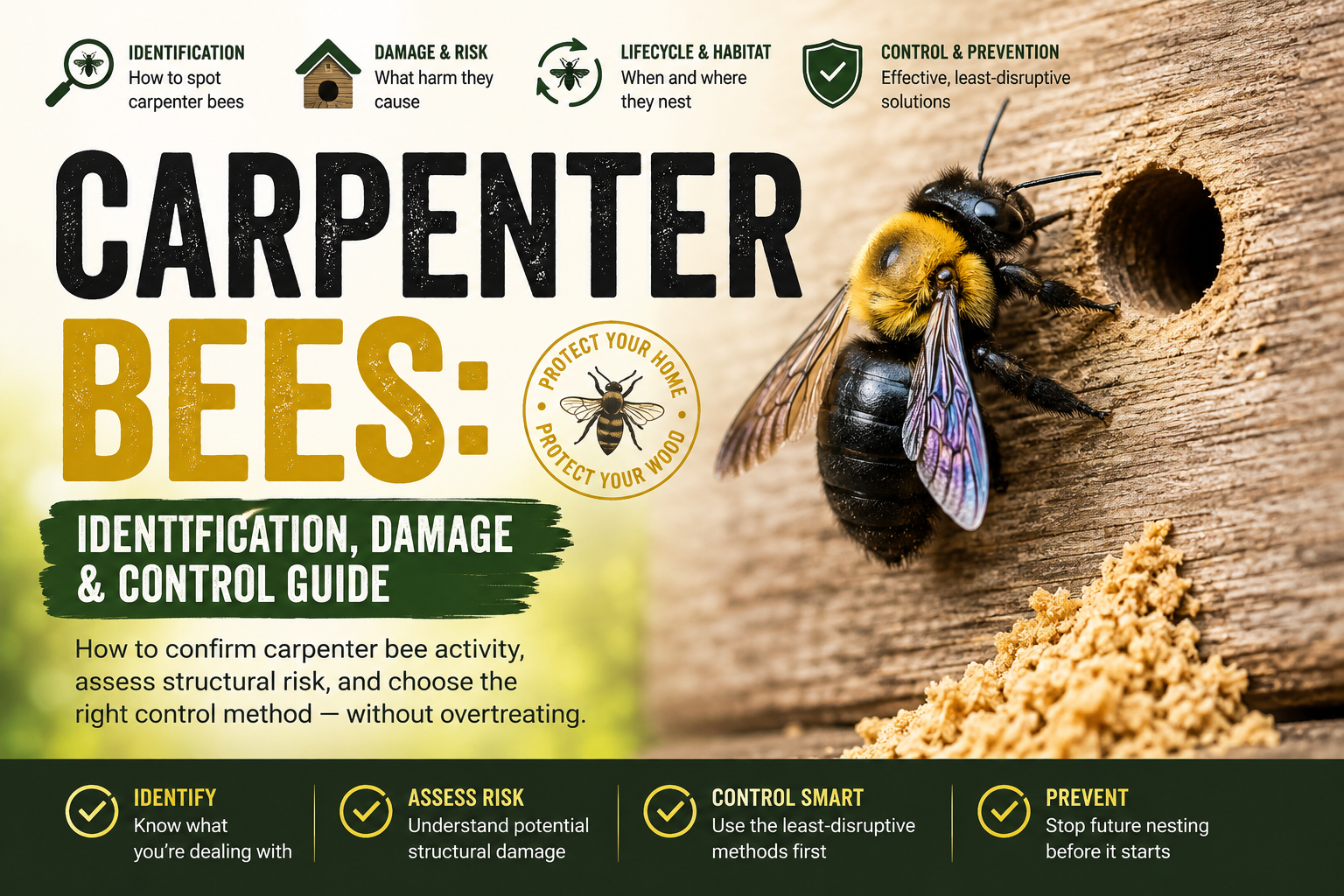

How to confirm carpenter bee activity, assess structural risk, and choose the right control method — without overtreating.
Key Takeaways
- Carpenter bees are large, shiny-black bees that drill perfectly round ½-inch holes into untreated wood.
- They rarely sting (males can’t, females seldom do) — the real concern is cumulative wood damage over years.
- Painting or staining exposed wood is the single most effective long-term prevention.
- Insecticide dust in active galleries works when prevention alone isn’t enough.
1. How to Identify Carpenter Bees
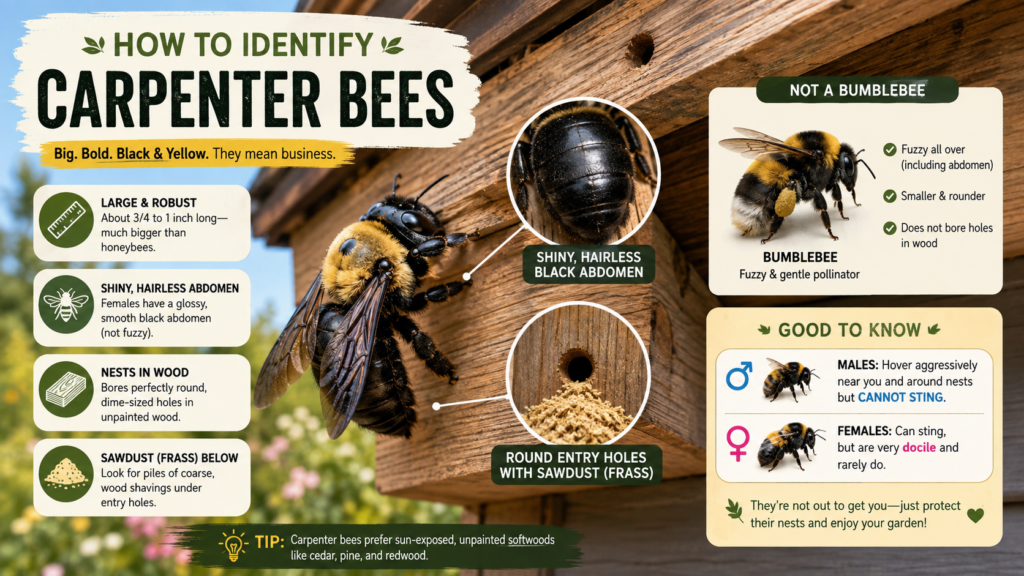
Carpenter bees (Xylocopa spp.) are large, robust bees — roughly 20–25 mm long — often mistaken for bumblebees. The key difference: the top of a carpenter bee’s abdomen is shiny, hairless, and jet-black, while a bumblebee’s abdomen is fuzzy and banded with yellow.
Males are often the ones you see hovering aggressively near eaves and decks — they’re territorial but cannot sting. Females have a stinger but are docile unless handled. You’ll typically spot them in spring, buzzing around wooden structures.
Look for sawdust (frass) piles beneath round, dime-sized entry holes in wood. Fresh holes have clean edges; old ones may show staining from bee excrement. A single hole leads to a tunnel that can extend 6–10 inches along the grain.
2. Damage & Structural Risk
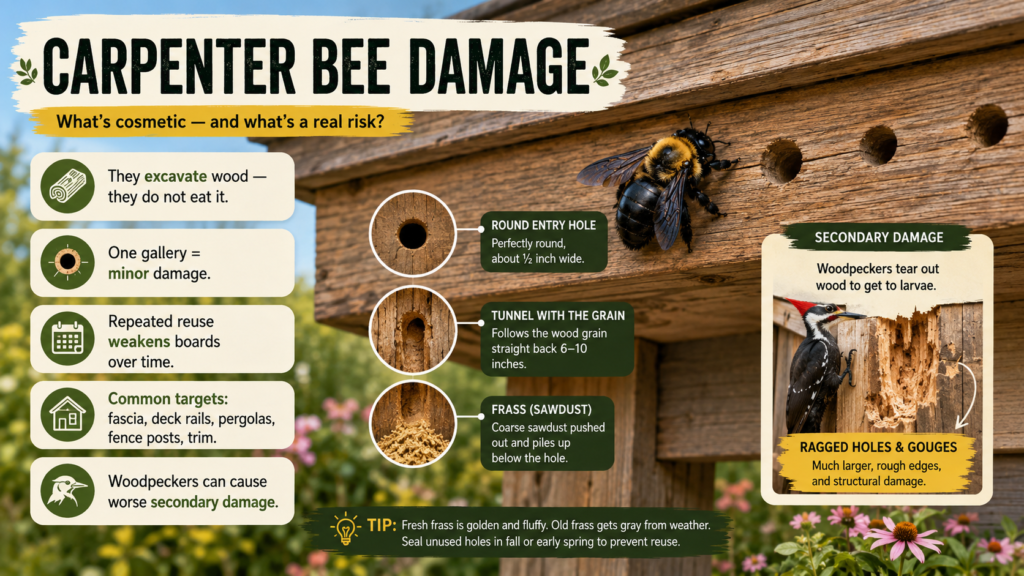
Carpenter bees don’t eat wood — they excavate tunnels (galleries) to lay eggs. A single gallery causes minimal structural harm. The real risk comes from reuse: bees return to the same boards year after year, extending tunnels and weakening the timber from within.
Favourite targets include fascia boards, deck railings, pergola beams, fence posts, window trim, and unpainted siding — essentially any exposed softwood (pine, cedar, redwood, cypress) that is bare or has a worn finish.
Secondary damage comes from woodpeckers that drill into galleries to eat larvae, enlarging the holes significantly. If you see ragged, oblong gouges near round entry holes, woodpeckers have found the nest.
3. Lifecycle & Habitat
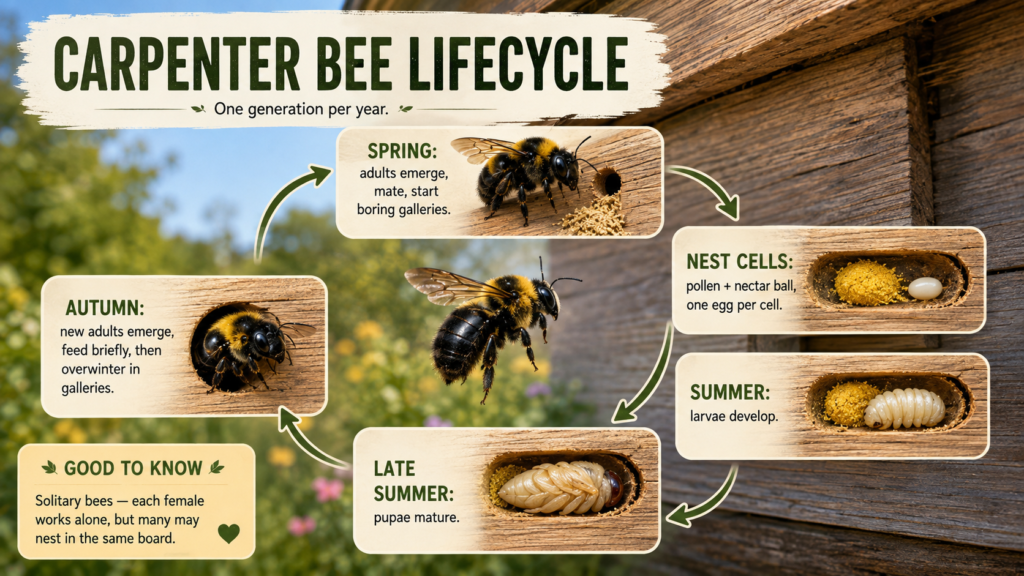
Adults emerge in spring (April–May), mate, and females begin boring new galleries or reusing old ones. She provisions each cell with a ball of pollen and nectar, lays an egg, then seals it with a chewed-wood partition. A single gallery typically holds 6–8 cells.
Larvae develop over summer, pupate in late summer, and new adults emerge in autumn to feed briefly before overwintering inside the galleries. One generation per year is standard. Carpenter bees are solitary — each female works alone, though many may nest in the same board if conditions are favourable.
4. Common Lookalikes
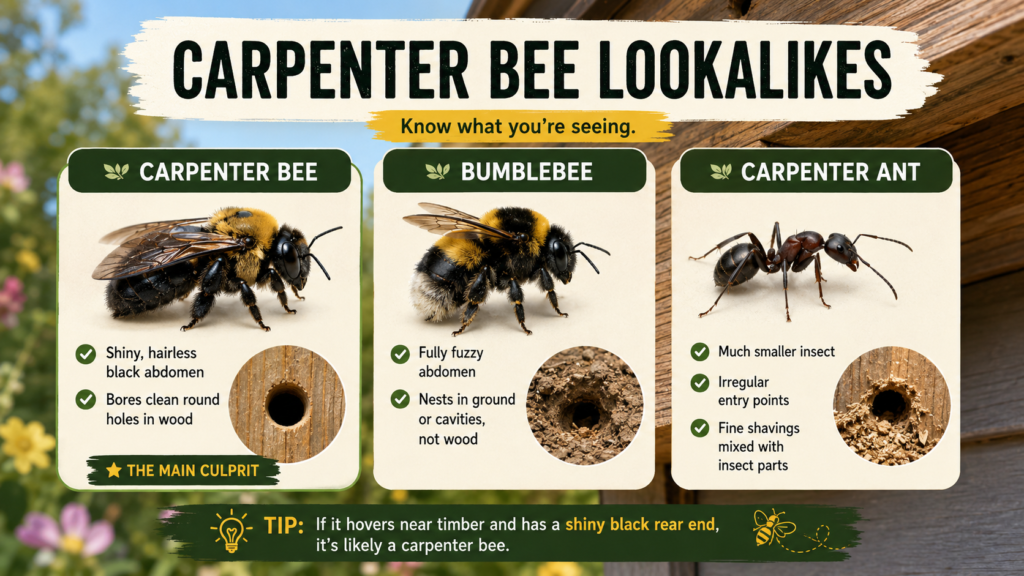
Bumblebees are the most frequent confusion. Remember: bumblebees have a fully fuzzy abdomen and nest in the ground or in cavities — never in wood. If the bee is hovering near timber and has a shiny black rear end, it’s a carpenter bee.
Carpenter ants also bore into wood but leave irregular, sandpaper-smooth galleries with expelled frass that looks like fine shavings mixed with insect parts. Their entry holes are smaller and ragged, not the clean ½-inch circles of carpenter bees.
5. Control Methods (Least-Disruptive First)
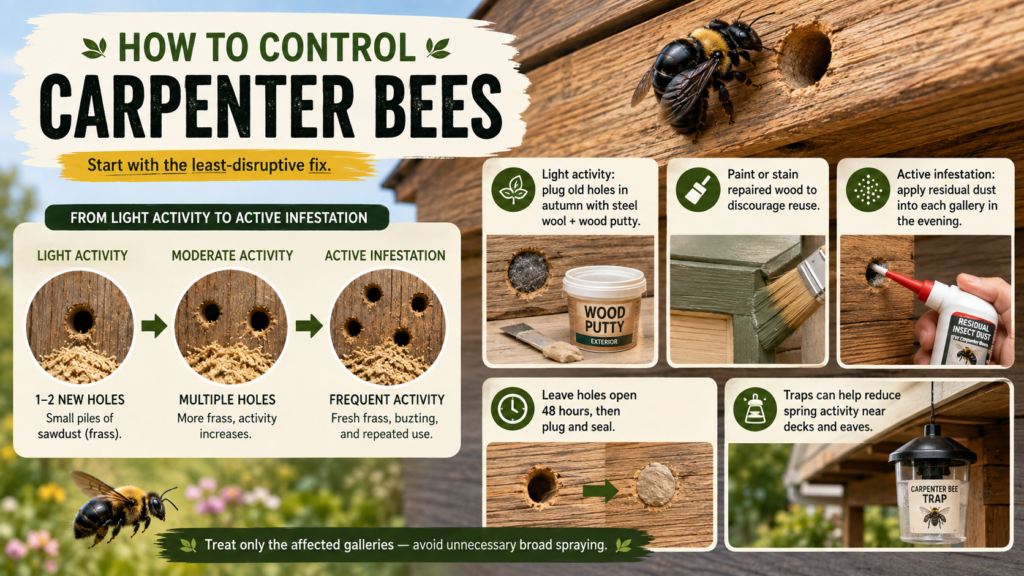
For light activity (fewer than 5 holes), simply plug existing holes with steel wool and wood putty in autumn after larvae have emerged. This prevents reuse the following spring. Painting or staining the repaired area discourages new drilling.
For active infestations, apply residual insecticide dust (deltamethrin or carbaryl) into each gallery using a hand duster. Do this in the evening when bees are inside. Leave holes open for 48 hours so returning bees contact the dust, then plug and seal.
Carpenter bee traps — wooden blocks with pre-drilled angled holes leading to a collection jar — can reduce populations around decks and eaves. They work best when placed near existing damage in early spring before peak activity.
6. Prevention
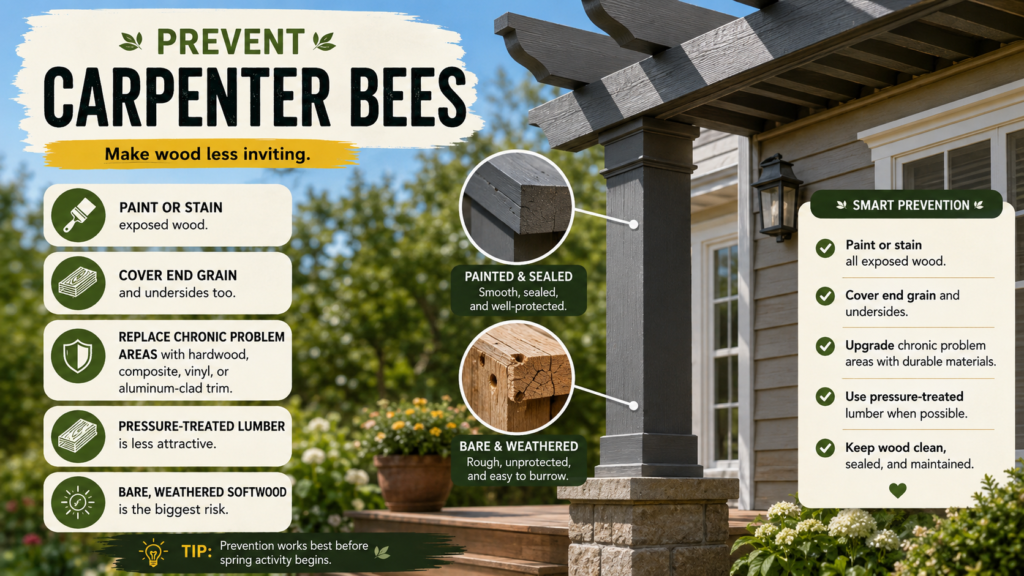
Paint or stain all exposed wood surfaces — this is the most effective deterrent. Carpenter bees strongly prefer bare, weathered wood. Oil-based stains and latex paints both work; the key is full coverage, including end-grain and undersides of trim.
Replace softwood trim with hardwood, composite, vinyl, or aluminium-clad alternatives in chronic problem areas. Hardwoods like oak and maple are far less attractive. For pergolas and outdoor furniture, consider pressure-treated lumber, which bees typically avoid.
7. When to Call a Professional
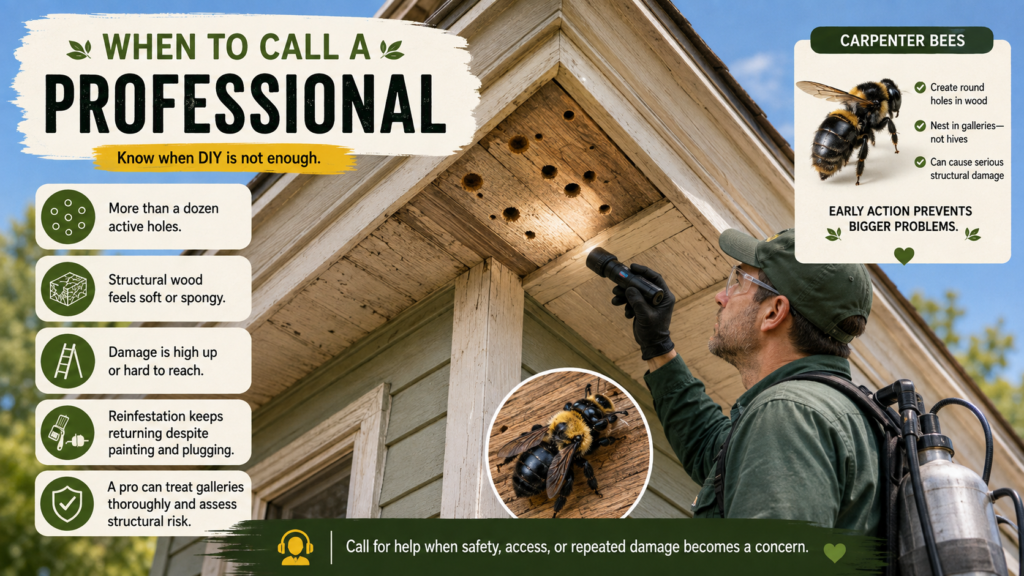
If you find extensive galleries (more than a dozen active holes), structural members that feel spongy, or damage in hard-to-reach areas like second-storey soffits, a licensed pest control operator can treat galleries more thoroughly and assess structural integrity.
Professionals can also apply longer-lasting residual treatments to high-risk areas as a preventive barrier each spring — worthwhile for homes with chronic re-infestation despite painting and plugging efforts.
Frequently Asked Questions
Do carpenter bees sting?
Males cannot sting at all despite their aggressive hovering. Females can sting but rarely do unless directly handled or trapped against skin. They are not considered dangerous to people.
Will carpenter bees destroy my house?
A single season of activity won’t cause structural failure. The risk is cumulative — galleries reused and extended over many years can weaken fascia, rafters, and deck posts. Early intervention prevents serious damage.
Should I kill carpenter bees or are they beneficial?
Carpenter bees are effective pollinators, especially for open-faced flowers and vegetable crops. If they’re nesting in non-structural wood away from living areas, consider leaving them alone or redirecting them to a ‘bee block’ of untreated scrap wood.