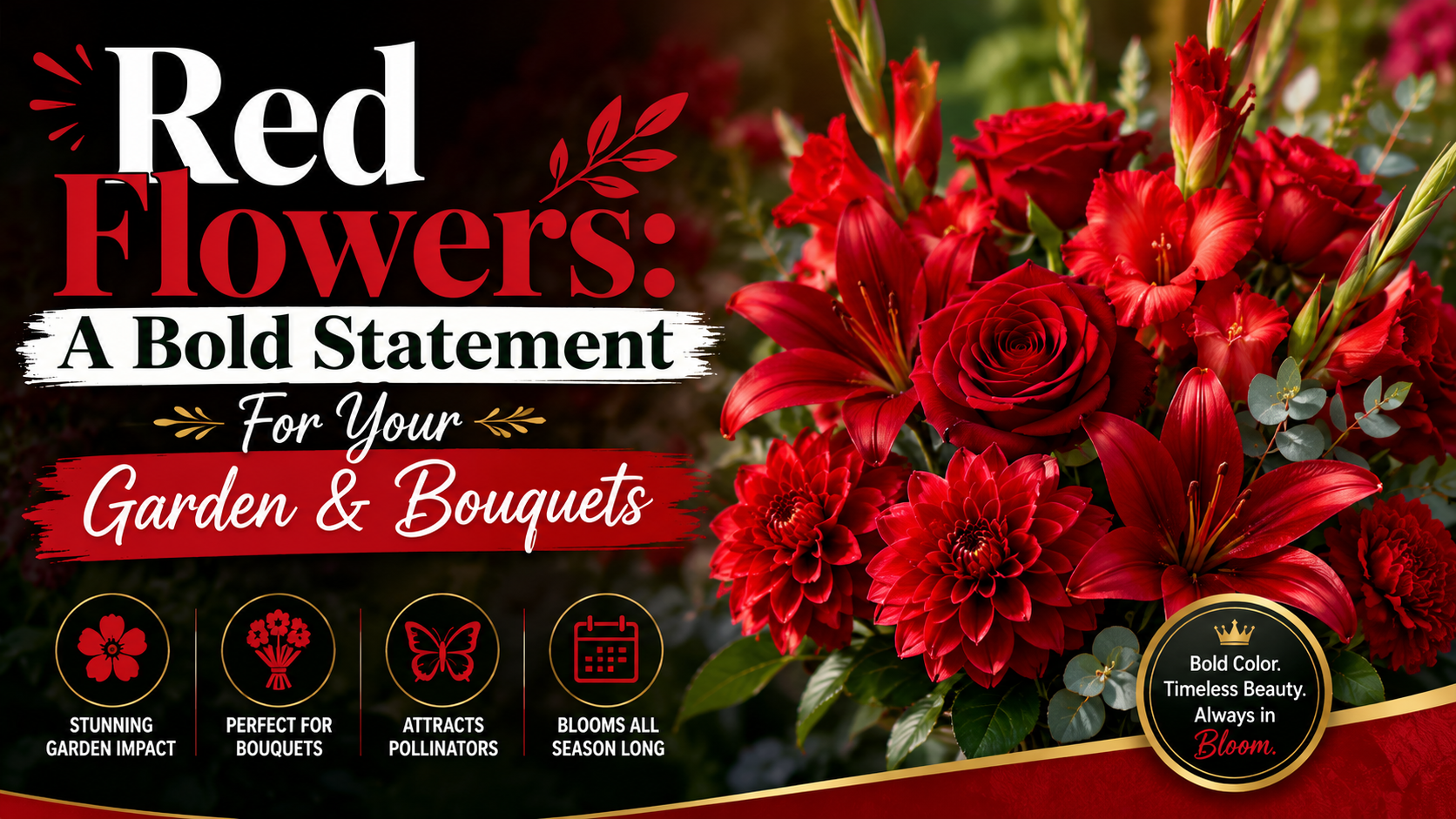

Discover the best red flowers for stunning garden borders, containers, and homemade bouquets — with expert growing advice, variety comparisons, and seasonal planting tips.
🌹 Quick Answer: What Are the Best Red Flowers?
The best red flowers for most gardeners are roses, dahlias, zinnias, and tulips. For gardens, choose red-flowered perennials like bee balm and peonies for year-after-year colour, or annuals like zinnias and celosia for continuous summer blooms. For bouquets, roses, dahlias, ranunculus, and gladioli offer long stems and excellent vase life of 7–14 days.
Why Choose Red Flowers For Your Garden?
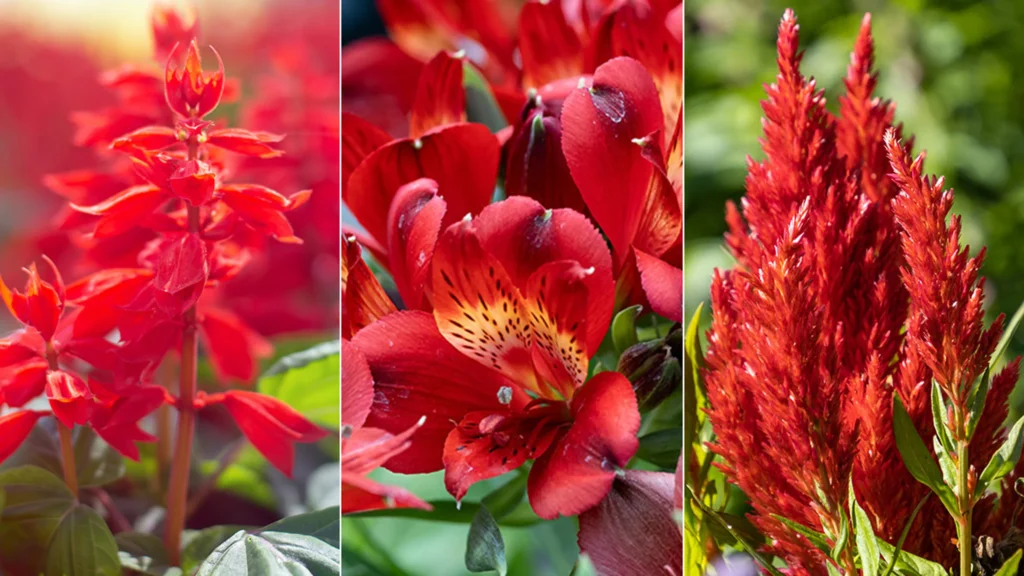
Red flowers create instant visual impact. They are the first colour the human eye notices in a landscape, making them ideal for focal points, front-yard curb appeal, and dramatic borders. A single drift of red flowers can anchor an entire garden design and draw the eye across a mixed planting scheme.
Beyond aesthetics, many red flowers are powerful pollinator magnets. Hummingbirds are instinctively attracted to red blooms, while bees visit red-flowered plants like bee balm, salvia, and penstemon throughout summer. Choosing red flowers means building a garden that is both beautiful and ecologically valuable.
What Do Red Flowers Symbolize?
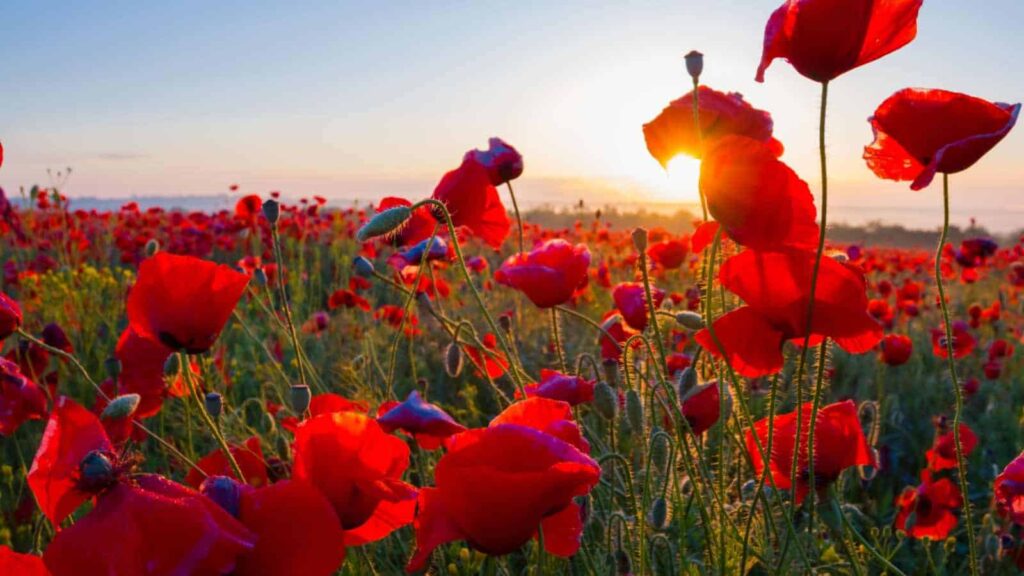
In the language of flowers (floriography), red symbolizes love, passion, courage, and respect. Red roses remain the world’s most popular romantic gift, while red poppies represent remembrance and sacrifice. Red carnations signify admiration, and red tulips declare perfect love.
Understanding flower symbolism helps you choose appropriate red flowers for specific occasions — Valentine’s Day, anniversaries, memorial arrangements, or simply expressing warmth and energy in your home.
Best Red Flowers For Gardens: Comparison Table
This comparison covers the most reliable red flowers for home gardens, rated by bloom season, light needs, bouquet suitability, and maintenance level. Exact performance depends on cultivar and local climate.
| Flower | Type | Bloom Season | Light | Bouquet Use | Maintenance |
|---|---|---|---|---|---|
| Rose | Shrub | Spring–Autumn | Full sun | Excellent | Moderate |
| Zinnia | Annual | Summer–Frost | Full sun | Excellent | Easy |
| Tulip | Bulb | Spring | Full sun | Very good | Easy |
| Dahlia | Tuberous perennial | Summer–Frost | Full sun | Excellent | Moderate |
| Bee Balm | Perennial | Summer | Sun–part shade | Fair | Easy |
| Gladiolus | Corm | Summer | Full sun | Excellent | Moderate |
| Camellia | Shrub | Winter–Spring | Partial shade | Limited | Moderate |
| Celosia | Annual | Summer–Autumn | Full sun | Very good | Easy |
Note: Flower colour can vary by cultivar, soil pH, light intensity, and plant maturity. Always check the specific cultivar name (e.g., Dahlia ‘Bishop of Llandaff’, Rose ‘Mister Lincoln’) to ensure a true red bloom rather than pink-red or orange-red.
Best Red Flowers For Bouquets And Cut Arrangements
Not every garden flower performs well as a cut flower. The best red flowers for bouquets combine long stems, a vase life of at least 7 days, minimal sap issues, and petals that hold without shattering. Roses, dahlias, ranunculus, gladioli, and zinnias consistently rank as the top red cut flowers among professional florists and home growers alike.
For the longest vase life, harvest red flowers early in the morning when stems are fully hydrated. Cut at a 45-degree angle, strip leaves below the waterline, and place immediately in clean water with floral preservative. Dahlias and zinnias benefit from a hot-water dip (brief immersion of stem ends in near-boiling water for 10 seconds) to seal the sap and extend longevity to 7–10 days.
Red Annual Flowers: Season-Long Colour
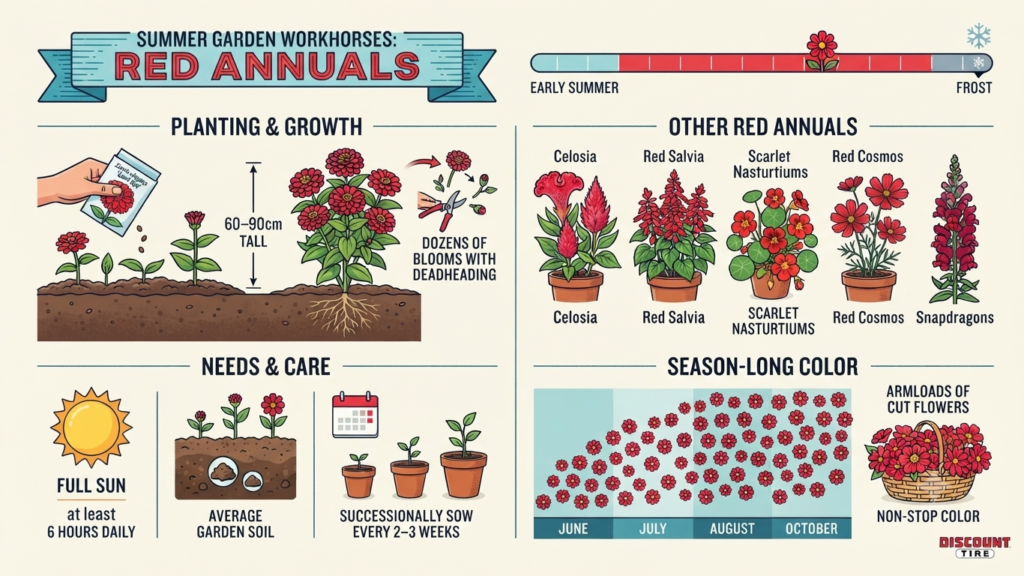
Annual red flowers are the workhorses of summer gardens. They bloom continuously from early summer until frost, making them ideal for filling gaps, edging borders, and producing armloads of cut flowers. Zinnias (Zinnia elegans ‘Giant Red’) grow 60–90cm tall, are incredibly easy from seed, and produce dozens of blooms per plant when deadheaded regularly.
Other excellent red annuals include celosia (both crested and plume types), red salvia (Salvia coccinea or Salvia splendens), scarlet nasturtiums, red cosmos, and snapdragons. Most red annuals need full sun — at least 6 hours daily — and average garden soil. Sow successionally every 2–3 weeks for non-stop red flowers from June to October.
Red Perennial Flowers: Colour That Returns Every Year
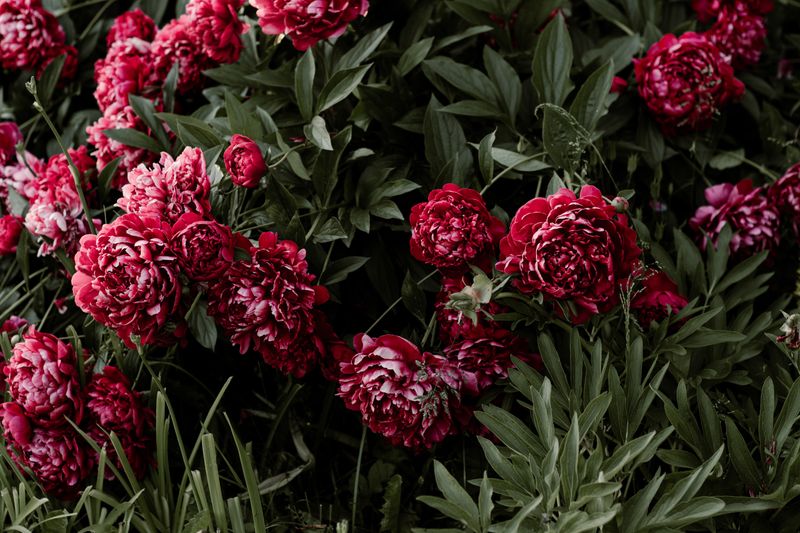
Red-flowered perennials form the backbone of a permanent garden design. Bee balm (Monarda didyma ‘Jacob Cline’) produces shaggy scarlet heads that hummingbirds adore, blooming June through August in Zones 4–9. Peonies offer breathtaking red blooms in late spring — ‘Red Charm’ and ‘Karl Rosenfield’ are reliable cultivars with large double flowers.
Other dependable red perennials include crocosmia ‘Lucifer’ (fiery red sprays, Zones 5–9), red hot poker (Kniphofia), hardy hibiscus ‘Lord Baltimore’, penstemon ‘Garnet’, and daylilies such as Hemerocallis ‘Scarlet Orbit’. Most red perennials prefer full sun and well-drained soil enriched with compost.
Red Bulbs, Corms, And Tubers
Bulbs provide some of the earliest and most dramatic red flowers of the year. Red tulips (Tulipa ‘Apeldoorn’, ‘Red Impression’, ‘Jan Reus’) bloom in April and May, producing classic goblet-shaped flowers on sturdy stems perfect for cutting. Plant them 15cm deep in autumn for reliable spring colour.
Dahlias are the undisputed stars of late-summer red flowers. ‘Bishop of Llandaff’ combines scarlet semi-double flowers with dark bronze foliage — stunning in both garden and vase. Gladioli offer tall, stately spikes ideal for dramatic bouquets, while ranunculus (Ranunculus asiaticus) produce exquisite layered blooms in cooler climates. Lilies such as Lilium ‘Monte Negro’ add fragrance and height.
Red Flowering Shrubs And Climbers
For permanent garden structure, red-flowered shrubs and climbers are unbeatable. Climbing roses such as ‘Don Juan’ and ‘Dublin Bay’ cover walls and arches with repeat-flowering red blooms from June to October. Bush roses like ‘Mister Lincoln’ (hybrid tea) and ‘Europeana’ (floribunda) provide classic red garden roses with outstanding fragrance.
Camellias offer glossy evergreen foliage with red blooms in winter and early spring — ideal for shaded positions. Red-flowered weigela, azaleas (in acidic soil), and bougainvillea (in frost-free climates) add seasonal drama. Red clematis varieties like ‘Niobe’ and ‘Rebecca’ provide vertical interest on fences and pergolas.
Red Flowers For Containers And Patio Pots
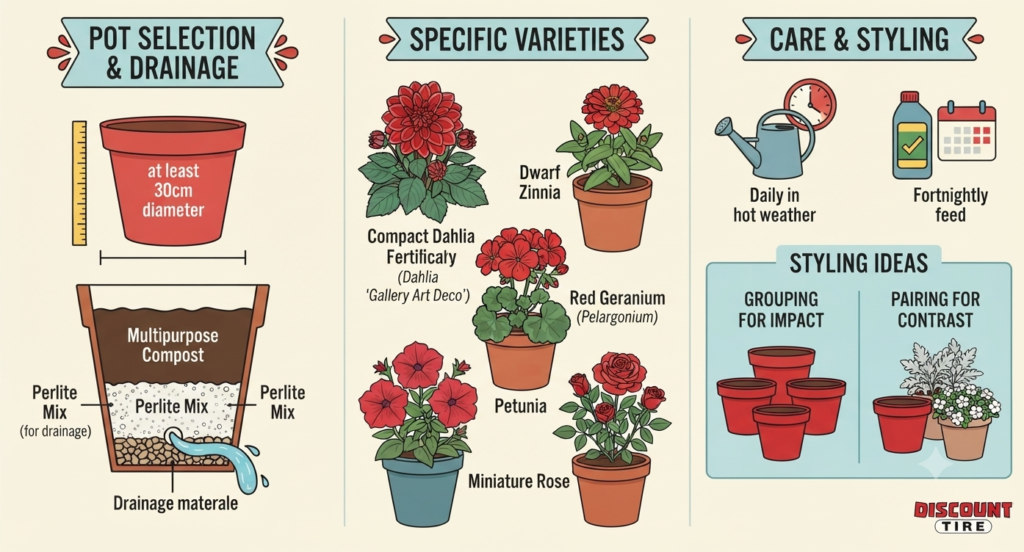
Containers allow gardeners in any space — balconies, patios, doorsteps — to enjoy bold red flowers. Compact dahlias (‘Gallery Art Deco’), dwarf zinnias, red geraniums (Pelargonium), petunias, and miniature roses all thrive in pots of at least 30cm diameter with good drainage.
Use multipurpose compost mixed with perlite for drainage, and feed fortnightly with a high-potash liquid fertiliser to maximise flowering. Water daily in hot weather — containers dry faster than borders. Group several red-flowered pots together for maximum impact, or pair with white or silver-foliage plants for contrast.
How To Design A Garden With Red Flowers
Red is a dominant colour that advances visually — use it strategically rather than scattering it randomly. Plant red flowers in drifts of at least 3–5 plants for cohesive impact. Place red at focal points: the end of a path, beside a gate, or against a dark hedge where the colour pops dramatically.
Best colours to pair with red flowers: white (classic, clean contrast), deep green foliage, silver or grey-leaved plants (artemisia, lamb’s ear), purple (rich and moody), and orange (hot, energetic schemes). Avoid placing red directly beside bright pink — the colours compete. Red and dark foliage (e.g., purple heuchera, bronze fennel) create sophisticated, contemporary borders.
How To Cut And Condition Red Flowers For Bouquets
Proper cutting and conditioning techniques can double the vase life of your red flowers. Follow these steps for professional-quality home bouquets:
- Harvest early morning or late evening when stems are fully hydrated and temperatures are cool
- Use sharp, clean secateurs and cut stems at a 45-degree angle to maximise water uptake
- Strip all foliage below the waterline to prevent bacterial growth
- Place stems immediately in a bucket of lukewarm water with floral preservative — let them hydrate for 2–4 hours before arranging
- Change vase water every 2 days, re-cut stems by 2cm each time, and keep bouquets away from direct sunlight and fruit bowls
Expected vase life: roses 7–12 days, dahlias 5–7 days, zinnias 7–10 days, gladioli 7–10 days, tulips 5–7 days, ranunculus 7–10 days. Celosia can last 2–3 weeks and also dries beautifully.
Pet Safety And Toxicity Considerations
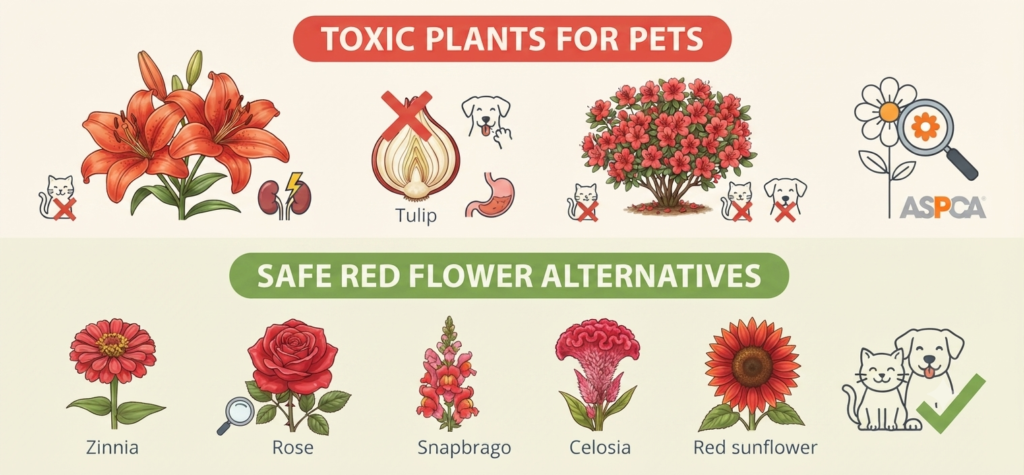
Some popular red flowers are toxic to cats and dogs. Lilies (all Lilium species) are extremely dangerous to cats — even small amounts of pollen can cause fatal kidney failure. Tulip bulbs contain toxins irritating to pets if ingested, and azaleas are poisonous to both cats and dogs. Always check the ASPCA Toxic Plant Database before planting if you have pets.
Pet-safe red flower alternatives include zinnias, roses (thorns aside), snapdragons, celosia, and sunflowers. Dahlias are considered mildly toxic but rarely cause serious harm. If you grow lilies, keep them in areas completely inaccessible to cats, or choose pet-safe alternatives for bouquets brought indoors.
Frequently Asked Questions About Red Flowers
What red flowers bloom all summer?
Zinnias, dahlias, salvia, celosia, and petunias bloom continuously from early summer to first frost when deadheaded regularly. Bee balm and repeat-flowering roses also provide months of red colour. For non-stop blooms, combine annuals (which flower continuously) with perennials (which bloom in waves).
Which red flowers grow in shade?
Most red flowers prefer full sun, but several tolerate partial shade (3–4 hours of sun): camellias, impatiens (red varieties), fuchsias, astilbe ‘Fanal’, begonias, and azaleas. In deep shade, options are limited — consider red-leaved foliage plants like heuchera ‘Fire Alarm’ for a red effect without relying on flowers.
Are red flowers good for attracting pollinators?
Yes — red flowers are especially attractive to hummingbirds, which see red more vividly than other colours. Bee balm, salvia, penstemon, fuchsia, and trumpet vine are top hummingbird plants. Bees also visit many red-flowered plants, particularly single-petalled varieties where pollen and nectar are accessible.
Which red flowers last longest in a vase?
Roses (7–12 days), celosia (14–21 days), carnations (14–21 days), alstroemeria (10–14 days), and chrysanthemums (14+ days) offer the longest vase life among red cut flowers. Proper conditioning — clean water, stem re-cutting, floral preservative — extends all cut flowers by several days.
Can I grow enough red flowers for regular bouquets?
Absolutely. A small cutting garden of 10–15 zinnia plants, 5–6 dahlia tubers, and a row of gladioli can produce a fresh bouquet every week from July through October. Choose ‘cut-and-come-again’ varieties that produce more stems when harvested — zinnias and cosmos are the best examples.
Will red flowers make my garden look too intense?
Not if you use red strategically. Balance red with white, cream, silver foliage, and plenty of green. Use red as an accent — 20–30% of your planting — rather than filling every bed. Deeper shades like burgundy and crimson feel more sophisticated than scarlet. Place red at focal points and let softer colours dominate surrounding areas.