How to recognize spotted lanternfly at every life stage, understand plant and nuisance risks, prevent accidental spread, and choose practical control methods without relying on one spray.
Quick Answer
Spotted lanternfly is an invasive planthopper that changes appearance dramatically as it develops: mud-like egg masses hatch into black-and-white nymphs, later nymphs turn red and black, and adults have gray spotted forewings with bright red hindwings visible in flight. The insect feeds on plant sap and can produce heavy honeydew and sooty mold. Control works best as an integrated program: inspect items before moving them, destroy reachable egg masses, use traps where practical, manage important hosts such as tree-of-heaven correctly, and use labeled insecticides only when plant risk or nuisance pressure justifies them.
| Key principle: Spotted lanternfly control is not one spray or one egg-scraping session. Use identification, spread prevention, mechanical control, host management and targeted treatment together. |
Spotted Lanternfly at a Glance
| Type | Invasive planthopper |
| Overwintering stage | Egg mass |
| Early nymph | Black with white spots |
| Late nymph | Red and black with white spots |
| Adult | Gray spotted forewings; red hindwings visible when open |
| Main high-risk crop | Grapevines |
| Preferred host | Tree-of-heaven is strongly associated with SLF |
| Main homeowner nuisance | Honeydew, sooty mold and large aggregations |
| Human danger | Does not bite or sting |
| Best management approach | IPM: stop spread + mechanical control + host management + targeted treatment |
What Is a Spotted Lanternfly?
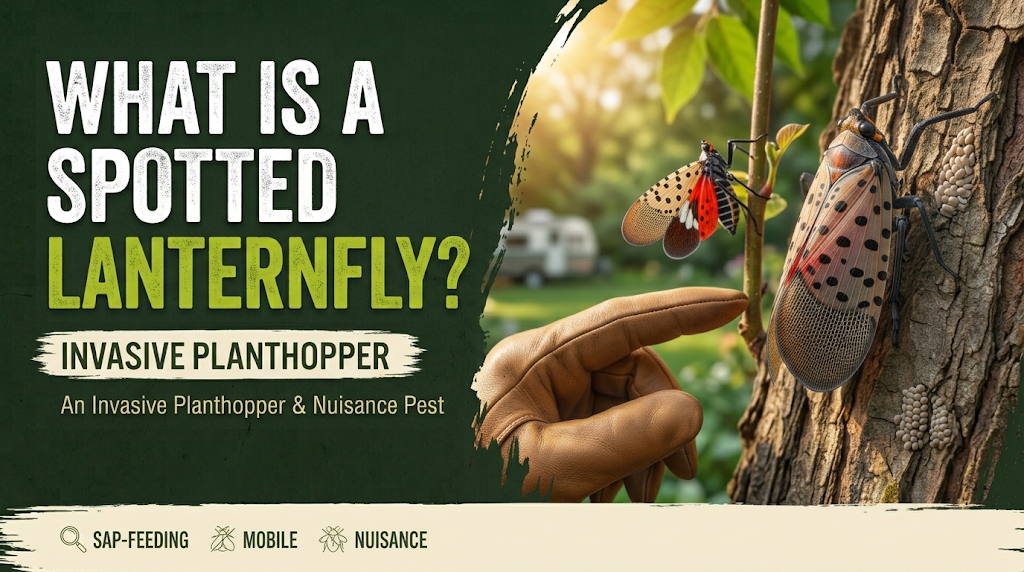
Spotted lanternfly (Lycorma delicatula) is an invasive planthopper that feeds by inserting piercing-sucking mouthparts into plant tissue and drawing sap. It is not a fly despite its common name. Its broad host range, association with tree-of-heaven, strong nuisance potential and ability to hitchhike on vehicles and outdoor objects make it unusually important compared with many ordinary garden insects.
For homeowners, the most useful way to think about the pest is not as a single ‘tree killer’ but as a mobile plant stressor and nuisance insect whose importance depends on the host plant, number of insects, life stage, plant condition and local population pressure.
How to Identify Every Life Stage
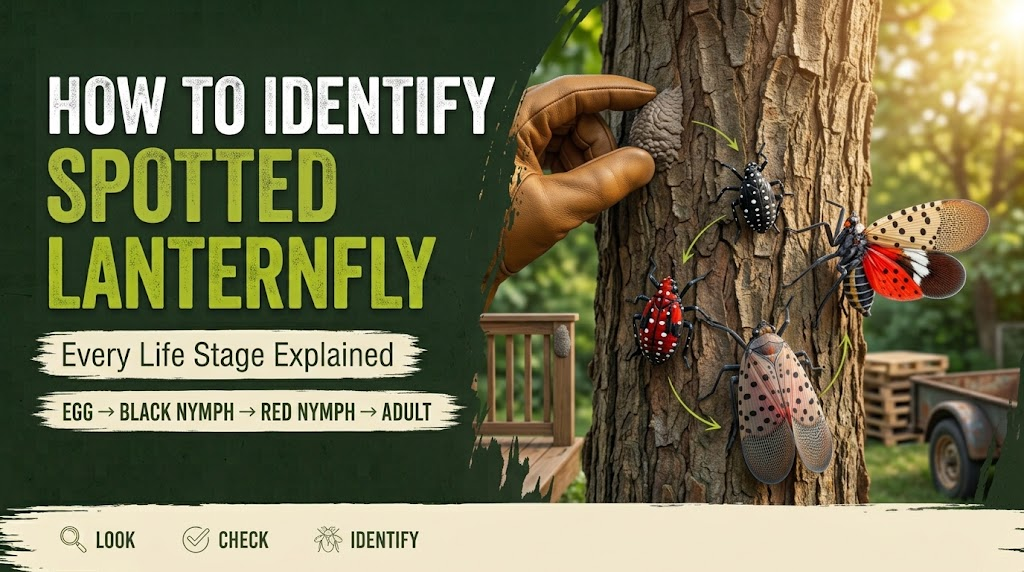
Egg Masses
Egg masses are the overwintering stage. Fresh masses may look like a gray-brown smear of dried mud or putty, while older masses become cracked and weathered. They are laid in rows beneath a protective coating on many surfaces, including tree trunks, rocks, decks, trailers, vehicles, outdoor furniture, pallets and equipment.
A single mass commonly contains dozens of eggs. Because females can place masses on non-plant objects, egg inspection is one of the most important ways to prevent the insect from being moved to a new area.
Black Early Nymphs
The first three nymphal stages are black with distinct white spots. They are wingless, small and strong jumpers. They may feed on many different plants rather than staying on one preferred host.
Red Late Nymphs
The fourth nymphal stage is much easier to recognize: the body becomes red and black while the white spotting remains. Late nymphs are larger and often more conspicuous on tree trunks, vines and woody plants.
Adults
Adults are roughly an inch long. With the wings closed they appear gray to pinkish-gray with black spotting. When the wings open, bright red, black and white hindwing markings become visible. Adults jump readily and can fly, but they also spend considerable time walking and climbing on trunks and branches.
Spotted Lanternfly Life Cycle
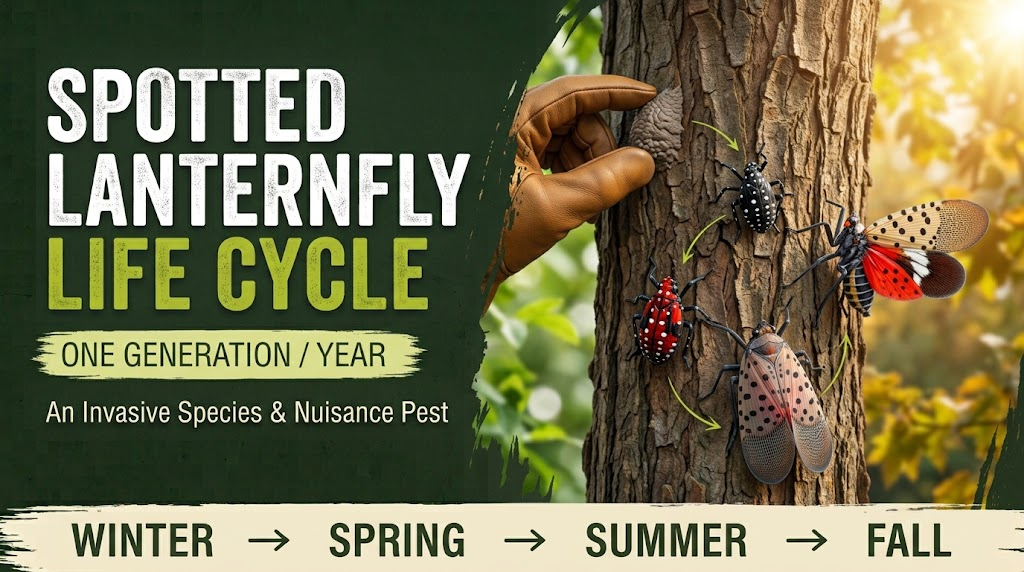
In regions where spotted lanternfly has been studied most intensively, it generally produces one generation per year. Egg masses survive winter, nymphs hatch in spring, nymphal stages progress through early and midsummer, adults appear later in the season, and females lay new egg masses in fall. Exact dates shift with latitude, temperature and local weather.
| Management timing should follow the life stage that is actually present, not a fixed national calendar. |
What Plants Do Spotted Lanternflies Attack?
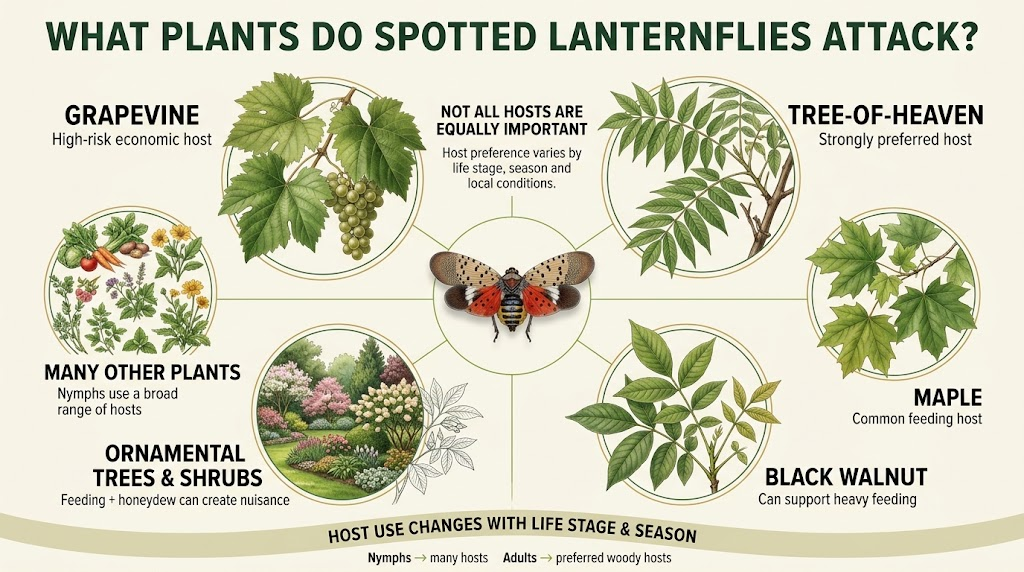
Spotted lanternfly can feed on many woody and herbaceous plants, but not all hosts are equally important. The insect’s preferred plants also change with life stage and season.
| Grapevines | One of the highest-risk economic hosts; heavy populations can weaken vines and reduce productivity. |
| Tree-of-heaven | Strongly preferred host and important in SLF ecology and management. |
| Maples | Common feeding hosts; established trees often experience stress/nuisance rather than direct mortality. |
| Black walnut | Can support heavy feeding; young or stressed plants may be more vulnerable. |
| Ornamental trees and shrubs | Feeding and honeydew may be significant even when plant survival is not threatened. |
| Many other plants | Nymphs especially can use a broad range of hosts; local host use changes through the season. |
What Does Spotted Lanternfly Damage Look Like?
Adults and nymphs feed on plant sap. Heavy feeding can contribute to reduced vigor, wilting, shoot stress and, on vulnerable hosts such as grapevines, more serious decline. On many established landscape trees, however, the most obvious homeowner problem is not tree death but the enormous amount of sticky honeydew produced by dense populations.
- Large groups of nymphs or adults feeding on stems, trunks or vines
- Sticky honeydew coating leaves and objects beneath infested plants
- Black sooty mold growing on honeydew-coated surfaces
- Ants, wasps or other insects attracted to sugary deposits
- Reduced vigor or wilt in heavily stressed plants
- Branch dieback or decline where high pressure combines with other stresses
Can Spotted Lanternflies Kill Trees?
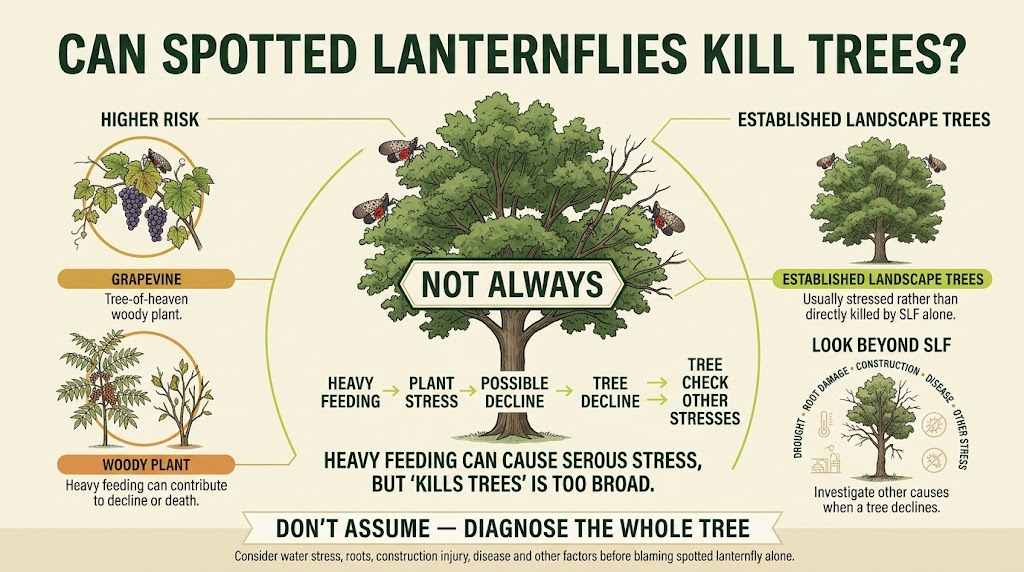
They can seriously stress certain plants, but the statement ‘spotted lanternflies kill trees’ is too broad. Heavy feeding has been associated with death or serious decline of grapevines, tree-of-heaven and some young or stressed woody hosts. Most established landscape trees are not known to be killed directly by spotted lanternfly alone.
If an infested tree is declining, investigate drought, root damage, construction injury, disease and other stresses rather than assuming spotted lanternfly is the only cause.
Why Is Everything Under the Tree Sticky?
The sticky material is honeydew, a sugary waste produced as spotted lanternflies process large quantities of plant sap. Honeydew can drip onto patios, decks, cars, outdoor furniture and understory plants. Black sooty mold fungi grow on this sugar-rich coating, creating dark staining that can make an infestation look even more severe.
Honeydew can also attract ants, yellowjackets and other insects. In residential landscapes this nuisance can be a valid reason to manage a dense infestation even if the host tree itself is not in immediate danger.
How Spotted Lanternflies Spread
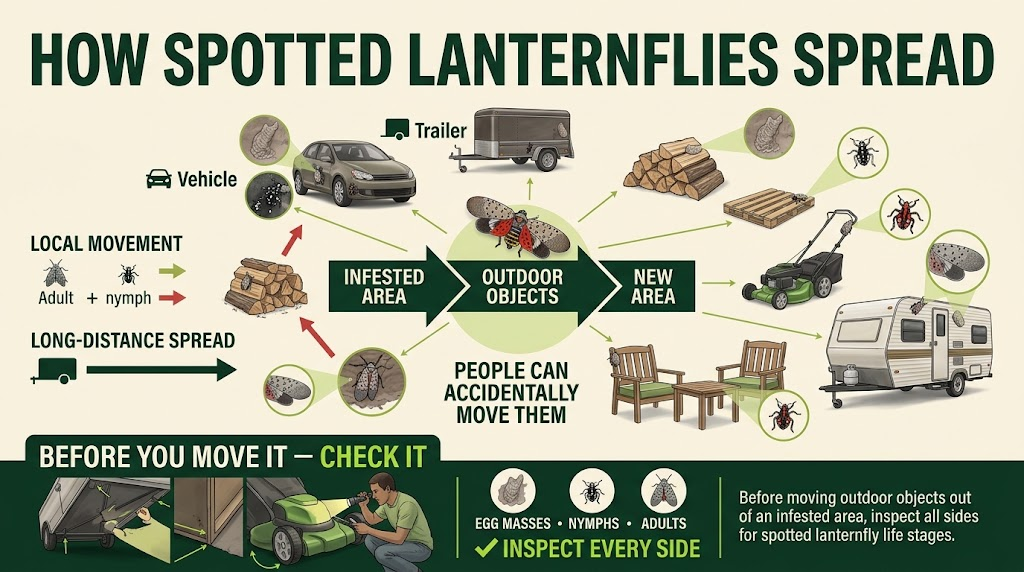
Spotted lanternfly is a highly effective hitchhiker. Adults and nymphs can move locally, but long-distance spread often occurs when people move egg masses or insects on vehicles, trailers, firewood, pallets, lawn equipment, outdoor furniture, campers and other objects stored outside.
| Stop-the-spread rule: Before moving outdoor objects out of an infested area, inspect every side for egg masses, nymphs and adults. |
Stop-the-Spread Checklist
- Vehicles, wheel wells and trailers
- Campers and recreational equipment
- Firewood and cut logs
- Patio furniture and grills
- Lawn mowers and garden equipment
- Pallets, crates and building materials
- Stone, pots and outdoor containers
- Tarps, play equipment and items stored outside
If spotted lanternfly is new or not yet established in your area, photograph the insect and check your state Department of Agriculture or Extension reporting instructions before moving potentially infested material.
How to Find and Destroy Egg Masses
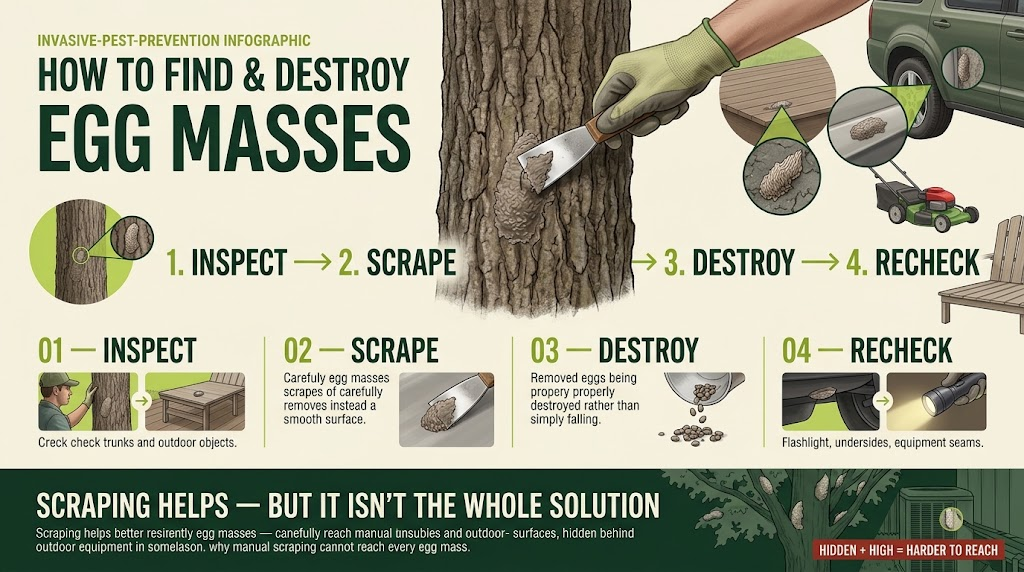
Scraping reachable egg masses is easy and worthwhile, especially on smooth surfaces, lower trunks, decks, vehicles and outdoor equipment. The goal is to destroy viable eggs rather than simply knock the mass onto the ground.
1. Inspect trunks and outdoor objects during the egg stage.
2. Use a firm scraper or similar tool to remove the mass.
3. Crush or otherwise destroy the eggs according to local Extension guidance.
4. Recheck hidden surfaces, undersides and equipment before movement.
| Egg scraping helps, but it cannot manage a large population by itself. Many egg masses are hidden or located high in tree canopies. |
Spotted Lanternfly Traps
Circle Traps
Circle traps intercept nymphs and adults as they walk upward on tree trunks. They can reduce insects on individual trees without coating the trunk in a broad sticky surface. Trap performance depends on placement, tree use and maintenance.
Sticky Bands
Sticky bands can catch climbing lanternflies, but uncovered adhesive can also capture birds, bats and beneficial insects. If sticky bands are used, they should include an appropriate wildlife barrier or guard and follow current Extension recommendations.
| Do not use bare, exposed sticky bands around tree trunks where wildlife can contact the adhesive. |
Tree-of-Heaven and Spotted Lanternfly
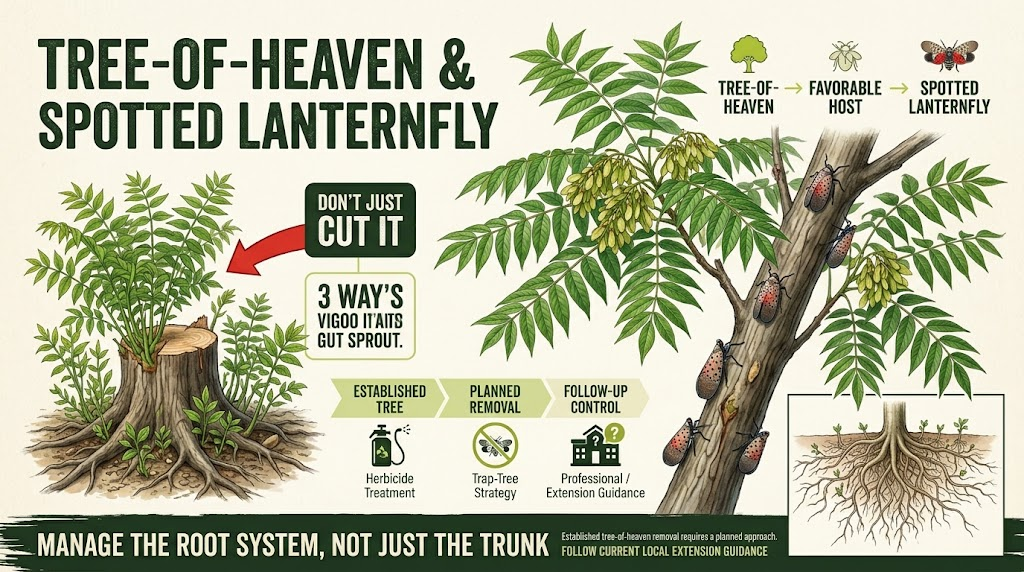
Tree-of-heaven (Ailanthus altissima) is an invasive tree strongly associated with spotted lanternfly. Managing it can be useful, but simply cutting the trunk is often a mistake because the root system may respond with vigorous stump sprouts and root suckers.
For established trees, effective removal usually requires a planned invasive-tree control approach. Large-scale tree-of-heaven removal, herbicide treatment or trap-tree strategies should follow current local Extension guidance rather than improvised cutting.
When Should You Treat Spotted Lanternflies?
There is no universal homeowner threshold such as ‘spray after 20 insects.’ Treatment is a decision based on the host plant, life stage, plant health, number of insects, nuisance level and whether the population is staying on a high-value or vulnerable host.
| Few insects, healthy landscape tree | Monitor; mechanical removal may be enough. |
| Reachable egg masses | Destroy them as part of prevention. |
| Heavy nuisance/honeydew on high-use area | Traps or targeted treatment may be reasonable. |
| Heavy pressure on grapevines or vulnerable host | More active management may be justified; use local crop guidance. |
| Insects moving through nonpreferred plant | Avoid automatic treatment; populations may shift naturally. |
Lower-Impact Control Options
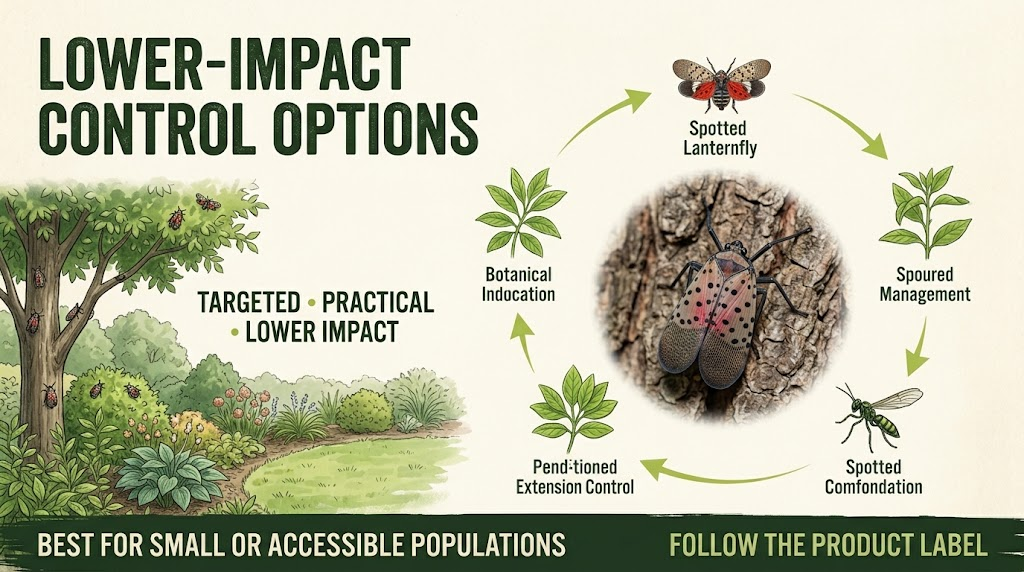
For small or accessible populations, physical and contact-based methods may reduce numbers without committing to a broad residual treatment.
- Hand removal or crushing where practical
- Reachable egg-mass destruction
- Circle traps on heavily used trunks
- Wildlife-protected sticky traps where appropriate
- Insecticidal soap or horticultural oil where the product is labeled for the site and pest
Soap and oil products generally work only when they directly contact the insect, so thorough coverage is important and residual activity is limited.
When Insecticides May Be Appropriate
Chemical treatment may be justified when populations are high, the host is vulnerable or high-value, mechanical control is impractical, or honeydew creates an unacceptable nuisance. Choose an EPA-registered product labeled for the treatment site and follow all directions.
- Use the least disruptive effective option.
- Do not exceed label rates or treatment frequency.
- Avoid unnecessary treatment of blooming plants.
- Protect pollinators and other non-target organisms.
- Prevent runoff into drains and surface water.
- Do not assume a product labeled for one ornamental site is legal for every crop or tree.
Systemic tree treatments and commercial vineyard programs can involve additional environmental and timing considerations and should not be improvised from generic internet advice.
Homemade Spotted Lanternfly Sprays to Avoid
Household mixtures are frequently promoted online, but homemade pesticide recipes can injure plants, harm pets or beneficial insects, provide inconsistent control, and may create legal problems when household substances are used as unregistered pesticides.
| Dish-soap mixtures | Household detergents are not the same as labeled insecticidal soap and may burn foliage. |
| Vinegar | Can injure plant tissue and is not a reliable landscape SLF program. |
| Salt mixtures | Can damage soil and plants. |
| Household oils | May cause phytotoxicity; use only registered horticultural products as labeled. |
| Garlic/chili/cayenne mixes | Inconsistent control and potential irritation. |
| Household cleaners | Not designed or labeled for pest control on plants. |
| Use labeled pest-control products and proven mechanical/IPM methods instead of homemade pesticide recipes. |
Do You Need to Report a Spotted Lanternfly?
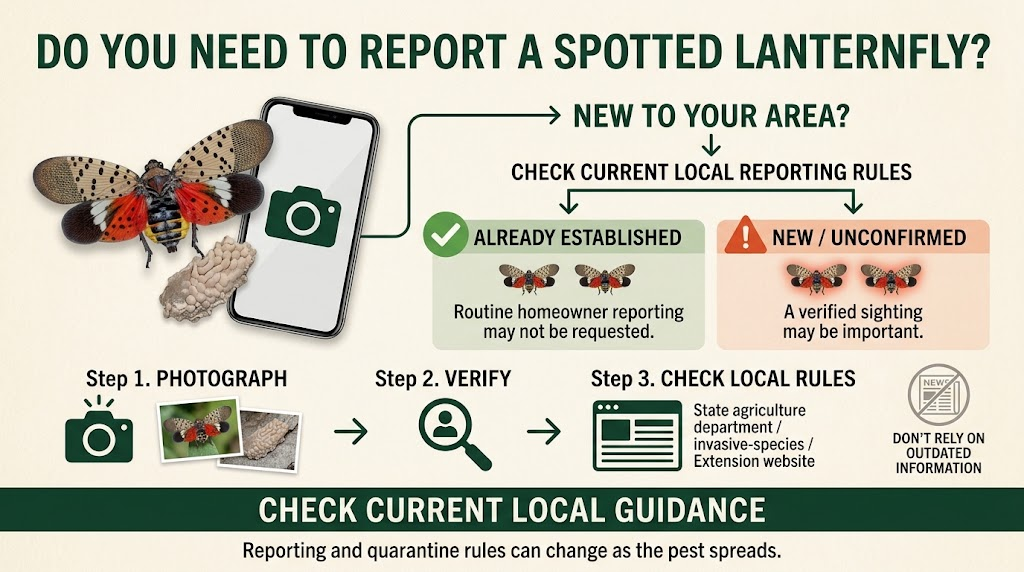
Reporting rules change as spotted lanternfly spreads. If the insect is already established in your area, routine homeowner reporting may not be requested. If it is new to your county or state, a verified sighting may be important.
Photograph the insect or egg mass and check the current website of your state Department of Agriculture, state invasive-species program or local Extension service. Do not rely on an old national article for current quarantine or reporting requirements.
Are Spotted Lanternflies Dangerous to People or Pets?
Spotted lanternflies do not bite or sting people. Their primary concerns are plant feeding, honeydew, sooty mold and invasive spread. Pets may investigate or eat insects, but the homeowner control priority is still to prevent unnecessary pesticide exposure and use products only as labeled.
Common Spotted Lanternfly Control Mistakes
| Mistake | Why It Matters | Better Approach |
| Treating every host automatically | Not every feeding event threatens the plant. | Evaluate host risk, plant health and pressure. |
| Relying on egg scraping alone | Many egg masses remain hidden or high in trees. | Combine egg removal with broader IPM. |
| Using bare sticky bands | Birds and beneficial insects can be trapped. | Use wildlife-protected designs. |
| Cutting tree-of-heaven only | Roots may produce vigorous suckers. | Use a planned invasive-tree control method. |
| Using vinegar or household soap | Can injure plants and provide inconsistent control. | Use labeled products. |
| Spraying open blooms unnecessarily | Pollinators can be exposed. | Avoid bloom treatment unless label and need justify it. |
| Ignoring vehicles and equipment | Eggs can hitchhike long distances. | Inspect before movement. |
| Assuming all tree decline is SLF | Other stresses may be the real cause. | Diagnose the whole plant. |
Frequently Asked Questions
What is a spotted lanternfly?
It is an invasive planthopper that feeds on plant sap. It is known for its changing life stages, large aggregations, honeydew production and ability to hitchhike on outdoor objects.
What do spotted lanternfly eggs look like?
Fresh masses often resemble gray-brown mud or putty spread over rows of eggs. Older masses become dry, cracked and weathered.
When do spotted lanternflies hatch?
Eggs generally hatch in spring, but exact timing varies with geography and weather. Use local Extension timing for your area.
What plants do spotted lanternflies eat?
They use many hosts. Grapevines are particularly vulnerable, while tree-of-heaven is a strongly preferred host. Maples, walnuts and many ornamentals may also be used.
Do spotted lanternflies kill trees?
They can seriously stress some hosts, especially grapevines and certain young or stressed plants, but they are not known to directly kill most established landscape trees by themselves.
Why is the area under my tree sticky?
Feeding lanternflies excrete sugary honeydew. Sooty mold can then grow on the sticky coating.
How do I kill spotted lanternfly eggs?
Destroy reachable egg masses according to local Extension guidance, but remember that egg removal alone will not eliminate a large population.