Learn how to identify centipedes, understand whether they pose a real threat, and choose the least-disruptive control method for your home and garden.
Key Takeaways
- Most house centipedes are beneficial predators that eat spiders, cockroaches, and other pests.
- Centipedes indicate a moisture problem — fix the dampness and they’ll leave on their own.
- Only large tropical species pose any real bite risk; common house centipedes are essentially harmless.
- Sealing entry points and reducing humidity is far more effective than chemical treatment.
What Are Centipedes?
Centipedes are elongated arthropods belonging to the class Chilopoda. Despite the name (“hundred legs”), most species have between 30 and 354 legs — always an odd number of pairs. They are predatory creatures that hunt insects, spiders, and other small invertebrates using venomous front claws called forcipules. Over 3,000 species exist worldwide, but only a handful regularly enter homes.
The most common indoor species is the house centipede (Scutigera coleoptrata) — a fast-moving, greyish-yellow creature with 15 pairs of long, banded legs. Outdoors you may encounter soil centipedes (Geophilomorpha) or stone centipedes (Lithobiomorpha) under rocks, mulch, and leaf litter. Understanding what you’re dealing with helps you decide whether any action is needed at all.
How to Identify Centipedes
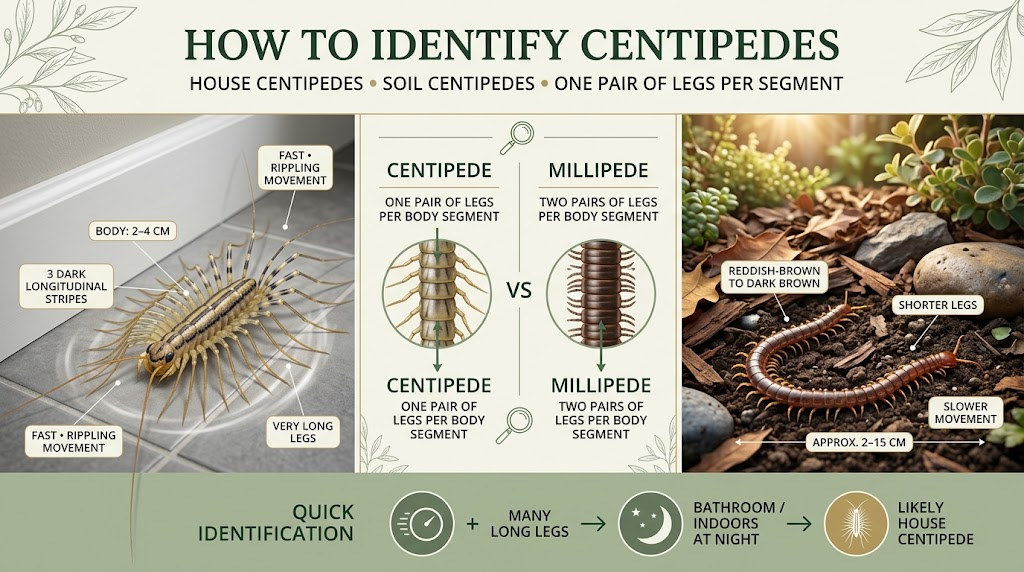
House centipedes are 2–4 cm long with a flattened, segmented body and extremely long legs that give them an overall span of 5–10 cm. Their legs progressively lengthen toward the rear, and they move in a distinctive rippling motion at surprising speed. Colouring is yellowish-grey with three dark longitudinal stripes. They have large compound eyes — unusual among centipedes — and long, sensitive antennae.
Soil centipedes found in the garden are typically reddish-brown to dark brown, shorter-legged, and slower. They range from 2 cm to 15 cm depending on species. All centipedes have one pair of legs per body segment (millipedes have two — this is the key distinguishing feature). If you see a fast-moving, many-legged creature darting across a bathroom floor at night, it’s almost certainly a house centipede.
Habitat & Why They Enter Homes
Centipedes require high humidity to survive — they lack the waxy cuticle that prevents water loss in insects. Outdoors they live under rocks, logs, leaf litter, bark, and compost piles where moisture is constant. They are nocturnal and avoid light. Indoors, they gravitate toward basements, bathrooms, laundry rooms, crawl spaces, and any area with persistent dampness.
They enter homes through foundation cracks, gaps around pipes, floor drains without water traps, and poorly sealed basement windows. Their presence indoors is almost always a sign of two things: excess moisture and a food source (other bugs). If you’re seeing centipedes regularly, it likely means you also have populations of the prey insects they’re hunting — silverfish, cockroaches, spiders, or carpet beetle larvae.
Are Centipedes Harmful?
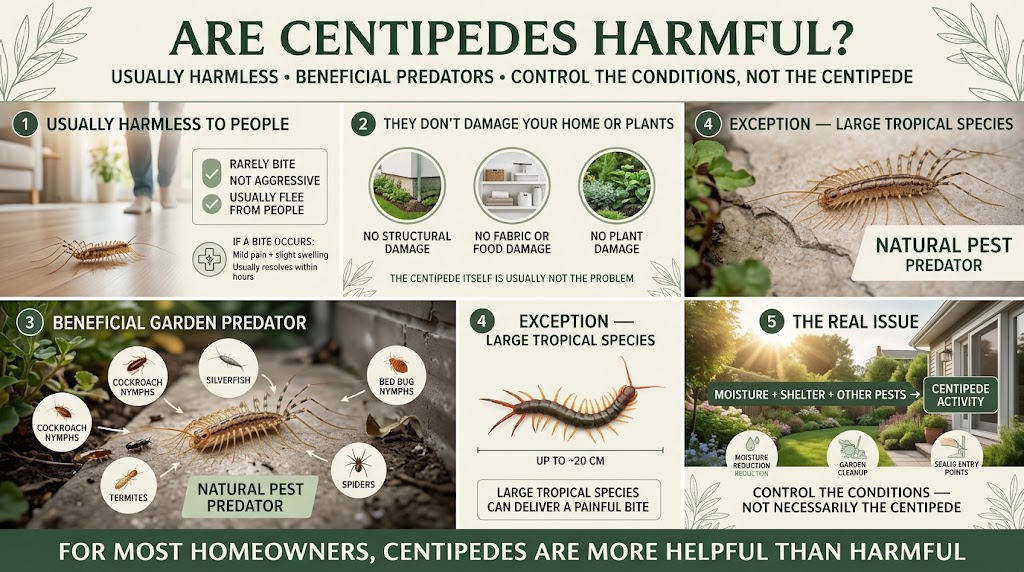
House centipedes can technically bite, but they rarely do and their forcipules often can’t penetrate human skin. If a bite does occur, it’s comparable to a mild bee sting — localised pain and slight swelling that resolves within hours. They are not aggressive and will flee rather than confront a person. They do not damage structures, fabrics, food, or plants.
In fact, house centipedes are considered beneficial because they prey on genuinely harmful pests like cockroach nymphs, silverfish, bed bug nymphs, termites, and spider populations. Larger tropical species (e.g., Scolopendra subspinipes, up to 20 cm) deliver a painful bite that may require medical attention, but these are not typical household invaders in temperate climates. For most homeowners, the centipede itself is not the problem — the conditions attracting it are.
Lookalikes: What Else Could It Be?
Millipedes are the most common confusion — they are rounder in cross-section, move slowly, curl into a spiral when disturbed, and have two pairs of legs per segment (centipedes have one). Millipedes feed on decaying plant matter and are harmless. Silverfish are wingless, silver-scaled insects that move quickly but have only six legs and two long tail filaments. Earwigs have pincers at the rear and six legs. If the creature has extremely long, delicate legs and moves in fast bursts across walls, it’s a house centipede.
Control Methods (Least-Disruptive First)

1. Reduce Moisture (Most Effective Long-Term)
Fix leaking pipes, improve bathroom ventilation with exhaust fans, and use a dehumidifier in basements or crawl spaces. Ensure downspouts direct water away from the foundation. Remove standing water in drip trays. Improving drainage around the home’s perimeter eliminates the conditions centipedes need to survive — without moisture, they simply cannot stay.
2. Exclude & Remove Prey
Seal cracks in the foundation, gaps around utility pipes, and spaces under doors with weatherstripping or caulk. Install fine mesh over floor drains. Remove their food source by addressing any underlying insect problems — treat for cockroaches or silverfish and the centipedes will leave once prey is gone. Clear leaf litter, mulch, and debris from directly against the house exterior.
3. Direct Removal & Targeted Treatment
For occasional sightings, simply relocate the centipede outdoors with a jar and card — they’re beneficial predators. Sticky traps placed along baseboards in damp rooms help monitor and reduce numbers. If infestations are persistent despite moisture control, a residual insecticide (cyfluthrin or lambda-cyhalothrin) can be applied along baseboards and entry points. Diatomaceous earth in cracks and voids is a low-toxicity alternative. Chemical treatment alone without fixing moisture will not solve the problem long-term.
Prevention
Keep indoor humidity below 60% year-round using ventilation and dehumidifiers. Store firewood away from the house and elevate it off the ground. Maintain a 30 cm gravel or bare-soil perimeter around the foundation — avoid mulch touching walls. Repair cracks in concrete foundations and seal all utility entry points. Keep gutters clean and functional. In the garden, reduce heavy mulch layers to 5 cm maximum and turn compost regularly. Regular vacuuming of basements and storage areas removes both centipedes and their prey insects.
When to Call a Professional

Contact a licensed pest controller if: you see centipedes daily despite reducing moisture and sealing entry points; you’ve identified a large species (over 10 cm) and aren’t sure if it’s medically significant; there’s an underlying cockroach, termite, or silverfish infestation you can’t manage alone; or the centipedes are appearing in bedrooms or living spaces where young children or anxious household members are distressed. A professional can identify the species, assess the moisture source, and apply targeted treatments safely.
Frequently Asked Questions
Are house centipedes dangerous to pets?
No. House centipedes are not toxic to cats or dogs. A pet that eats one may experience brief drooling or mild stomach upset, but there’s no poisoning risk. The centipede’s venom is designed for tiny prey and is far too weak to affect a mammal of any size.
Why do I only see centipedes at night?
Centipedes are strictly nocturnal. They hide in dark, humid crevices during the day and emerge at night to hunt. If you’re seeing them during daylight, it usually means the population is large enough that competition forces some individuals into the open, or their hiding spots have been disturbed.
Will centipedes damage my garden plants?
No. Centipedes are exclusively predatory — they do not eat plant material. Their presence in the garden is actually beneficial because they consume slugs, insect larvae, and other genuine plant pests. There is no reason to control centipedes in outdoor garden settings unless they’re entering the home.
How long do centipedes live?
House centipedes can live 3–7 years, which is unusually long for arthropods their size. They mature slowly, moulting repeatedly over 2–3 years before reaching adult size. This longevity means a single centipede you see may have been living in your home for years — but it also means the population grows slowly compared to insects.