
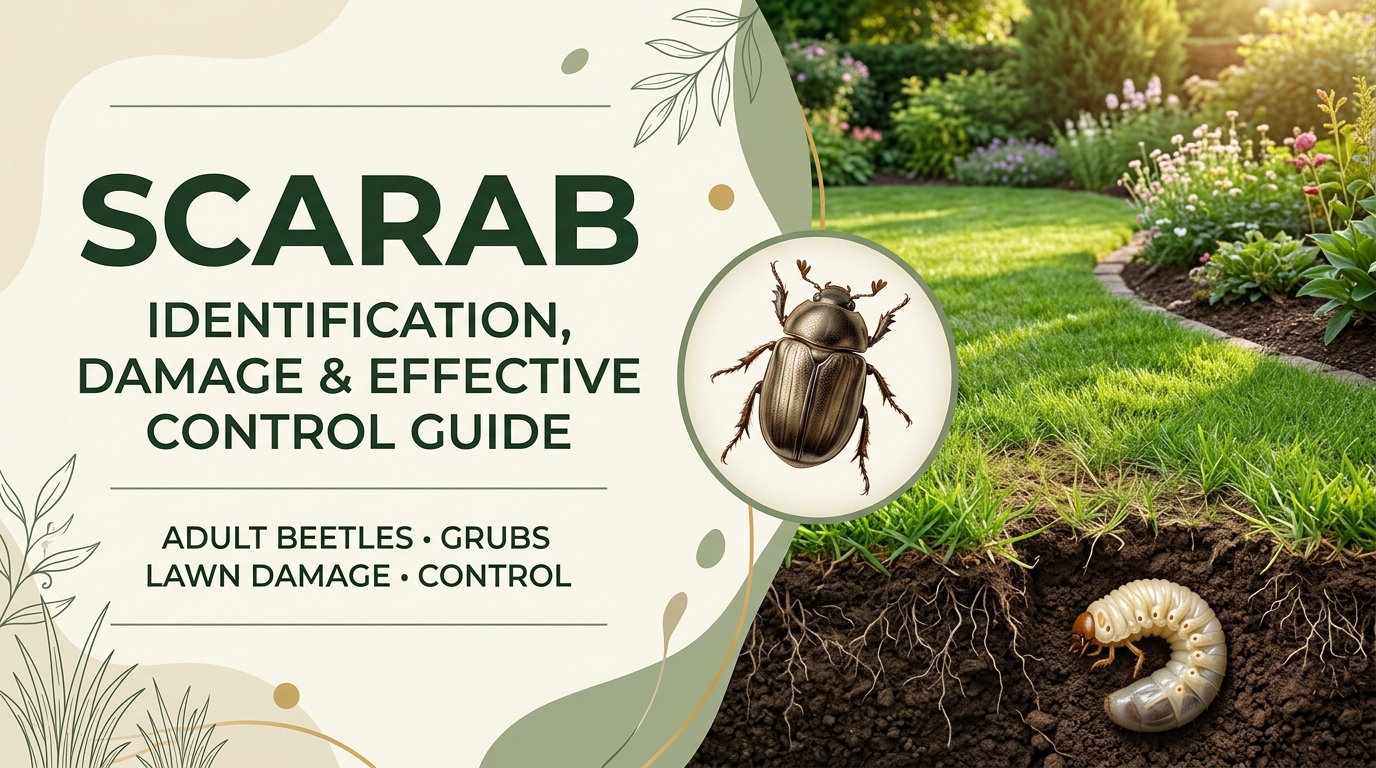

Learn how to identify scarab beetles and their grubs, confirm whether they’re damaging your lawn or garden, and choose the right control method.
Key Takeaways
- Scarab beetle grubs (curl grubs) cause far more damage underground than the adult beetles do above ground.
- Brown patches of lawn that peel back like carpet are the classic sign of a grub infestation.
- Not all scarab species are pests — many are beneficial decomposers of dung and organic matter.
- Biological controls like beneficial nematodes are highly effective and avoid harming other soil life.
What Are Scarab Beetles?
Scarab beetles belong to the family Scarabaeidae, one of the largest beetle families with over 30,000 species worldwide. Common pest species in home gardens include Japanese beetles, June bugs (May beetles), chafers, and Christmas beetles. Adults are typically oval-shaped, 1–3 cm long, and many have a distinctive metallic sheen — iridescent greens, coppers, or browns. Their larvae, known as curl grubs or white grubs, are C-shaped, creamy-white with a brown head and six small legs near the front.
While many scarab species are harmless or even beneficial (dung beetles are scarabs that recycle organic waste), a handful of species cause significant damage to lawns, ornamental plants, and vegetable gardens. The key is identifying which species you’re dealing with before taking action — unnecessary treatment wastes money and can harm beneficial insects in your soil.
How to Identify Scarab Beetles
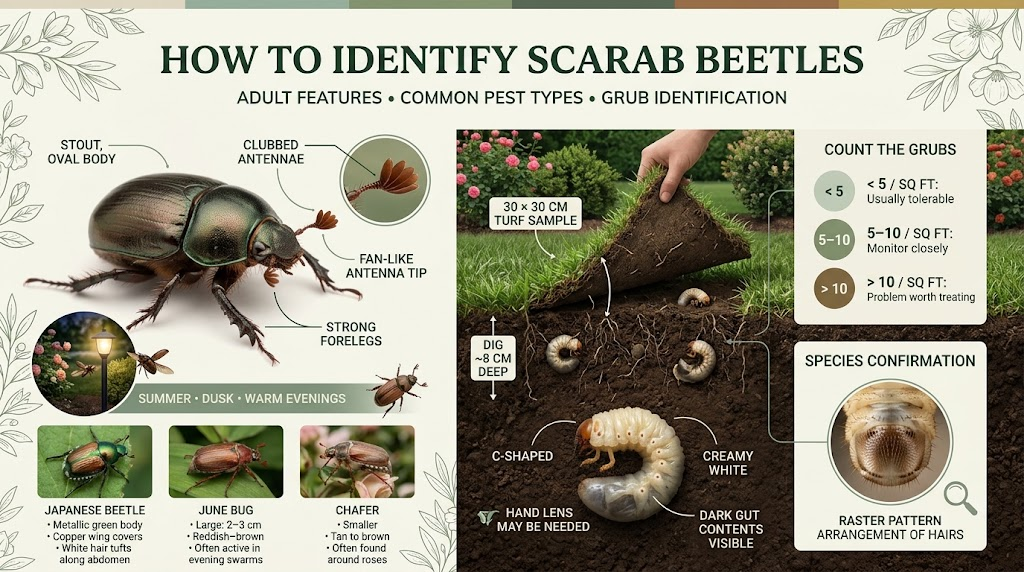
Adult scarab beetles share several features: a stout, oval body; clubbed antennae with fan-like plates at the tip (lamellate antennae); and strong forelegs often adapted for digging. Pest species are commonly seen flying clumsily around lights at dusk during summer. Japanese beetles are metallic green with copper wing covers and tufts of white hair along the abdomen. June bugs are large (2–3 cm), reddish-brown, and arrive in swarms on warm evenings. Chafers are smaller, tan to brown, and often found on roses.
To confirm grubs, dig a 30 cm × 30 cm section of turf about 8 cm deep in a damaged area. Curl grubs are unmistakable: plump, C-shaped, white with a translucent body showing the dark gut contents. Count what you find — fewer than 5 per square foot is usually tolerable; more than 10 indicates a problem worth treating. The grubs’ raster pattern (arrangement of hairs on the underside of the last abdominal segment) identifies the species, though this usually requires a hand lens.
Damage Signs
Grub damage to lawns appears as irregular brown patches that feel spongy underfoot. The turf rolls back easily like a loose carpet because the roots have been severed. You’ll often notice increased activity from birds, magpies, crows, or even bandicoots digging up the lawn to eat the grubs — secondary digging damage is often the first visible clue. Damage is worst in late summer to autumn when grubs are largest and feeding most heavily before pupation.
Adult beetles cause different damage depending on species. Japanese beetles skeletonise leaves — eating the soft tissue between veins, leaving a lace-like pattern. They attack roses, grapes, linden trees, and over 300 other plants. June bug adults rarely cause noticeable plant damage but are a nuisance around lights. Rose chafer adults feed on flower petals and soft fruit. In vegetable gardens, adult scarabs may chew on bean leaves, corn silks, and ripe stone fruit.
Lifecycle & Habitat
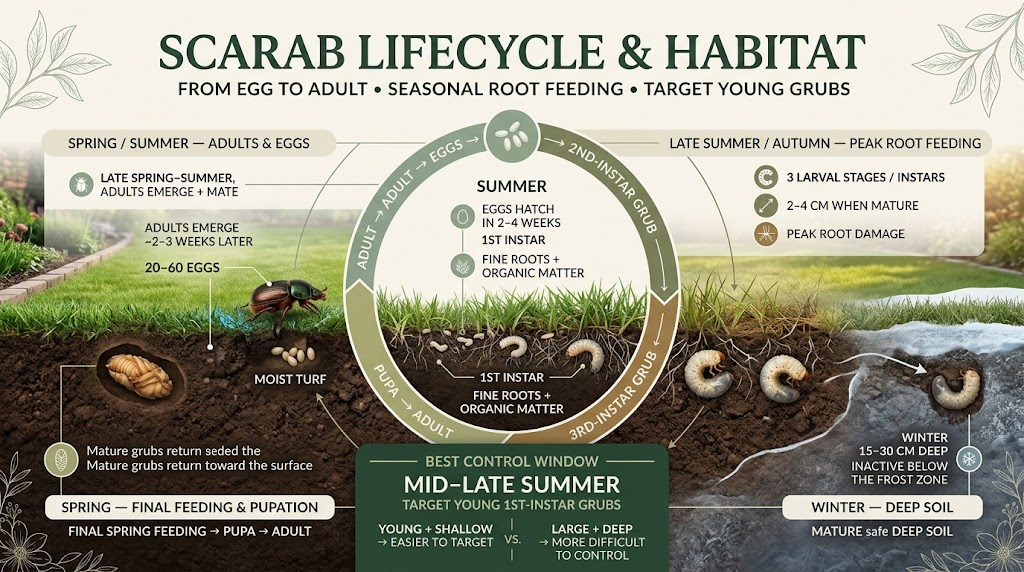
Most pest scarabs have a one-year lifecycle (some species take 2–3 years). Adults emerge in late spring or summer, mate, and females burrow into moist turf to lay 20–60 eggs. Eggs hatch in 2–4 weeks and the tiny grubs begin feeding on organic matter and fine roots. Through summer and autumn they moult through three larval stages (instars), growing larger and consuming progressively more root material. By late autumn, mature third-instar grubs are 2–4 cm long and causing peak damage.
As soil cools in winter, grubs move deeper (15–30 cm) to avoid frost, becoming inactive. In spring they return near the surface for a final feeding burst before pupating in an earthen cell. Adults emerge 2–3 weeks later and the cycle repeats. Timing control measures to target young first-instar grubs (mid to late summer) is far more effective than waiting until they are large and deep.
Host Plants & Targets
Grubs feed on roots of almost any turf grass — buffalo, couch, kikuyu, fescue, and rye are all susceptible. They also attack roots of strawberries, young vegetable seedlings, and ornamental ground covers. Adults vary by species: Japanese beetles prefer roses, grapes, linden, hibiscus, and stone fruit. Christmas beetles feed on eucalyptus leaves. June bugs target deciduous tree foliage but cause minimal damage. Chafers concentrate on rose petals, dahlias, and other soft-petalled flowers. Lawns with high organic matter and consistent irrigation are most attractive for egg-laying.
Lookalikes: What Else Could It Be?
Other lawn-damaging grubs include African black beetle larvae (also a scarab but requiring different timing), billbug larvae (legless, found in the thatch layer rather than soil), and sod webworm caterpillars (which feed on leaf blades at night, not roots). Armyworm caterpillars strip grass blades but leave roots intact — the lawn recovers quickly. If your brown patch doesn’t peel back easily, the problem may be fungal (dollar spot, brown patch disease) rather than grubs. For adult beetles: click beetles are narrower with a pointed body; ground beetles are fast-running predators found under objects and are beneficial.
Control Methods (Least-Disruptive First)

1. Biological Control (Recommended First Step)
Beneficial nematodes (Heterorhabditis bacteriophora) are microscopic worms that seek out and kill grubs in the soil. Apply them to moist lawn in the evening when soil temperature is above 14°C — typically late summer when grubs are small and near the surface. Water the lawn before and after application. Nematodes are safe for children, pets, birds, and earthworms. Milky spore disease (Paenibacillus popilliae) targets Japanese beetle grubs specifically and persists in soil for years, but takes 2–3 seasons to build up.
2. Cultural & Physical Methods
Reduce irrigation in summer during egg-laying — dry soil deters females from laying and desiccates eggs. Allow the lawn to go slightly dormant rather than keeping it lush and moist. For adult Japanese beetles, hand-pick into a bucket of soapy water in the early morning when they are sluggish. Avoid beetle traps (pheromone traps) — research consistently shows they attract more beetles to your yard than they catch. Encourage natural predators: birds, parasitic wasps (Tiphia), and ground beetles all consume grubs.
3. Chemical Control (When Thresholds Are Exceeded)
If grub counts exceed 10 per square foot and biological methods haven’t reduced numbers, targeted insecticides may be warranted. Chlorantraniliprole (applied preventively in early summer) is low-toxicity to bees and earthworms. Imidacloprid or trichlorfon can be applied curatively when grubs are actively feeding near the surface. Always water the product in immediately to move it into the root zone. Avoid broad-spectrum sprays on flowering plants — protect pollinators. Read and follow all label directions for your specific product and local regulations.
Prevention
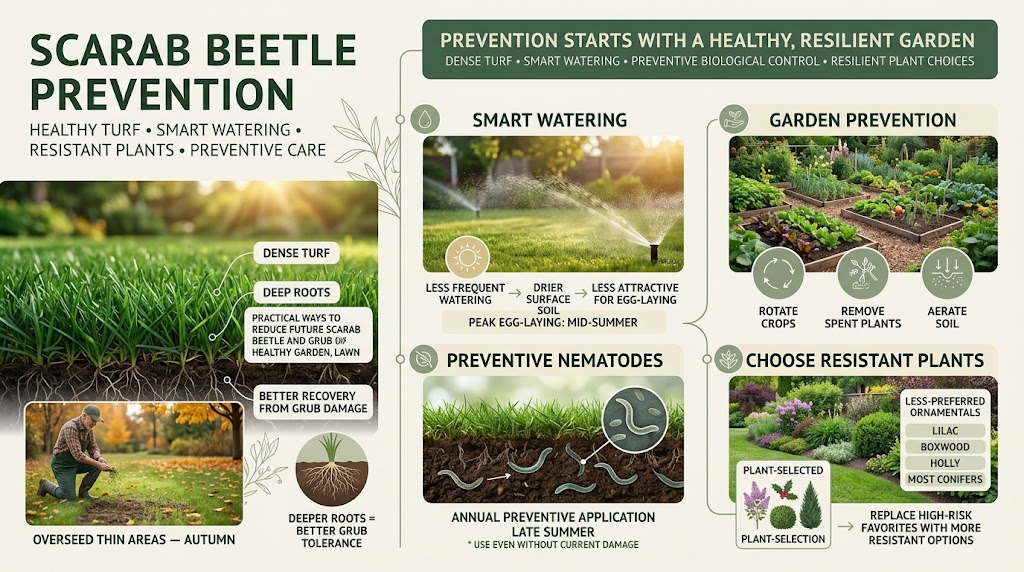
Maintain a healthy, dense lawn — thick turf outcompetes grub damage and recovers faster. Overseed thin areas in autumn. Reduce watering frequency during peak egg-laying months (mid-summer) to make your lawn less attractive for oviposition. Apply nematodes annually as a preventive in late summer even if you don’t see current damage. Choose grass varieties known for deeper root systems and better grub tolerance. For gardens, rotate crops, remove spent plants promptly, and keep soil aerated. If Japanese beetles are recurrent, consider replacing their favourite ornamentals with resistant varieties (lilac, boxwood, holly, and most conifers are rarely attacked).
When to Escalate
Contact a lawn care professional or licensed pest controller if: grub counts remain high after two seasons of biological treatment; large areas of lawn (more than 30%) are severely damaged and need re-establishment; secondary predator damage (birds, animals digging) is extensive; or you’re unsure of the grub species and need precise identification for targeted treatment. Your local agricultural extension service can identify grubs from photos or samples and recommend region-specific treatments and timing.
Frequently Asked Questions
Are scarab beetles harmful to humans or pets?
No. Adult scarab beetles do not bite, sting, or transmit diseases. They are harmless to handle. Pets that eat a few beetles may experience mild stomach upset but there is no toxicity risk. The grubs are similarly harmless to touch — they cannot bite effectively.
Do beetle traps work?
Pheromone and floral-lure traps attract beetles from a wide area — studies show they pull in more beetles than they catch, often increasing damage to nearby plants. They are more useful for monitoring population timing than for control. If you use one, place it far from the garden (at least 10 metres downwind) rather than among your plants.
When is the best time to treat for grubs?
The ideal window is mid to late summer, roughly 2–4 weeks after you notice adult beetles flying. At this stage grubs are small first-instar larvae feeding near the surface — they are most vulnerable to both nematodes and chemical treatments. Treating in autumn when grubs are large and deep is far less effective.
Will grubs kill my entire lawn?
Healthy, well-established lawns can tolerate 5–8 grubs per square foot without visible damage because the root system is robust enough to compensate. Thin, stressed, or newly laid turf is more vulnerable. If you address the infestation within the same season and reseed bare patches, the lawn typically recovers fully by the following spring.