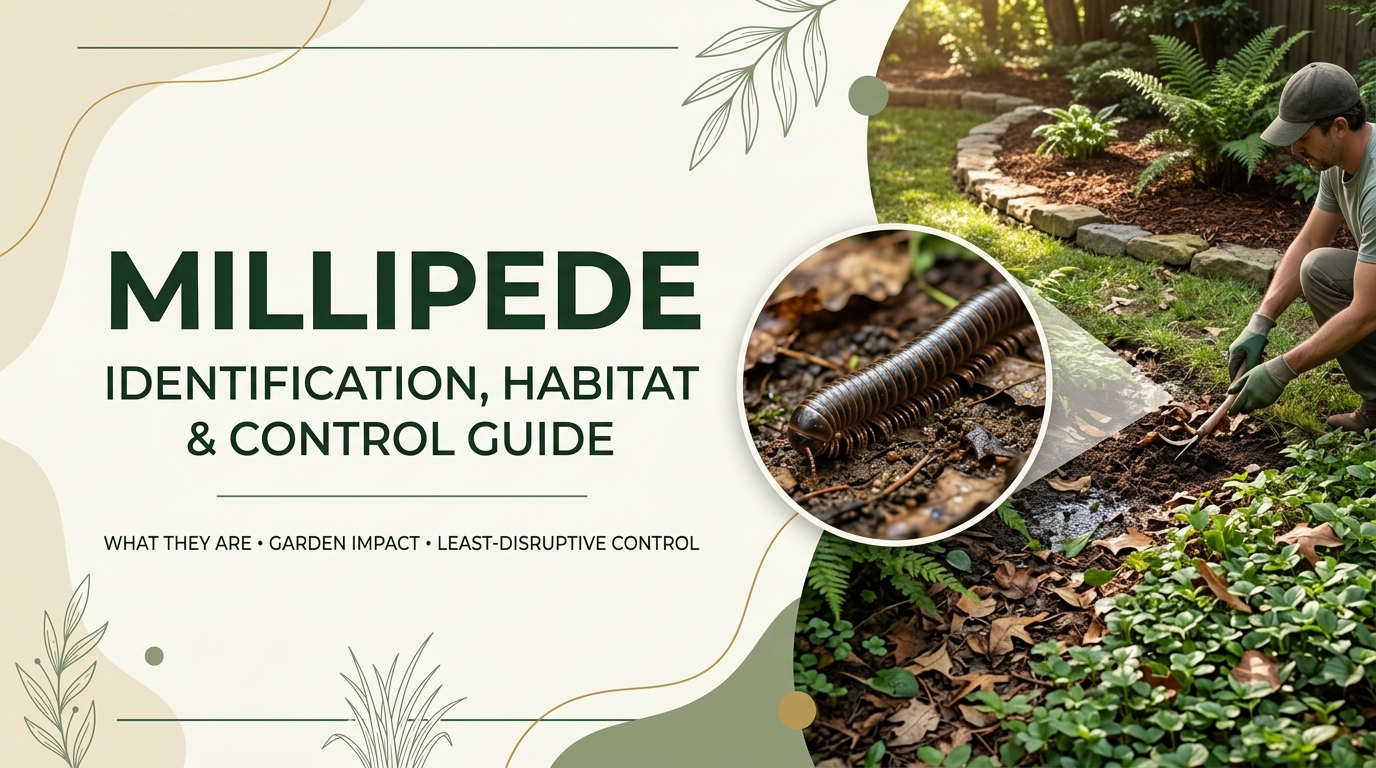

Learn what millipedes really are, whether they harm your garden, and how to control them without unnecessary treatment.
Key Takeaways
- Millipedes are mostly harmless decomposers — they rarely damage healthy plants.
- They curl into a coil when disturbed and have two pairs of legs per body segment.
- Large numbers indoors usually signal excess moisture around your home’s foundation.
- Reducing moisture and removing organic debris is the most effective long-term control.
What Are Millipedes?
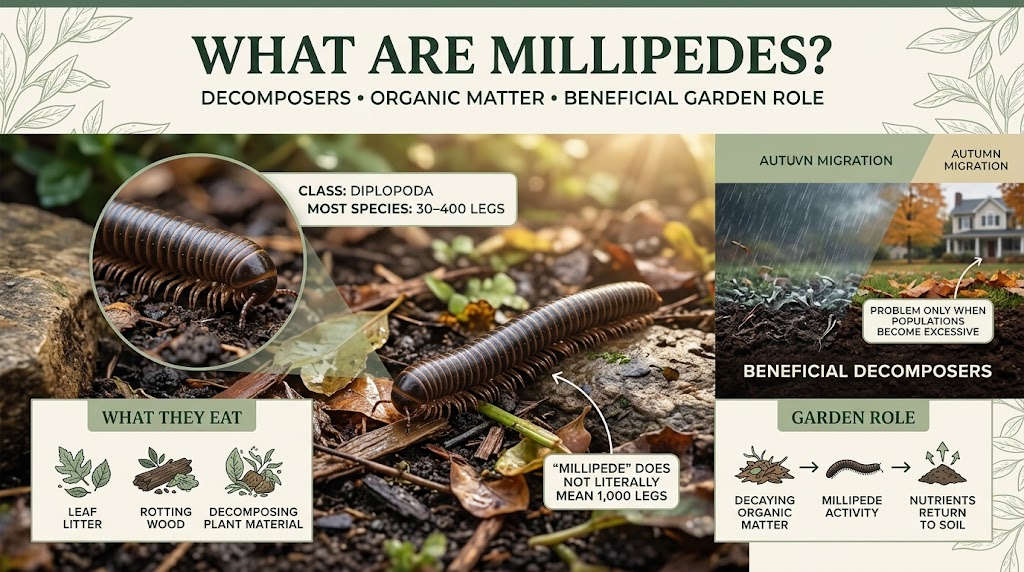
Millipedes are elongated arthropods belonging to the class Diplopoda. Despite their name (which means ‘thousand feet’), most species have between 30 and 400 legs. They are detritivores — meaning they feed primarily on decaying organic matter such as leaf litter, rotting wood, and decomposing plant material. In your garden, they actually play a beneficial role by breaking down organic matter and returning nutrients to the soil.
Problems arise when millipede populations explode — often after heavy rain or during autumn migrations — and they invade homes or occasionally feed on soft seedlings and strawberries at ground level. Understanding the difference between a helpful decomposer and a genuine pest situation will save you time, money, and unnecessary chemical use.
How to Identify Millipedes
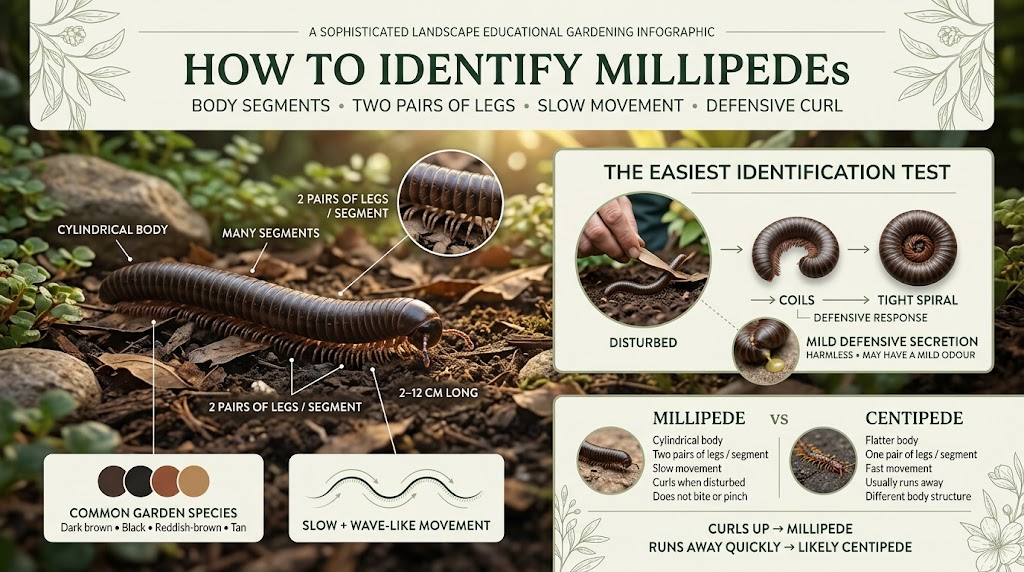
Millipedes have a cylindrical, worm-like body made up of many segments. Each body segment (except the first few behind the head) carries two pairs of legs. They range from 2 cm to 12 cm in length depending on species. Common garden species are dark brown to black, though some are reddish-brown or tan. Their movement is slow and wave-like — legs ripple in sequence from back to front.
The easiest identification test: gently touch or disturb the creature. Millipedes curl into a tight spiral or coil as a defensive response. They do not bite or pinch. Some species emit a mild, unpleasant odour or yellowish fluid when handled — this is a harmless defensive secretion. If the creature runs away quickly instead of curling, you likely have a centipede (see Lookalikes).
Do Millipedes Cause Damage?
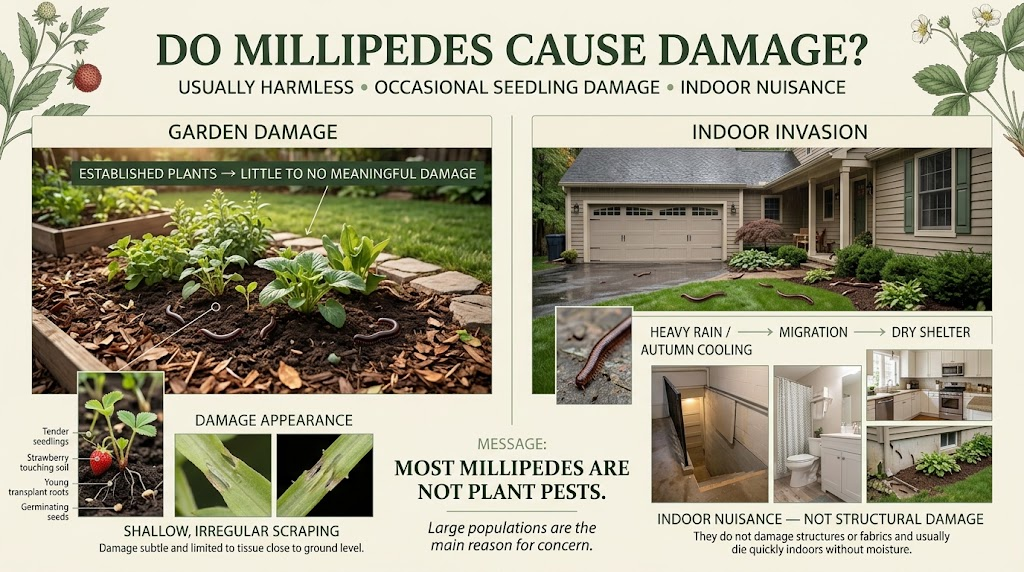
In most situations, millipedes cause no meaningful damage to established plants. They prefer dead and decaying material. However, in large numbers or when their preferred food is scarce, they may nibble on soft seedlings, strawberry fruits touching the soil, root tips of young transplants, and germinating seeds. Damage typically appears as shallow, irregular scraping on tender tissue close to ground level.
The bigger nuisance for homeowners is mass indoor invasion. After heavy rainfall saturates the soil, or in autumn when temperatures drop, millipedes migrate in large numbers seeking drier shelter — often ending up in garages, basements, bathrooms, and kitchens. They don’t damage structures or fabrics and they die quickly indoors from lack of moisture, but their sheer numbers can be alarming.
Lifecycle & Habitat
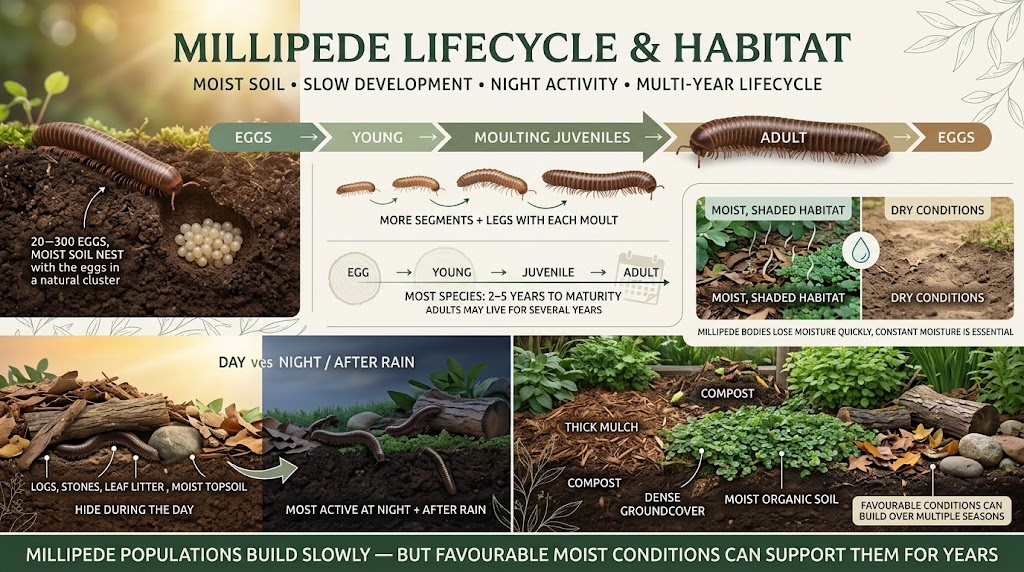
Millipedes lay clusters of 20–300 eggs in moist soil, often in small excavated nests. Eggs hatch in a few weeks and the young emerge with only a few body segments and leg pairs, adding more with each moult. Most species take 2–5 years to reach maturity and can live for several years as adults. This slow development means population booms are usually the result of favourable conditions building over multiple seasons.
They require constant moisture — their exoskeleton lacks the waxy waterproof layer that insects have, so they dehydrate quickly in dry conditions. During the day, they shelter under mulch, logs, stones, leaf litter, and in the top layer of moist soil. They are most active at night or after rain. Gardens with thick mulch layers, compost piles, and dense ground cover provide ideal habitat.
Where You’ll Find Them

Outdoors: under mulch, leaf litter, logs, stones, compost heaps, dense ground-cover plants, and in garden beds with heavy organic matter. They favour shaded, consistently moist areas. Indoors: ground-floor rooms, basements, garages, laundry rooms, and bathrooms — anywhere close to exterior walls with ground contact. Check under door thresholds, around weep holes, and where plumbing enters the building.
Lookalikes: What Else Could It Be?
Centipedes are the most common confusion. They are flattened (not cylindrical), have one pair of legs per segment, move very fast, and are predators that eat insects — generally beneficial. Centipedes do not curl into a coil. Wireworms (click beetle larvae) are small, shiny, segmented, and found in soil attacking roots — they lack visible legs along their body. Earthworms have no legs at all and a smooth, segmented body. Slaters (woodlice/pill bugs) curl into a ball like millipedes but are grey, oval, and crustaceans with 14 legs.
Control Methods (Least-Disruptive First)

1. Reduce Moisture & Harbourage (First Priority)
Pull mulch back at least 15 cm from your house foundation. Fix leaking taps, downpipes, and irrigation near walls. Improve drainage around the building. Remove piles of leaf litter, logs, and stones close to entry points. Allow garden beds near the house to dry out between watering. This alone will dramatically reduce millipede numbers over a few weeks.
2. Physical Barriers & Trapping
Seal gaps under doors with weather stripping and block weep holes with mesh screens. A band of diatomaceous earth (DE) along the foundation and in doorways dehydrates millipedes that cross it. Smooth, dry surfaces like gravel borders act as barriers they avoid. For mass invasions, a shallow tray of soapy water placed near entry points overnight will trap dozens.
3. Chemical Control (Severe Infestations Only)
If habitat modification hasn’t resolved the problem after 2–3 weeks, a residual insecticide (bifenthrin or permethrin) applied as a perimeter band around the house foundation can provide a knockdown barrier. Apply in late afternoon when millipedes begin moving. Iron-phosphate-based snail baits are also mildly effective. Avoid broad-spectrum sprays in garden beds — millipedes are beneficial decomposers and killing them all can disrupt soil health.
Prevention
Keep mulch layers thin (under 5 cm) and pull them back from the house. Water gardens in the morning so soil dries by evening. Store firewood off the ground and away from walls. Clear leaf litter regularly in autumn. Ensure gutters and downpipes direct water away from the foundation. In the vegetable patch, raise seedlings in trays and transplant once stems have hardened — millipedes target soft, newly germinated growth at soil level. Use raised beds or pot feet to reduce contact with damp ground.
When to Escalate

If hundreds of millipedes are entering your home nightly despite habitat reduction and barrier measures, contact a licensed pest controller for a professional perimeter treatment. In agricultural settings where millipedes are damaging seedling crops at scale, consult your local agricultural extension service for species-specific advice and registered chemical options. Remember: occasional millipedes indoors are not a sign of infestation — they simply wandered in and will die within a day or two without moisture.
Frequently Asked Questions
Are millipedes dangerous to humans or pets?
No. Millipedes do not bite, sting, or transmit diseases. Some large species secrete a mildly irritating fluid that can stain skin or cause minor irritation if rubbed in eyes — simply wash with soap and water. They are not toxic to dogs or cats, though eating many may cause mild stomach upset.
Why are there suddenly so many millipedes?
Mass appearances are usually triggered by heavy or prolonged rain saturating the soil and forcing millipedes to the surface, or by cooling autumn temperatures prompting migration to warmer, drier spots — like your house. Populations build quietly in mulch and leaf litter over years and only become visible during these trigger events.
Will millipedes damage my lawn?
Millipedes do not feed on living grass. They live in the thatch layer feeding on decomposing organic matter and are actually helping break it down. If you see them on your lawn after rain, they are migrating across it, not feeding on it.
Do I need to spray my entire garden?
No — and you shouldn’t. Millipedes are beneficial soil organisms. Spraying an entire garden kills them along with other helpful decomposers. Focus control efforts on entry points to your home and protect specific vulnerable seedlings with barriers or raised beds. Treat the cause (excess moisture and harbourage) rather than the symptom.