Everything you need to know about planting daffodil bulbs, caring for narcissus flowers, and creating a spring display that returns year after year.
Daffodils are among the most reliable and cheerful spring flowers you can grow. Whether you know them as daffodils, narcissus, or jonquils, these bulbs reward minimal effort with spectacular golden, white, and orange blooms that return faithfully year after year — often multiplying into larger clumps with every passing spring.
This guide covers everything a beginner needs: when to plant daffodil bulbs, how deep to set them, what care they need during and after flowering, and how to keep established clumps blooming strongly for decades. Whether you’re planting in borders, lawns, woodland edges, or containers, you’ll find practical, experience-based advice here.
Daffodil Care at a Glance
| Full sun to partial shade (6+ hours ideal) | Water in autumn after planting; minimal once established |
| Plant bulbs 3× their height deep (about 10–15 cm) | Well-drained soil — avoid waterlogged sites |
| Plant in autumn (September–November) | Blooms late winter to mid-spring |
Popular Daffodil Varieties
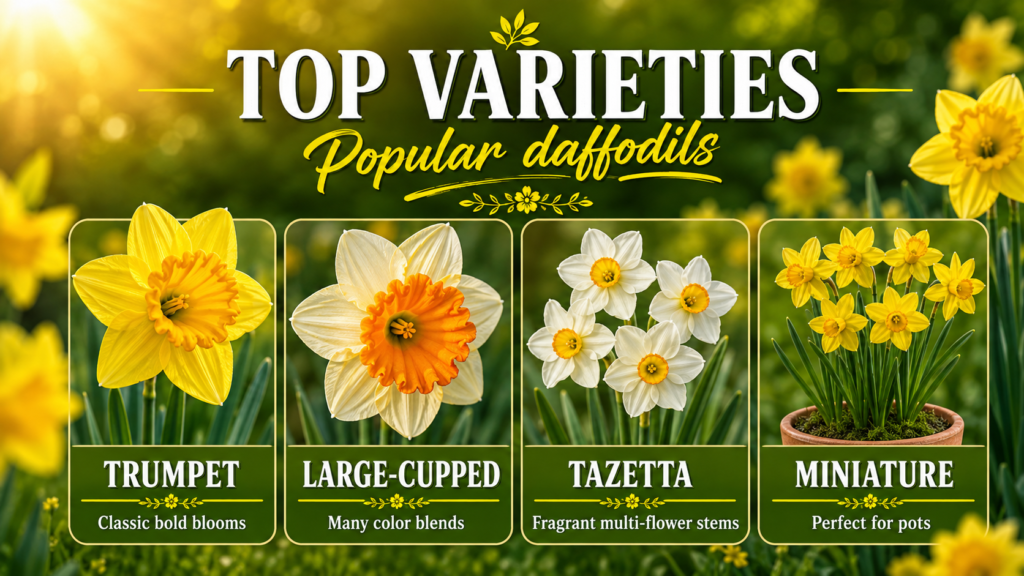
The term ‘daffodil’ covers the entire Narcissus genus — over 13,000 registered cultivars. Here are the main groups home gardeners love:
Trumpet Daffodils (e.g. ‘King Alfred’, ‘Dutch Master’)
The classic daffodil shape: one large flower per stem with a trumpet as long as or longer than the petals. Bold golden yellows and clean whites. Excellent for borders, naturalizing in lawns, and bouquets.
Large-Cupped Daffodils (e.g. ‘Ice Follies’, ‘Pink Charm’)
Versatile garden workhorses with a prominent cup that’s more than one-third the petal length. Available in stunning colour combinations including apricot, salmon-pink, and bicolours.
Tazetta Daffodils (e.g. ‘Paperwhite’, ‘Grand Soleil d’Or’)
Multiple sweetly fragrant flowers per stem. Better suited to milder climates or indoor forcing. Paperwhites are popular for growing indoors during winter without any chilling period.
Miniature Daffodils (e.g. ‘Tête-à-Tête’, ‘Jetfire’)
Compact varieties under 20 cm tall, perfect for containers, rock gardens, and front-of-border planting. ‘Tête-à-Tête’ is the UK’s best-selling daffodil — incredibly reliable and early-flowering.
When and How to Plant Daffodil Bulbs
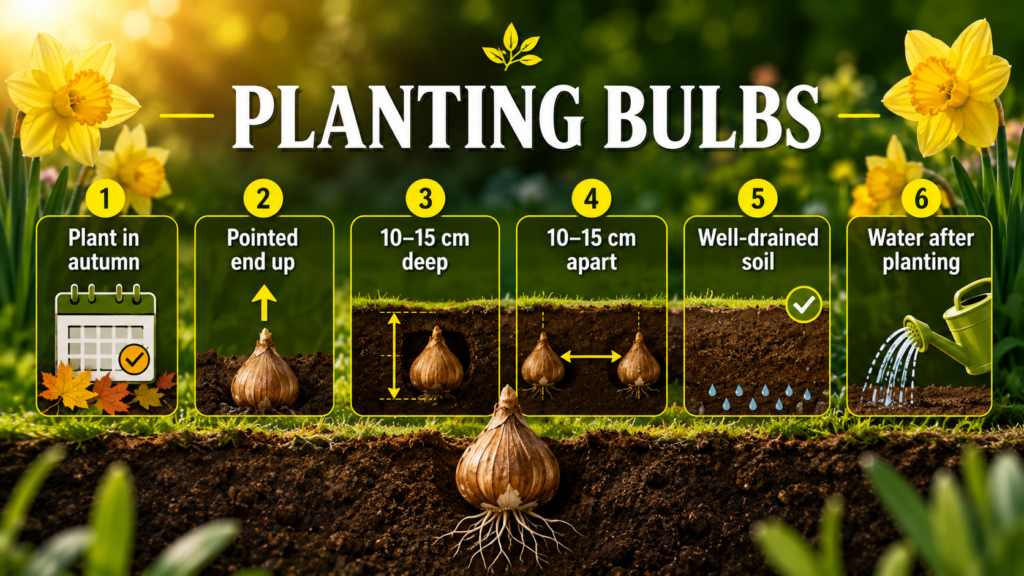
Plant daffodil bulbs in autumn — ideally from September to November — before the ground freezes. This gives bulbs time to develop a strong root system during cool, moist conditions before winter sets in. If you buy bulbs early, store them in a cool, dry place until planting time.
Dig a hole roughly three times the height of the bulb (around 10–15 cm deep for standard-sized bulbs). Place each bulb with the pointed end facing upward — this is where the shoot emerges. Space bulbs 10–15 cm apart. For a natural, informal look in lawns or under trees, scatter bulbs by hand and plant them where they land.
Daffodils thrive in well-drained soil. If your garden has heavy clay, add grit or compost to improve drainage — waterlogged soil causes bulb rot. A handful of bone meal mixed into the planting hole gives bulbs a gentle nutrient boost. Water well after planting, then leave nature to do the rest.
Watering, Feeding & Ongoing Daffodil Care
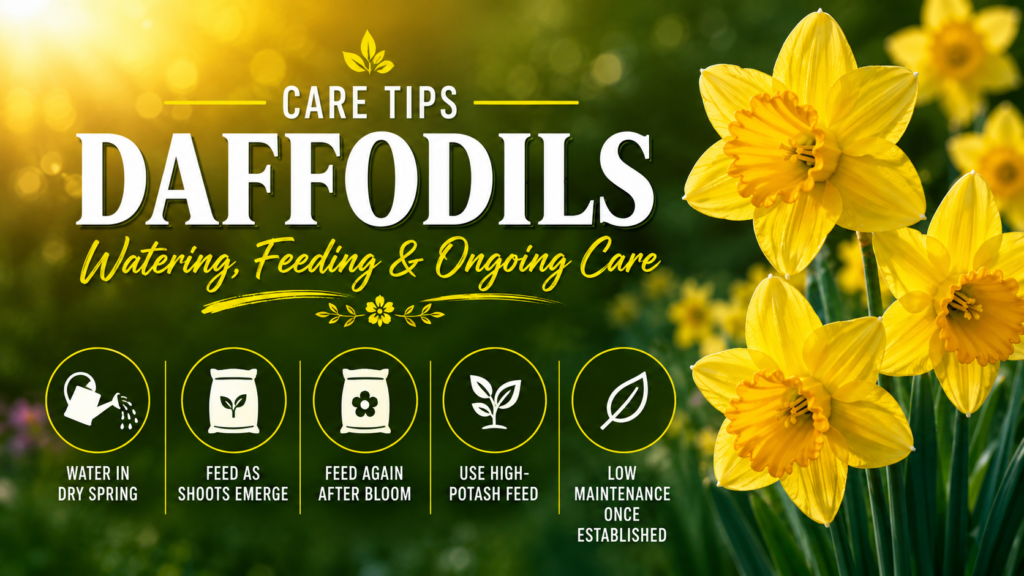
Once planted, daffodils are remarkably low-maintenance. Water newly planted bulbs to settle the soil, then let natural rainfall take over. During unusually dry springs, water while foliage is green and actively growing — this helps the bulb store energy for next year’s flowers.
Feed with a high-potash fertilizer (such as tomato feed) as shoots emerge in spring and again after flowering. Avoid high-nitrogen feeds which produce lush leaves at the expense of flowers. Mulching with well-rotted compost in autumn keeps soil healthy and helps suppress weeds around the clumps.
What to Do After Daffodils Finish Flowering
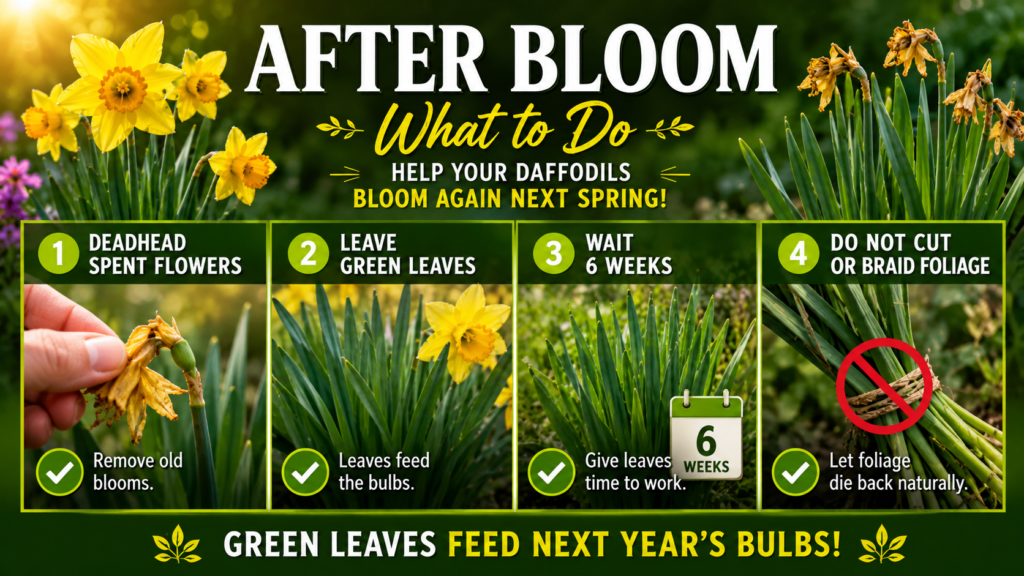
This is the single most important piece of daffodil advice: after the flowers fade, snap off the spent flower heads (deadhead) to stop the plant wasting energy on seed production — but leave the green foliage completely intact. The leaves are photosynthesising and feeding the bulb, building up reserves for next spring’s flowers.
Do not cut, tie, or braid the leaves. Wait at least six weeks after flowering — until the foliage has turned yellow and withered naturally — before removing it. Cutting green foliage too early is the most common reason established daffodils stop blooming well. Patience here pays off with stronger flowers every spring.
Growing Daffodils in Pots & Containers
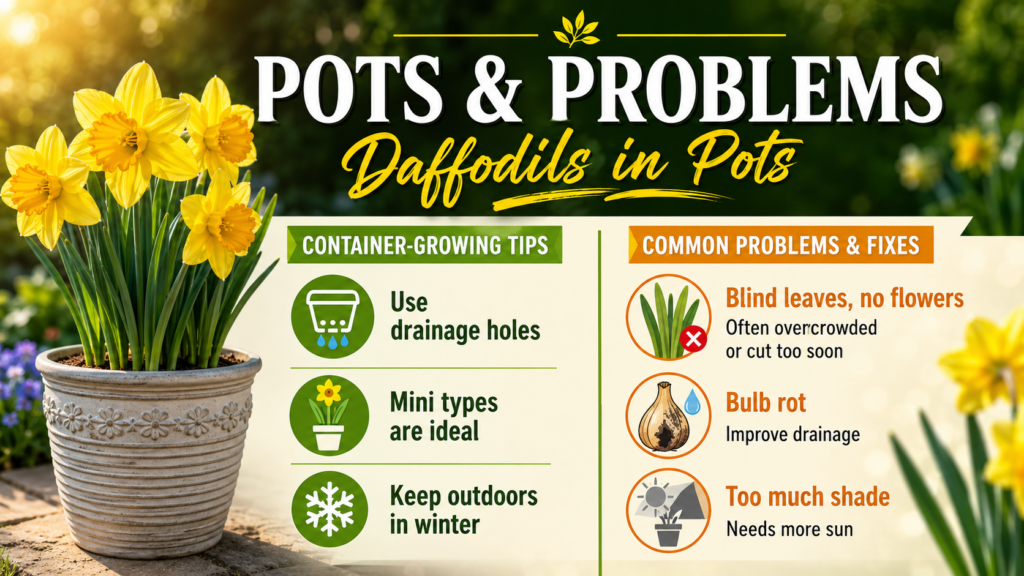
Daffodils grow beautifully in containers — particularly miniature varieties like ‘Tête-à-Tête’ and ‘Minnow’. Use a pot at least 15 cm deep with drainage holes and a quality peat-free compost mixed with grit. Plant bulbs closer together than in the ground — almost touching — for a full, impressive display.
Place containers outdoors in a sheltered spot over winter so bulbs receive the cold period they need. Water sparingly through winter, increasing as shoots appear. After flowering, continue watering until foliage dies back, then either plant bulbs out in the garden or store the pot on its side in a dry place until autumn.
Common Daffodil Problems & Solutions
The most frequent complaint is ‘blind’ daffodils — plants that produce healthy leaves but no flowers. This is usually caused by cutting foliage too early the previous year, overcrowded clumps that need dividing, planting bulbs too shallowly, or heavy shade. Feed well after flowering, leave foliage alone, and lift and divide congested clumps in late summer.
Narcissus bulb fly can damage bulbs, causing soft, mushy centres. Discard affected bulbs and plant replacements elsewhere. Basal rot (a fungal disease) thrives in warm, wet soil — ensure good drainage and avoid planting in sites where daffodils have recently failed. Slugs occasionally damage emerging shoots but rarely cause serious harm.
Frequently Asked Questions About Daffodils
Are daffodils and narcissus the same thing?
Yes — ‘daffodil’ is the common English name for all flowers in the genus Narcissus. ‘Jonquil’ specifically refers to Narcissus jonquilla and its hybrids, which have narrow leaves and multiple fragrant flowers per stem. All jonquils are daffodils, but not all daffodils are jonquils.
Can I plant daffodil bulbs in spring?
Autumn is the ideal planting time, but if you missed the window, planting in early winter is still better than not planting at all. Bulbs planted in spring (often sold ‘in the green’ — already growing) can establish but may not flower well until the following year. Avoid planting dry bulbs in spring as they rarely succeed.
Why are my daffodils producing leaves but no flowers?
This is called ‘blindness’ and the most common causes are: foliage cut too early the previous year, overcrowded clumps needing division, bulbs planted too shallow, insufficient sunlight, or poor feeding. Lift and divide congested clumps in late summer, replant at the correct depth, and feed with a potash-rich fertilizer in spring.
Do daffodils come back every year?
Yes — daffodils are perennial bulbs that return reliably each spring and often multiply over time. With proper after-flowering care (leaving foliage to die back naturally and feeding annually), a single bulb can become a clump of 5–10 bulbs within a few years.
How often should I divide daffodil clumps?
Divide every 3–5 years, or whenever you notice flowering declining. Lift clumps after the foliage has died back in late summer, separate the bulbs gently, discard any that are soft or damaged, and replant immediately at the correct depth and spacing. Newly divided bulbs may take a year to settle before flowering strongly again.