
If you’ve ever held a warm bowl of matcha and wondered what the word actually means, you’re not alone. The name carries a beautiful simplicity that, once understood, transforms the way you experience this vibrant green tea.
Unlike many food names that feel arbitrary, “matcha” is a word that tells you exactly what you’re drinking — and connects you to centuries of Japanese tea tradition in just two syllables.
Breaking Down the Word: 抹茶 (Matcha)
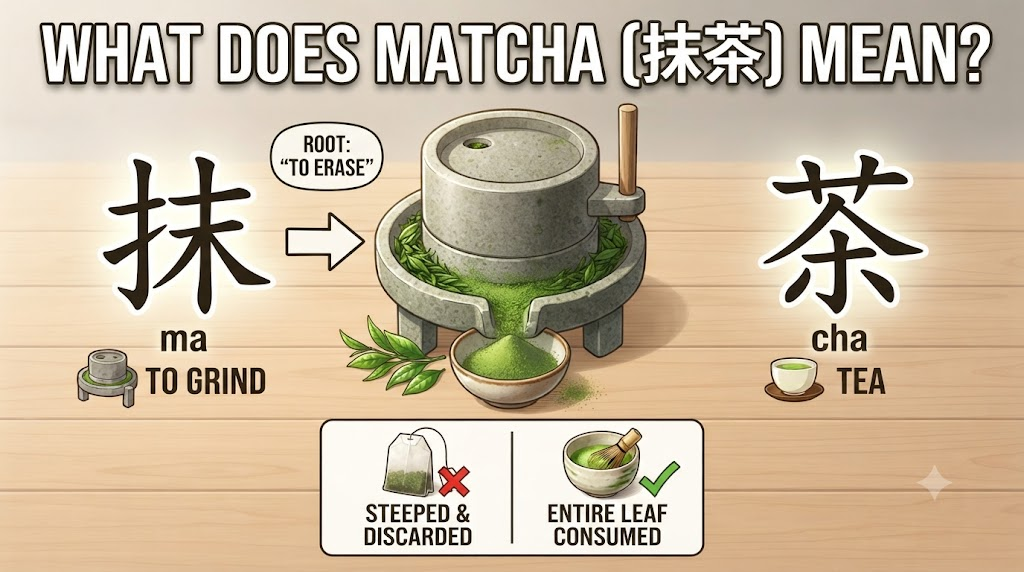
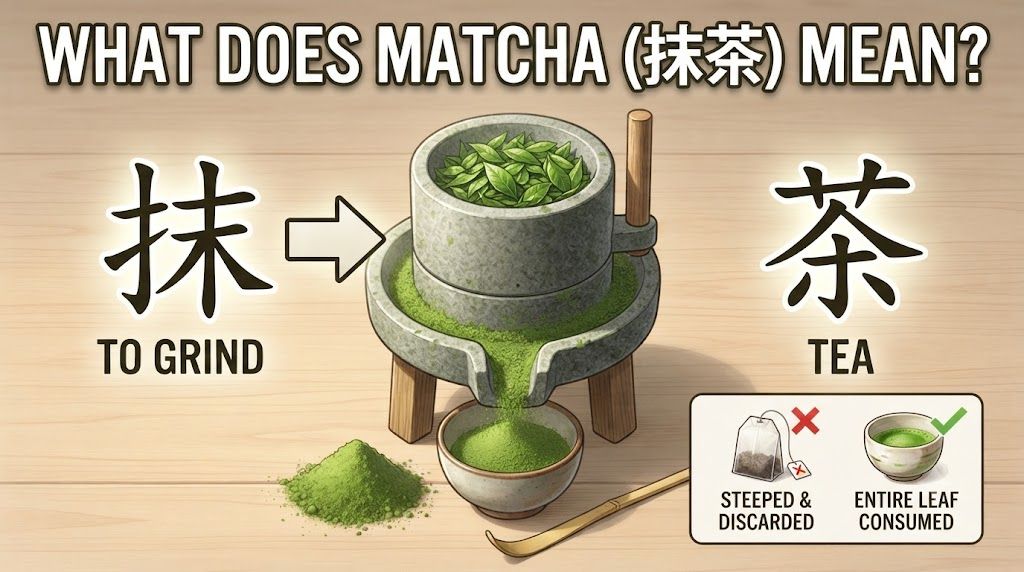
Matcha (抹茶) is written with two Japanese kanji characters. The first character, 抹 (ma), means “to rub” or “to grind” — it conveys the idea of something being reduced to a fine powder. The second character, 茶 (cha), simply means “tea.” Together, they create a name that translates directly to “powdered tea” or “ground tea.”
Did you know? The character 抹 (ma) shares its root with the Japanese word for “to erase” — evoking the idea of grinding something so finely that its original form disappears entirely.
This is what makes matcha fundamentally different from other teas. When you brew sencha or Earl Grey, you steep leaves in water and discard them. With matcha, you consume the entire leaf — ground into a powder so fine it dissolves into the water. The name tells you this story.
The word entered Japanese from Chinese, where the same characters (mǒ chá) were used during the Song Dynasty (960–1279 CE) to describe powdered tea preparation. When Buddhist monks brought the practice to Japan in the 12th century, the name came with it.
Why the Name Fits the Process Perfectly
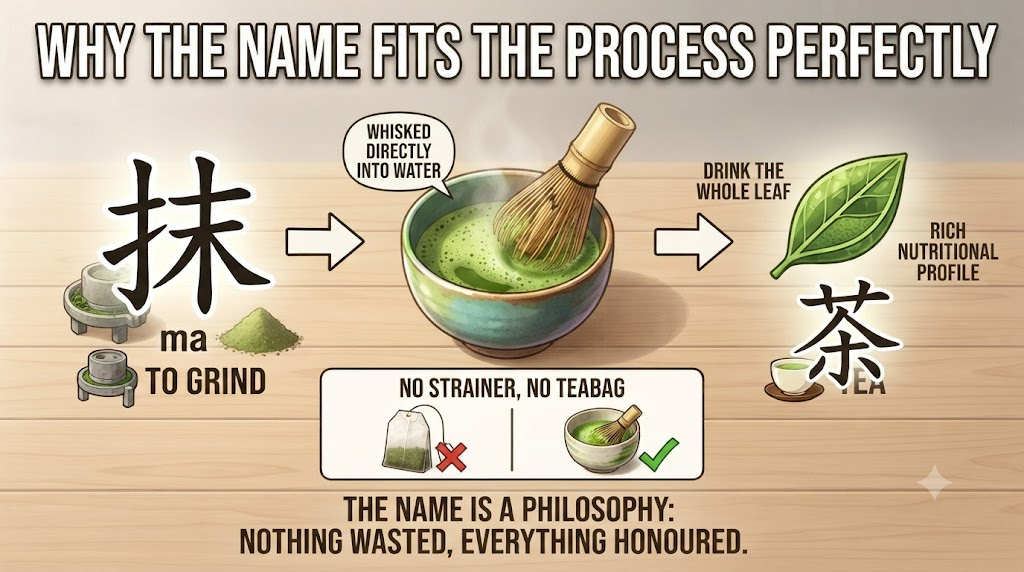
Understanding the meaning of “matcha” makes the traditional preparation ritual click into place. Tea leaves are stone-ground (抹) into an impossibly fine powder, then whisked directly into hot water with a bamboo chasen. There’s no strainer, no teabag — you drink the tea (茶) itself.
This is why matcha delivers a richer nutritional profile than steeped teas. You’re consuming the whole leaf, not just what dissolves during a brief steep. The name was never just a label — it was a description of a philosophy: nothing wasted, everything honoured.
Next time someone asks what matcha means, you can tell them: “It literally means ‘powdered tea’ — and that’s exactly what makes it special. You’re drinking the whole leaf.”
How Matcha Compares to Other Japanese Teas
| Tea Type | Preparation | Leaf Consumption |
|---|---|---|
| Matcha | Whisked into water | Whole leaf consumed |
| Sencha | Steeped in water | Leaves discarded |
| Gyokuro | Steeped in water | Leaves discarded |
Frequently Asked Questions
Is matcha a type of green tea?
Yes, matcha is a type of Japanese green tea. However, it’s unique because you consume the whole leaf in powder form, rather than steeping leaves and discarding them. This means matcha delivers more of the tea leaf’s nutrients and antioxidants compared to other green teas.
Why is the name so important?
The name “matcha” literally describes the tea itself: powdered (抹) tea (茶). Understanding the name helps you appreciate how intentional the preparation is, and why consuming the whole leaf makes this tea so special. It’s not just a label — it’s a philosophy.
Can I drink matcha as a latte?
Absolutely. While the traditional way is to whisk matcha into hot water in a ceramic bowl, matcha lattes (whisked matcha mixed with steamed milk) are a popular modern preparation. The name still applies — it’s still powdered tea, just enjoyed in a different way.
How old is matcha tea?
Matcha’s origins trace back to the Song Dynasty in China (960–1279 CE), where powdered tea was prepared during the tea ceremony. Buddhist monks brought the practice to Japan in the 12th century, where it became deeply integrated into Japanese tea culture and the tea ceremony (chanoyu).