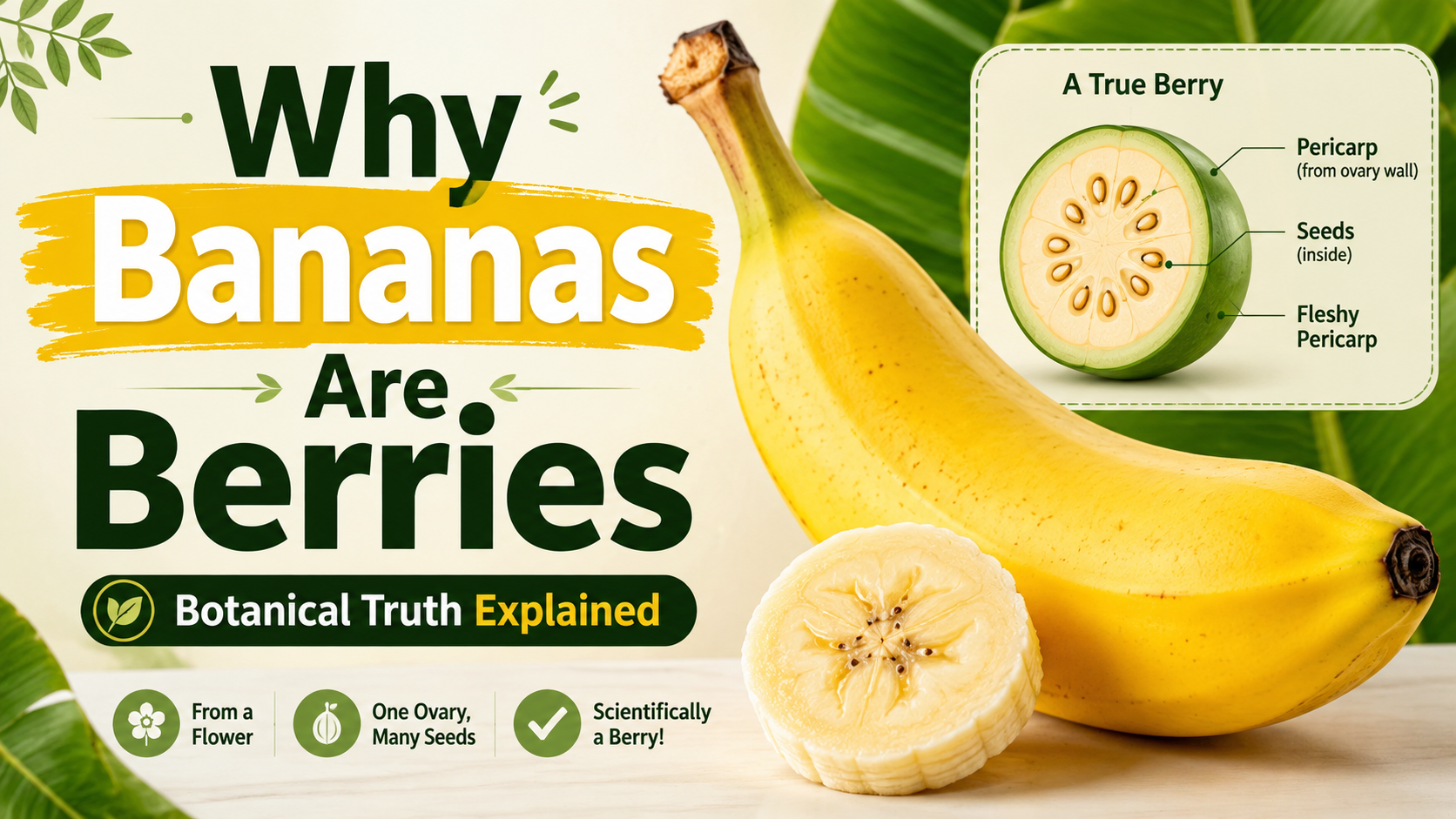

Yes, a banana is botanically a berry. The surprising part is not the banana—it is what botanists mean when they use the word “berry.”
Bananas are berries in botanical terms because each banana develops from one flower with one ovary, and its ovary wall ripens into soft, fleshy fruit tissue around the seed-bearing area. A berry does not have to be small, round, or blue.
What botanists mean by “berry”
In everyday cooking, “berry” is a useful description for small, juicy fruits such as strawberries and raspberries. In botany, though, a berry is a fruit type defined by how it forms—not by its size, flavour, or colour.
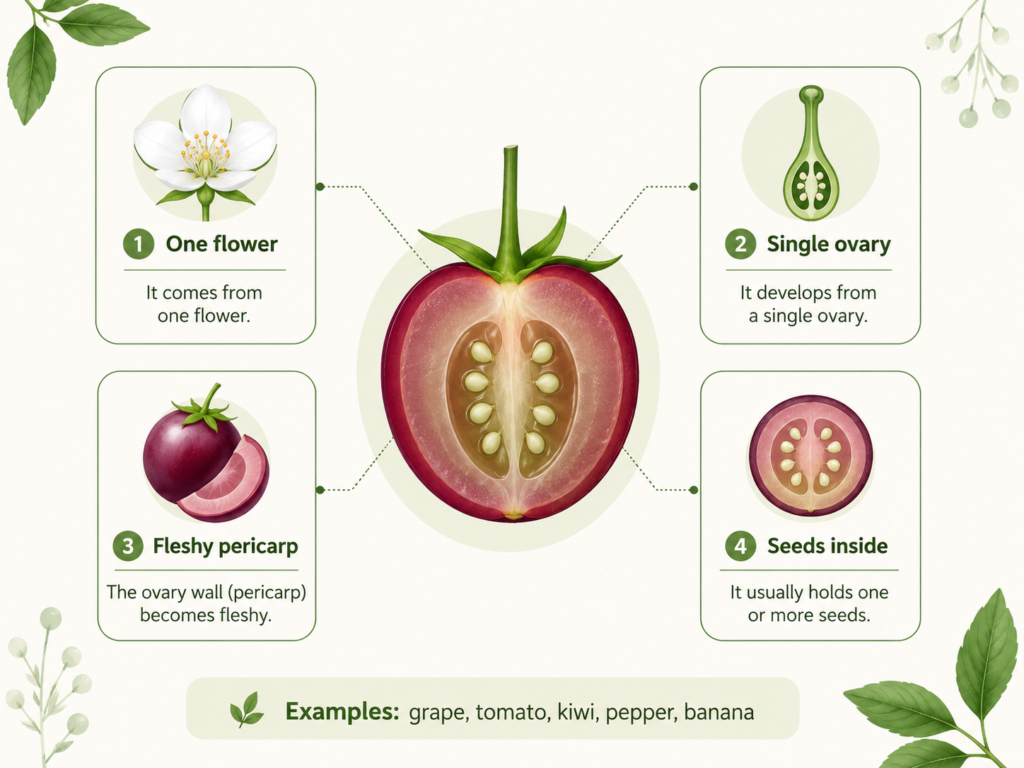
A fruit is the mature structure that develops from a flower and carries seeds. Inside the flower is an ovary: the part that holds ovules, which may become seeds after fertilisation. When the ovary ripens, its wall becomes the fruit wall, called the pericarp.
- It is a simple fruit, meaning it comes from one flower.
- It develops from a single ovary.
- Its pericarp—the mature ovary wall—becomes mostly fleshy rather than dry.
- It usually holds one or more seeds within that fleshy tissue.
Those rules make room for grapes, tomatoes, kiwifruit, peppers, eggplants—and bananas. They do not require a fruit to be tiny or sweet.
How a banana earns its berry status
A banana begins as a flower on a banana plant. The plant is often called a tree, but it is actually a giant herb with a soft, layered pseudostem rather than a woody trunk. Each individual banana develops from a single flower and its single ovary.
Exocarp
The outer layer of the pericarp: the banana peel.
Mesocarp + endocarp
The inner fruit-wall layers that make up most of the soft edible flesh.
Seed traces
Tiny, dark specks in many cultivated bananas: reduced seed structures.
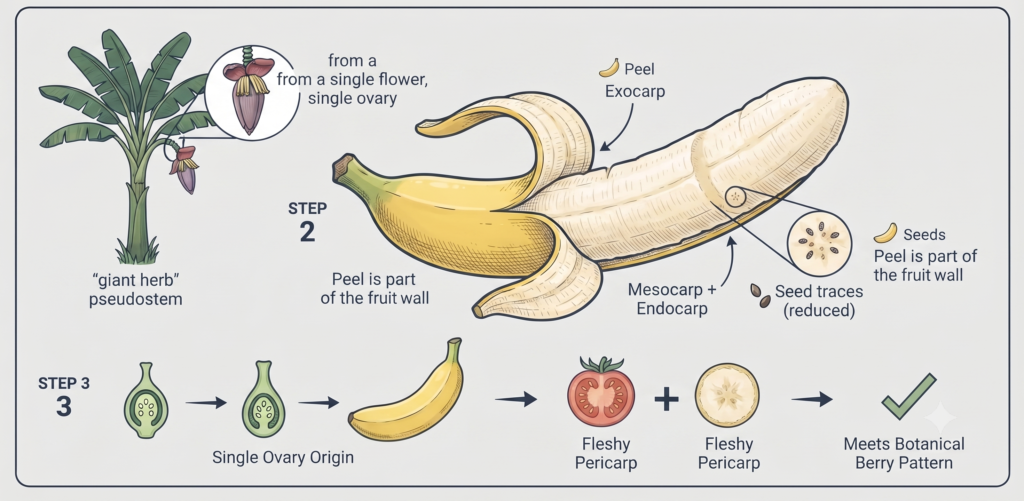
The peel is the outer pericarp layer, called the exocarp. The soft part you eat consists mostly of the inner pericarp layers: the mesocarp and endocarp. In other words, the peel is not a separate wrapper around the fruit—it is part of the fruit wall itself.
Because one ovary develops into a fruit with a fleshy pericarp, the banana fits the botanical berry pattern. A bunch of bananas comes from many flowers, but each individual banana has its own flower-and-ovary origin.
Do bananas have seeds?
Wild bananas can contain many large, hard seeds. Slice one open and you may find its pulp packed around dark, round seeds—very unlike the smooth fruit sold in most supermarkets.
Seedlessness does not undo a fruit’s botanical identity. It describes how that particular fruit developed.
Most commercial dessert bananas are cultivated varieties that produce fruit with little or no normal seed development. Many are sterile hybrids and commonly form fruit by parthenocarpy: fruit development without the usual fertilisation and mature seed formation.
Look closely at a supermarket banana and you can often see tiny brown or black flecks near the centre. These are reduced seed traces. The fruit still develops from the same flower structure and retains the same basic fruit type as a seeded banana.
Why strawberries and raspberries are not true berries
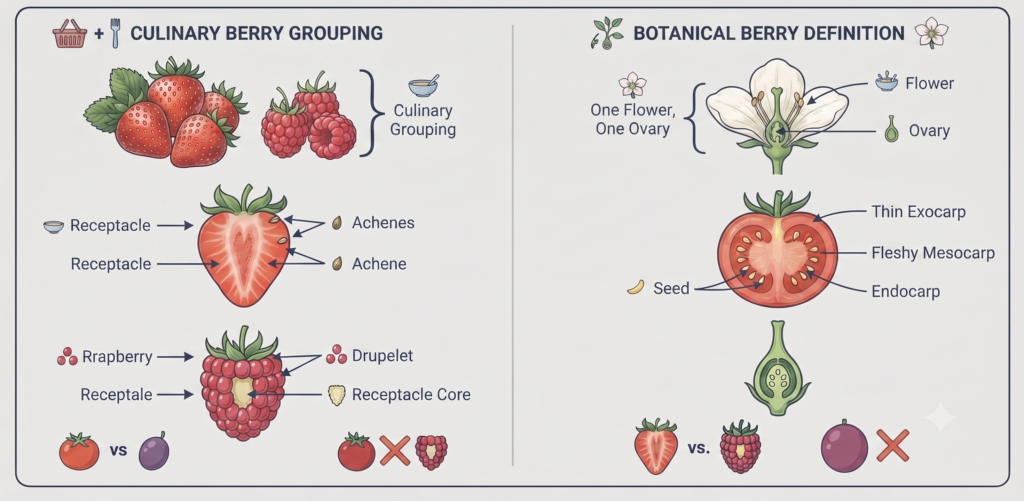
The contrast is useful because familiar berry names follow culinary language, while botanical fruit names follow flower structure. Neither system is “wrong”—they simply answer different questions.
Strawberries: accessory aggregate fruits
The red, juicy part of a strawberry is largely enlarged receptacle tissue—the flower base—not the ovary. Its actual fruits are the tiny dry structures on the outside, often called achenes. Each achene came from one of many ovaries in one flower.
Raspberries and blackberries are aggregate fruits too. Their little bead-like units, called drupelets, come from many separate ovaries in one flower. Pineapple takes another route: it is a multiple fruit, built from the joined products of many flowers.
| Fruit | Botanical category | Why |
|---|---|---|
| Banana | Berry | One ovary ripens into a fleshy fruit wall. |
| Grape | Berry | Fleshy fruit formed from one ovary. |
| Tomato | Berry | A fleshy ovary wall surrounds seeds. |
| Strawberry | Accessory aggregate fruit | The edible part is mostly flower-base tissue; many ovaries make the small achenes. |
| Raspberry | Aggregate fruit | Many ovaries from one flower form many drupelets. |
| Pineapple | Multiple fruit | Fruit tissue develops from many flowers joined together. |
Botanical and culinary labels can both be right
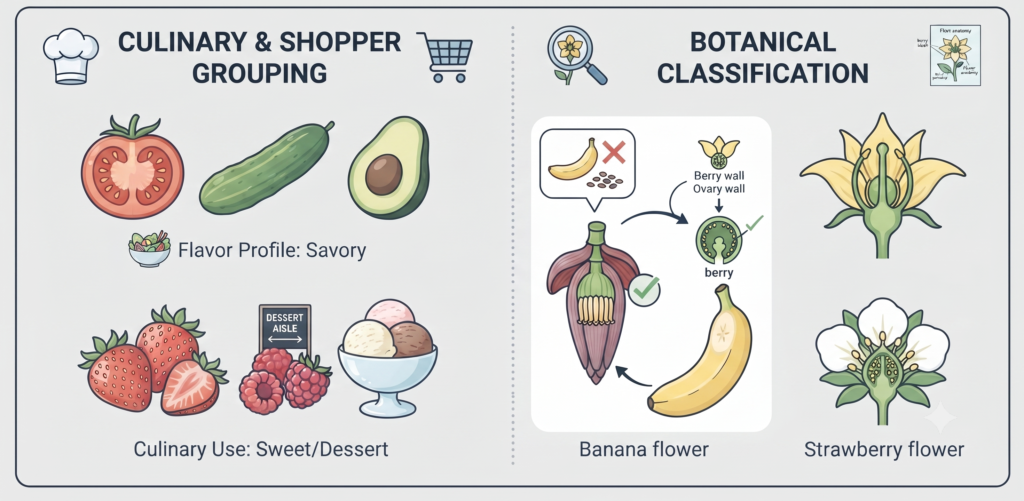
Cooks and shoppers group foods by flavour, texture, and how they are used. That is why tomatoes are vegetables in a salad and strawberries are berries in a dessert aisle. Botanists classify fruits by the parts of the flower that develop into them.
So “banana berry” is accurate in a botany lesson, but it is not a very useful everyday grocery label. The memorable fact is best shared with its explanation: bananas are berries because of their flower anatomy, not because they happen to contain seeds.
Banana berry FAQs
Are plantains berries too?
Yes. Plantains are closely related to dessert bananas and follow the same basic botanical fruit pattern: a fleshy fruit developing from one flower and one ovary.
Are wild bananas also berries?
Yes. Wild bananas usually make the berry pattern easier to see because they contain many large, mature seeds. Their seediness does not make them more “berry-like”; it simply reflects normal seed development.
Are peppers and eggplants berries?
Botanically, yes. Like tomatoes, peppers and eggplants develop from an ovary and ripen with fleshy fruit walls containing seeds.
Does a banana grow from one flower or many?
One individual banana develops from one flower. A hand or bunch contains many bananas because the banana plant produces many flowers in its large flowering structure.