A practical guide to recognizing leafhoppers and their nymphs, diagnosing stippling and hopper burn, understanding disease-vector risk, and choosing low-impact control when treatment is actually justified.
Quick Answer
Leafhoppers are small, wedge-shaped sap-feeding insects in the family Cicadellidae. Adults jump quickly when disturbed, while wingless nymphs often run sideways on the undersides of leaves. Feeding commonly causes pale stippling, yellowing or curling; certain species can cause hopper burn or transmit plant pathogens. A few leafhoppers on a healthy plant often do not justify treatment. Confirm the insect and the damage first, then use the least disruptive control that fits the infestation.
| Feature | Quick answer |
| Family | Cicadellidae |
| Typical size | Often about 1/8-1/4 inch; some sharpshooters are larger |
| Shape | Small, narrow and wedge-shaped |
| Common colors | Green, yellow, gray, brown or patterned |
| Movement | Adults jump; nymphs often move sideways or backward |
| Main damage | Stippling, yellowing, curling and reduced vigor |
| Serious symptom | Hopper burn in susceptible plants/species |
| Disease risk | Some species vector bacteria, viruses or phytoplasmas |
| First action | Inspect leaf undersides and confirm the pest |
| Best approach | IPM: monitor, conserve natural enemies, treat only when needed |
What Are Leafhoppers?
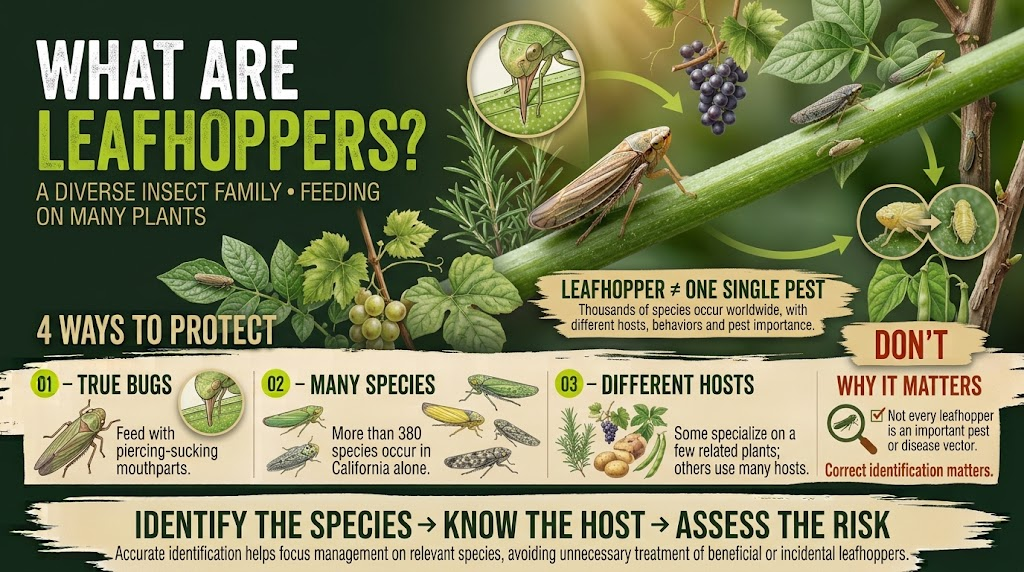
Leafhoppers are true bugs that feed by inserting piercing-sucking mouthparts into plant tissues. More than 380 species occur in California alone, and globally the family includes thousands of species with very different host ranges and pest importance. Some feed on only a few related plants, while others move among many crops, weeds, ornamentals and woody plants.
That diversity matters because “leafhopper” describes a large insect family rather than one pest with one behavior. A leafhopper found on rosemary may not be the same species causing damage in potatoes, grapes or beans, and not every species is an important disease vector.
What Do Leafhoppers Look Like?
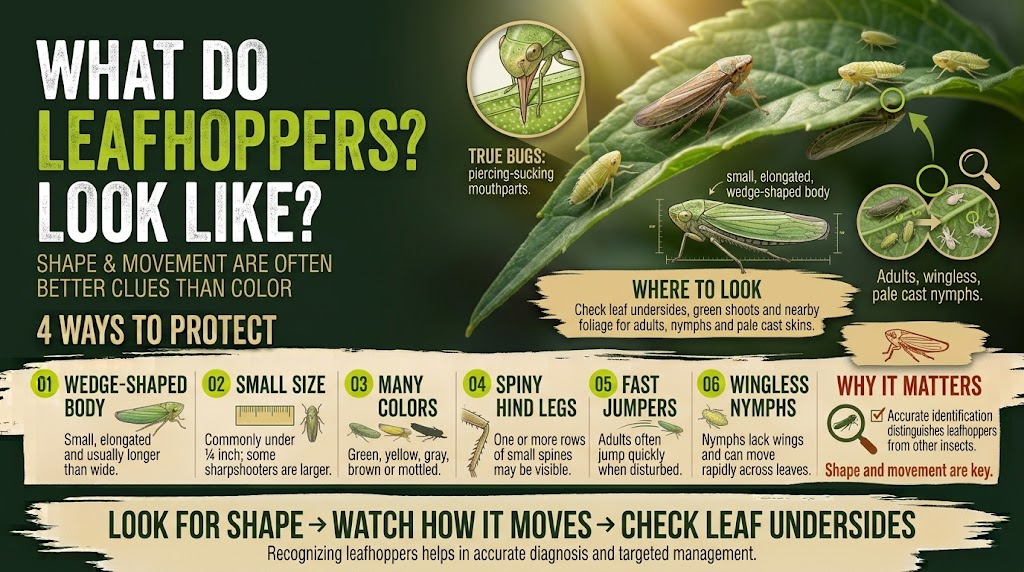
Shape and movement are generally more useful than color for identification. Common field clues include:
- Small, elongated, wedge-shaped body that is longer than it is wide.
- Commonly less than 1/4 inch long, although sharpshooters and a few other forms are larger.
- Green, yellow, gray, brown or mottled coloration; some species are strikingly patterned.
- One or more long rows of small spines along the hind legs.
- Fast jumping by adults when disturbed.
- Wingless nymphs that often run rapidly sideways, forward or backward on leaves.
- Adults, nymphs and pale cast skins frequently found on leaf undersides or green shoots.
Leafhopper Nymph vs. Adult
| Trait | Nymph | Adult |
| Wings | No functional wings | Fully winged |
| Body shape | Similar wedge shape, smaller | Wedge-shaped and more developed |
| Movement | Often runs sideways/backward | Jumps and flies readily |
| Location | Common on leaf undersides | Leaves, shoots and surrounding vegetation |
| Control relevance | Often easier to target with contact sprays | Highly mobile and prone to reinvasion |
Leafhopper vs. Planthopper
Leafhoppers and planthoppers can look similar at a glance, but several structural clues help separate them.
| Trait | Leafhopper | Planthopper |
| Overall body | Usually narrow and wedge-shaped | Often broader with flatter sides |
| Antennae | Usually between or in front of the eyes | Often below the eyes on the side of the head |
| Hind legs | Long rows of small spines | Several larger spines are common |
| Head shape | Usually without a pronounced snout | Some have a ridge, keel or snoutlike projection |
| Nymph residue | Cast skins common | Some species produce waxy filaments |
| Identification tip: If the insect vanishes as soon as the leaf is touched, photograph it before disturbing the plant. A close image of the side profile and hind legs can be more useful than color alone. |
Leafhopper Life Cycle
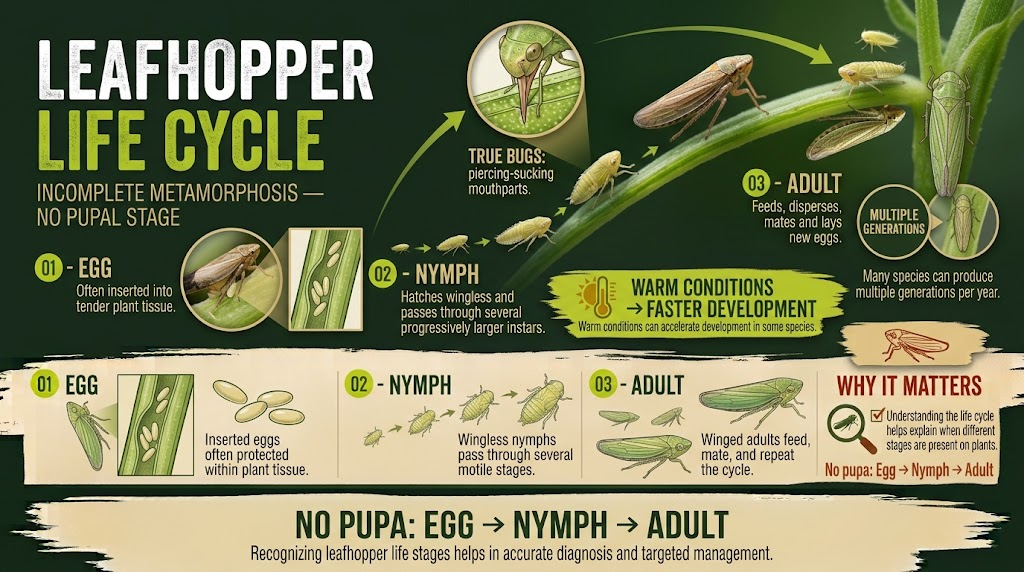
Leafhoppers undergo incomplete metamorphosis: there is no pupal stage.
| Stage | What happens |
| Egg | Females often insert eggs into tender plant tissue rather than leaving exposed egg masses. |
| Nymph | Wingless nymphs hatch and pass through several progressively larger instars. |
| Adult | Winged adults feed, disperse, mate and lay new eggs. Many species have multiple generations per year. |
Warm conditions can accelerate development in some species, which helps explain why populations can build quickly once a suitable crop or garden host is available.
What Plants Do Leafhoppers Attack?
Host range varies widely by species. Plants commonly associated with leafhoppers include:
| Plant group | Examples | Typical concern |
| Vegetables | Potato, tomato, beans, peas, carrots, peppers, eggplant | Stippling, hopper burn, yield reduction in severe cases |
| Herbs | Mint, rosemary, sage and other Lamiaceae | Pale stippling and cosmetic injury |
| Field crops | Alfalfa/lucerne, maize, cotton, peanuts | Crop-specific feeding injury and, for some species, disease transmission |
| Fruit crops | Grapes and some orchard crops | Stippling; certain sharpshooters vector pathogens |
| Ornamentals | Flowers, shrubs, woody plants | Usually cosmetic unless populations are high |
| Turf | Many grasses | Leaf bleaching; serious damage is uncommon |
What Does Leafhopper Damage Look Like?
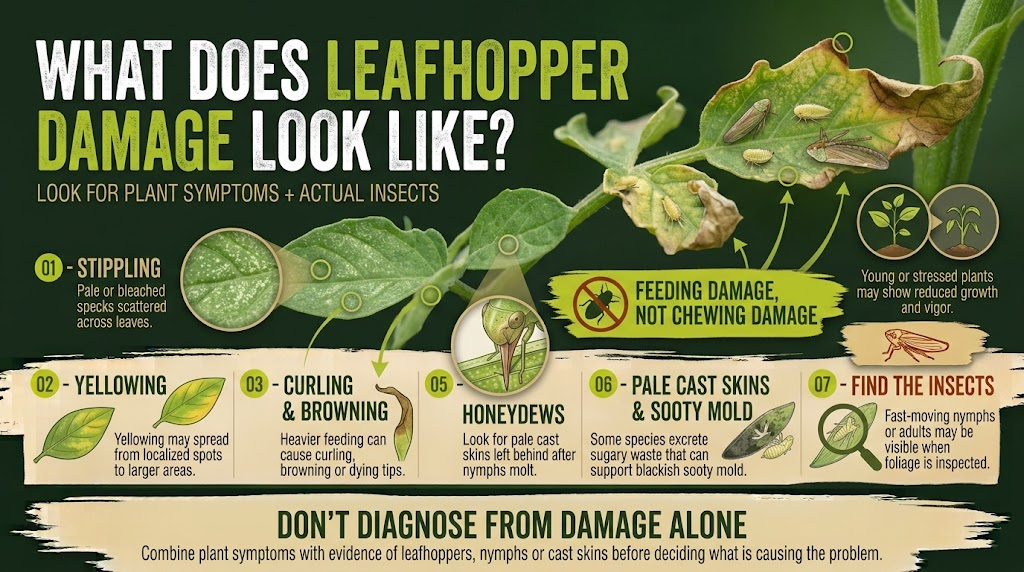
Leafhopper injury is usually caused by feeding rather than chewing. Look for a combination of plant symptoms and actual insects.
- Pale or bleached specks (stippling) scattered across leaves.
- Yellowing that can spread from localized spots to larger leaf areas.
- Curling, browning or dying leaf tips under heavier feeding.
- Reduced plant vigor, especially on young or stressed plants.
- Honeydew and blackish sooty mold with species that excrete sugary waste.
- Pale cast skins left behind as nymphs molt.
- Fast-moving nymphs or adults on leaf undersides when the plant is inspected.
What Is Hopper Burn?
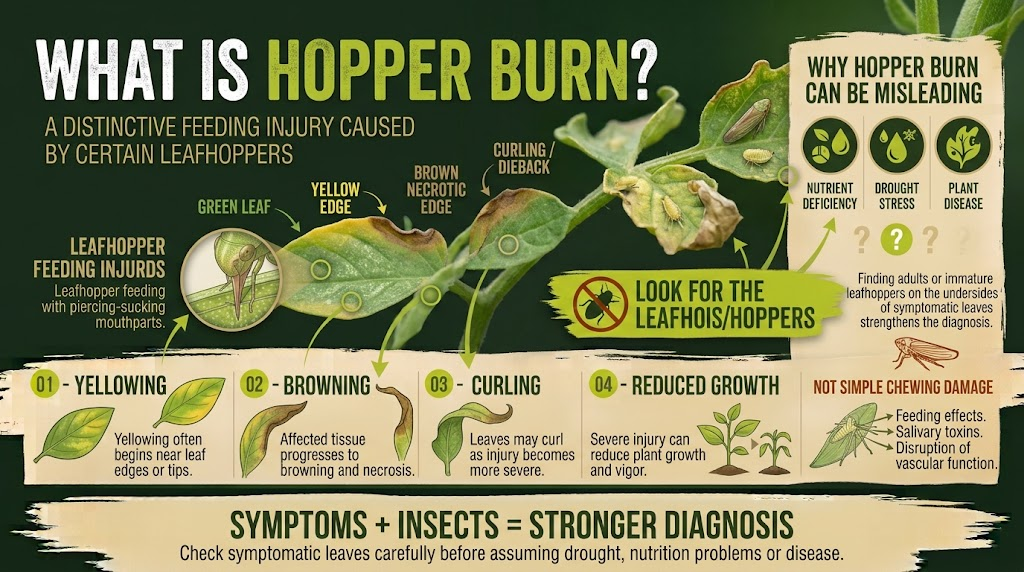
Hopper burn is a characteristic form of injury associated with certain leafhoppers, especially some Empoasca species. Affected leaves may develop yellowing near the edges or tips, followed by browning, necrosis, curling and reduced growth. The injury reflects feeding effects that can include salivary toxins and disruption of vascular function, rather than simple removal of leaf tissue.
Hopper burn is important diagnostically because it can resemble nutrient deficiency, drought stress or disease. Finding adult and immature leafhoppers on the undersides of symptomatic leaves makes the diagnosis much stronger.
Leafhopper Damage vs. Similar Plant Problems
| Problem | What can look similar | Useful clue |
| Leafhoppers | Pale stippling, yellowing, curling | Wedge-shaped insects or nymphs on leaf undersides; adults jump |
| Spider mites | Stippling and bronzing | Very small mites; fine webbing may be present |
| Thrips | Silvery/pale scarring | Slender insects and surface scarring rather than classic hopping insects |
| Lace bugs | Stippling | Dark fecal spotting and lace-like adults on leaf undersides |
| Nutrient deficiency | Yellowing or patterned chlorosis | No leafhopper nymphs/adults; pattern often follows nutrient physiology |
| Plant disease | Yellowing, distortion, decline | Symptoms may be systemic; confirm vector presence or laboratory/local diagnosis when important |
| Do not diagnose from stippling alone: UC IPM notes that lace bugs, plant bugs, spider mites and thrips can produce similar pale spotting. Turn the leaf over and look for the arthropod causing the injury. |
Do Leafhoppers Spread Plant Diseases?
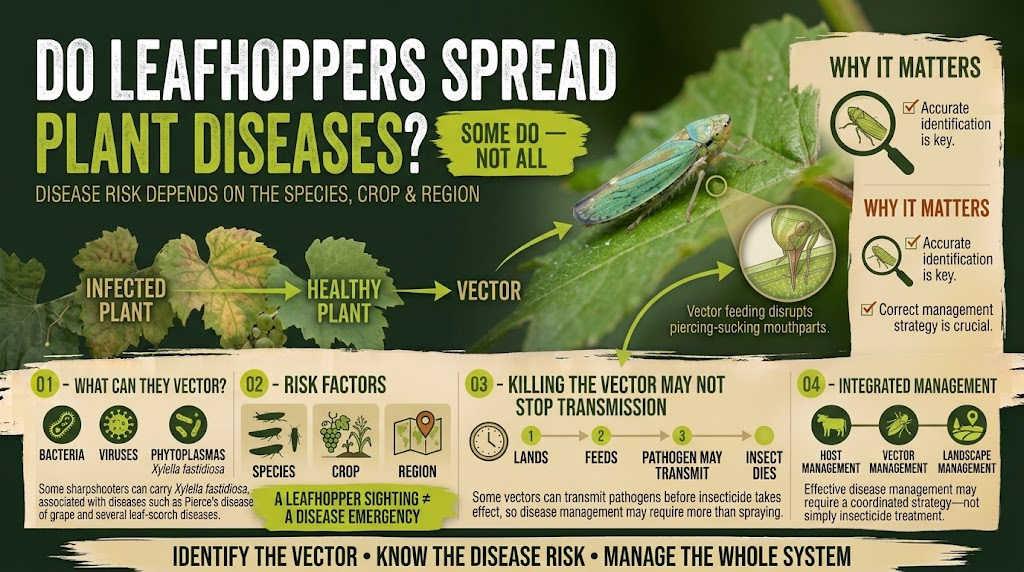
Some do, but not all. Certain leafhopper and sharpshooter species can vector bacteria, viruses or phytoplasmas between plants. One well-known example is Xylella fastidiosa, which can be carried by sharpshooters and cause diseases such as Pierce’s disease of grape and several leaf-scorch diseases.
The disease risk is species-, crop- and region-specific. It is therefore inaccurate to treat every leafhopper sighting as a disease emergency.
| Important limitation: Killing leafhoppers after they land does not always prevent disease transmission. Some vectors can transmit a pathogen before an insecticide kills them, so disease management may require host, vector and landscape strategies beyond spraying. |
How to Check Plants for Leafhoppers
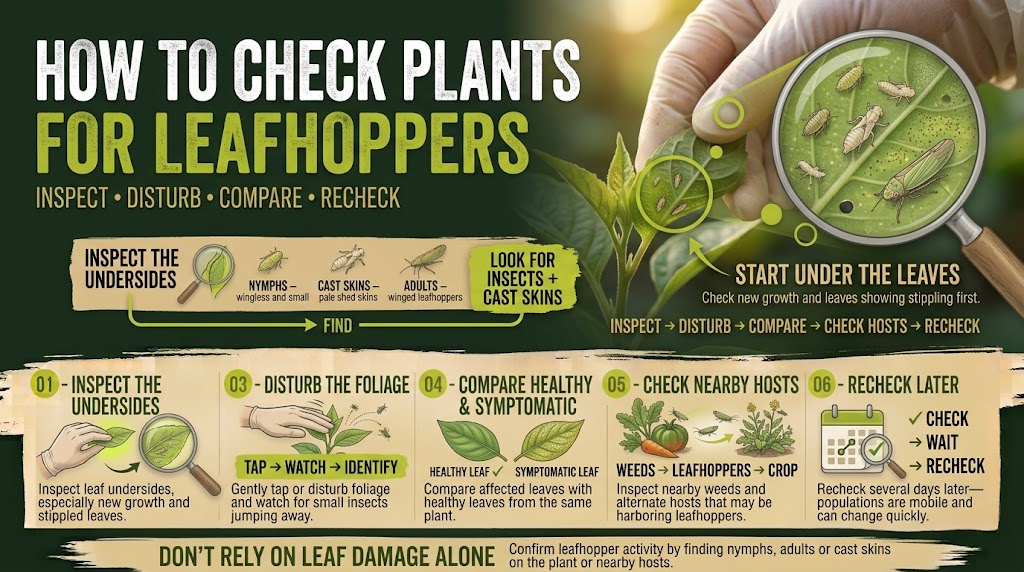
- Inspect the underside of leaves, especially on new growth and leaves showing stippling.
- Look for wingless nymphs, pale cast skins and adult insects.
- Gently tap or disturb foliage and watch for small insects jumping away.
- Compare symptomatic leaves with healthy leaves from the same plant.
- Check nearby weeds and alternate host plants that may be harboring leafhoppers.
- Recheck several days later because populations are mobile and may change quickly.
When Should You Control Leafhoppers?
Presence alone is not a treatment threshold. In many gardens and landscapes, leafhoppers are a nuisance or curiosity and do not threaten plant survival.
Control becomes more reasonable when one or more of the following apply:
- Leafhopper numbers are increasing and obvious injury is expanding.
- Young plants are being stunted or heavily damaged.
- A crop is known to be sensitive to hopper burn.
- A locally important leafhopper-vectored disease creates a meaningful risk.
- Crop-specific monitoring or Extension guidance indicates treatment is justified.
There is no universal “number of leafhoppers per plant” that applies to every crop. Thresholds differ, and for some crops measurable thresholds are not established.
How to Control Leafhoppers Naturally
1. Conserve Natural Enemies
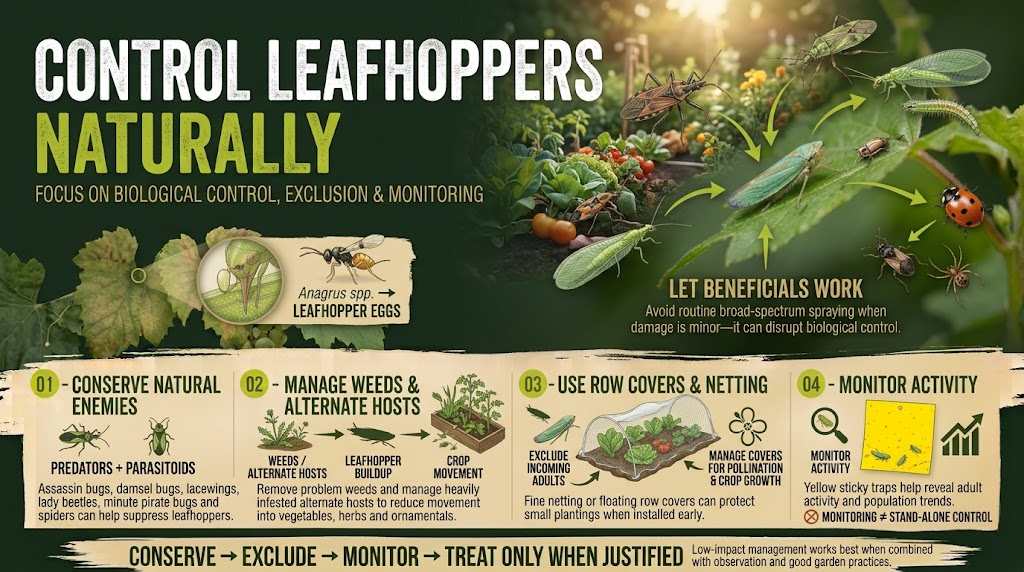
Leafhoppers have many predators and parasitoids. Assassin bugs, damsel bugs, lacewings, lady beetles, minute pirate bugs and spiders can all contribute to suppression. Tiny parasitoid wasps such as Anagrus species attack the eggs of some leafhoppers.
Avoid routine broad-spectrum spraying when damage is minor, because killing these natural enemies can disrupt the garden’s biological control system.
2. Manage Weeds and Alternate Hosts
Leafhoppers that feed on many plants can build up on weeds or other alternate hosts and later migrate into vegetables, herbs or ornamentals. Removing problem weeds and managing heavily infested alternate hosts can reduce this movement.
3. Use Row Covers or Netting Where Practical
For small vegetable plantings, fine netting or floating row covers can help exclude incoming adults if installed before infestations build. Remove or manage covers as needed for pollination and crop growth.
4. Monitor With Sticky Traps
Yellow sticky traps can help reveal adult activity and population trends, but they are better used as a monitoring tool than as a stand-alone solution for heavy infestations.
Can Insecticidal Soap, Horticultural Oil or Neem Help?
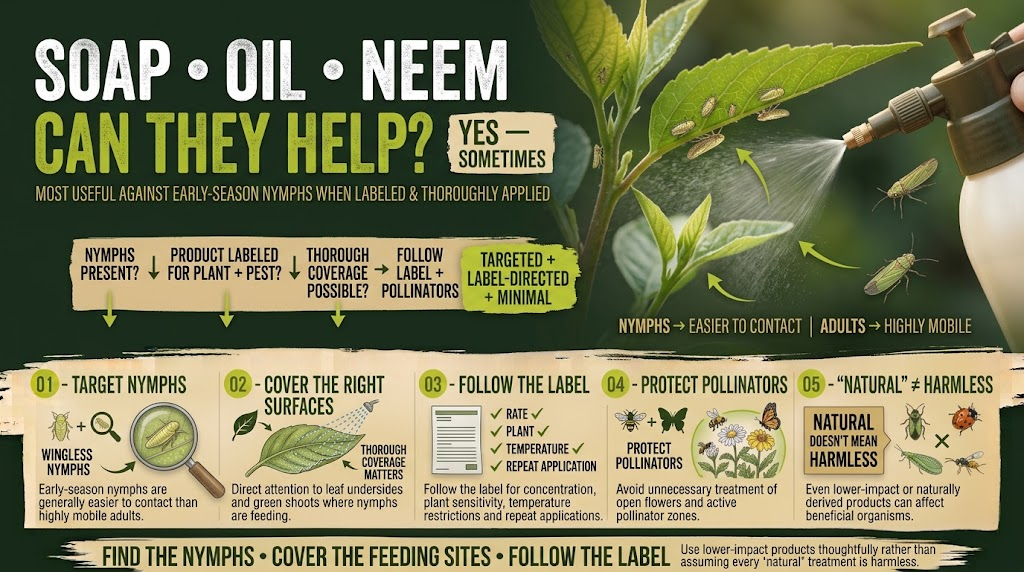
They can provide some control of early-season nymphs when the product is labeled for the plant and pest and coverage is thorough. Nymphs are generally easier to contact than highly mobile adults.
- Spray the undersides of leaves and green shoots where nymphs are feeding.
- Follow the label for concentration, plant sensitivity, temperature restrictions and repeat applications.
- Avoid unnecessary treatment of open flowers and pollinator activity zones.
- Do not assume “natural” means harmless to every beneficial organism.
When Insecticides May Be Needed
If leafhopper injury is severe, crop value is high or local disease-vector pressure makes control important, a labeled insecticide may be justified. Choose the least disruptive effective option available for the crop and pest, and follow the current product label.
Broad-spectrum products can kill predators and parasitoids, and adults may quickly reinvade from untreated vegetation. For this reason, pesticide use should be part of a larger monitoring and habitat-management plan rather than the only strategy.
Why Spraying Does Not Always Solve Leafhopper Problems
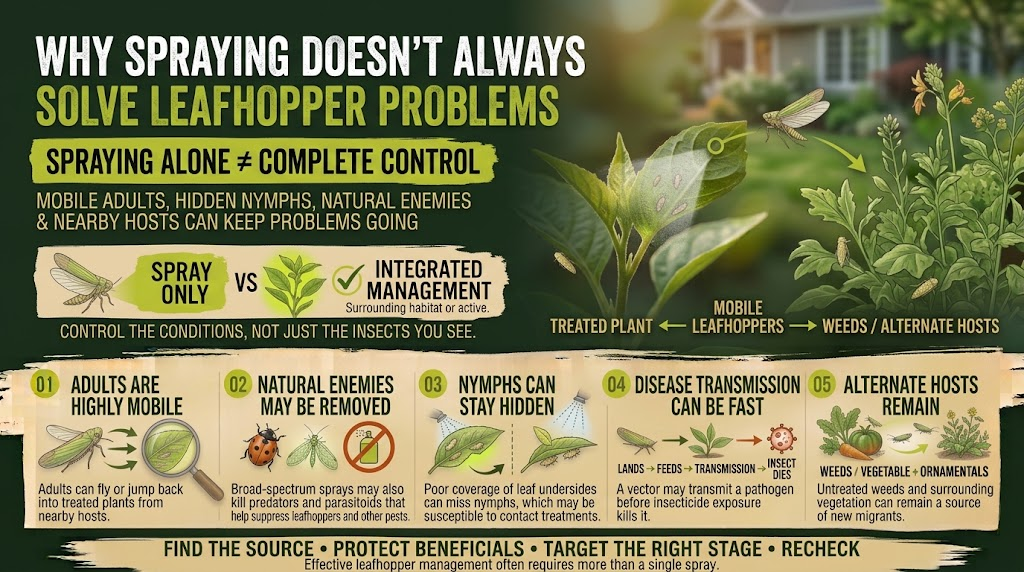
| Reason | What happens |
| Adults are highly mobile | They can fly or jump back into treated plants from nearby hosts. |
| Natural enemies are removed | Broad-spectrum sprays may kill predators and parasitoids that were suppressing leafhoppers or other pests. |
| Nymphs remain hidden | Poor coverage of leaf undersides can miss the stage most susceptible to contact treatments. |
| Disease transmission can occur quickly | A vector may infect a plant before dying from insecticide exposure. |
| Alternate hosts remain nearby | Untreated weeds and surrounding vegetation can serve as a continuing source of migrants. |
Common Leafhopper Control Mistakes
| Mistake | Why it matters | Better approach |
| Treating every stippled leaf | Several pests cause stippling | Inspect leaf undersides and confirm the insect |
| Spraying at first sight | Low numbers often cause little damage | Monitor injury and population trend |
| Ignoring weeds | Alternate hosts remain available | Manage important weed hosts |
| Killing beneficial insects | May worsen pest balance | Use IPM and selective options |
| Treating adults only | Nymphs may remain on leaf undersides | Inspect and target all relevant stages |
| Assuming all leafhoppers spread disease | Vector risk is species-specific | Use local crop/disease guidance |
| Expecting insecticide to prevent every disease case | Transmission may happen before the insect dies | Use integrated disease and vector management |
| Ignoring reinvasion | Adults move readily between plants | Continue monitoring after treatment |
Frequently Asked Questions
What is a leafhopper?
A leafhopper is a small sap-feeding insect in the family Cicadellidae. Most are wedge-shaped, jump readily and feed on leaves or green shoots.
How big are leafhoppers?
Many common garden species are roughly 1/8 to 1/4 inch long, although some sharpshooters are larger.
What do leafhoppers eat?
They feed on plant fluids using piercing-sucking mouthparts. Host plants vary greatly by species.
What does leafhopper damage look like?
Common symptoms include pale stippling, yellowing, curling and browning. Some species can cause hopper burn.
What is hopper burn?
Hopper burn is yellowing, browning and necrosis caused by feeding injury from certain leafhoppers, often affecting leaf margins and tips.
Do leafhoppers kill plants?
Most garden infestations do not kill healthy established plants, but high populations, sensitive crops or disease-vector species can cause serious problems.