
How to identify blister beetles, recognize plant damage, understand cantharidin risk, and manage outbreaks safely.
Quick answer: A blister beetle is usually a long, soft-bodied beetle with a conspicuously narrow thorax or “neck.” Adults feed on flowers and leaves and may occur in clusters. Avoid crushing them against bare skin because cantharidin can cause blistering. In a home garden, start with gloves, manual removal, weed management, monitoring, and row covers; reserve insecticides for damaging infestations and use only products labeled for the crop and pest.
Blister beetles are easy to underestimate. Adults can gather on vegetables, flowers, and forage crops and chew foliage or blossoms, while their body fluids contain cantharidin, a chemical that can blister skin and is especially dangerous when contaminated beetles end up in hay. The safest response is not to panic or spray first: identify the beetle, assess the damage, protect your skin, and use the least-disruptive effective control.
Blister Beetle at a Glance
| Family | Meloidae |
| Typical appearance | Elongated, relatively soft-bodied beetle |
| Best identification clue | Head broader than the narrow thorax, creating a distinct neck-like shape |
| Color | Black, gray, brown, striped, spotted, or brightly patterned depending on species |
| Adult feeding | Flowers and foliage of many crops and weeds |
| Main plant injury | Chewed leaves, blossoms, and sometimes heavy defoliation |
| Defensive chemical | Cantharidin |
| Human concern | Skin and eye exposure; ingestion can be serious |
| Livestock concern | Cantharidin-contaminated hay, especially for horses |
| First garden response | Confirm ID, wear gloves, assess numbers, remove safely, and use IPM |
What Is a Blister Beetle?
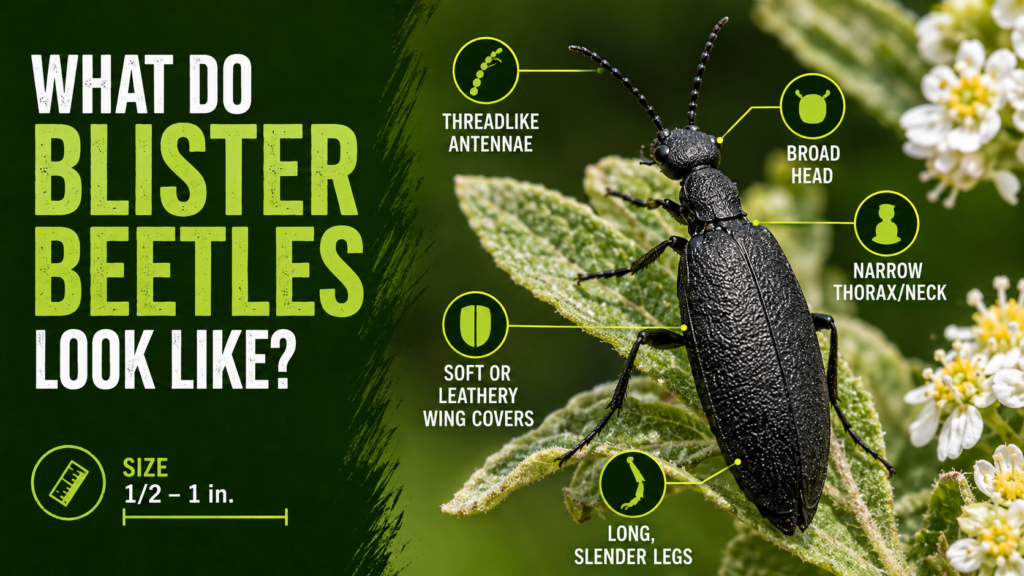
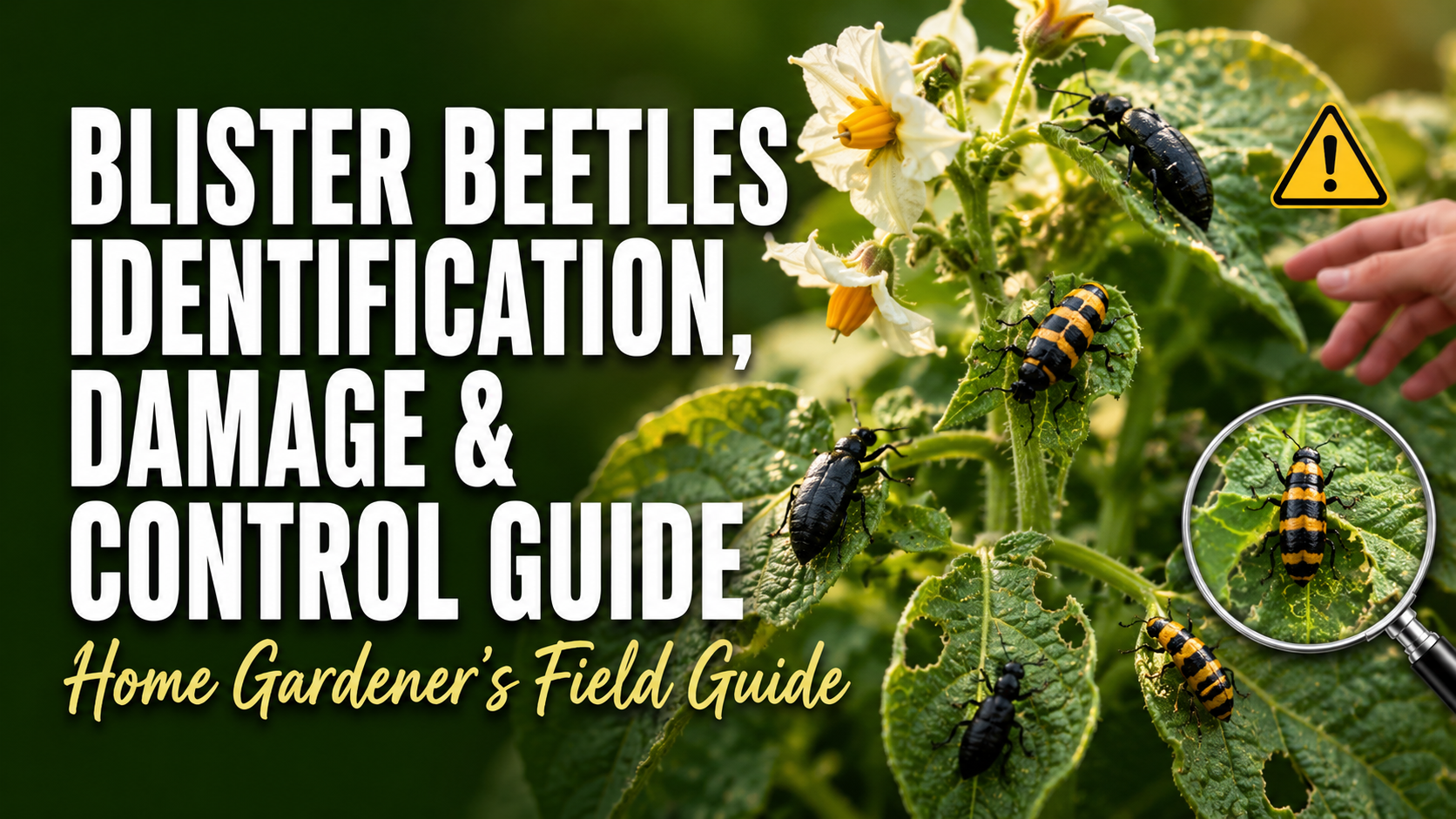
Blister beetles are members of the beetle family Meloidae. Adults are most often noticed on flowering plants and crops, where they feed on blossoms and foliage. Although color and markings vary widely, the family has a recognizable body plan: a relatively soft or leathery body, long legs, and a thorax that is narrower than the head and wing covers.
The name comes from cantharidin, a defensive chemical in the beetles’ body fluids. When a beetle is crushed, rubbed, or strongly disturbed, that chemical can contact skin or mucous membranes. This makes correct identification and careful handling more important than with many ordinary garden beetles.
What Do Blister Beetles Look Like?
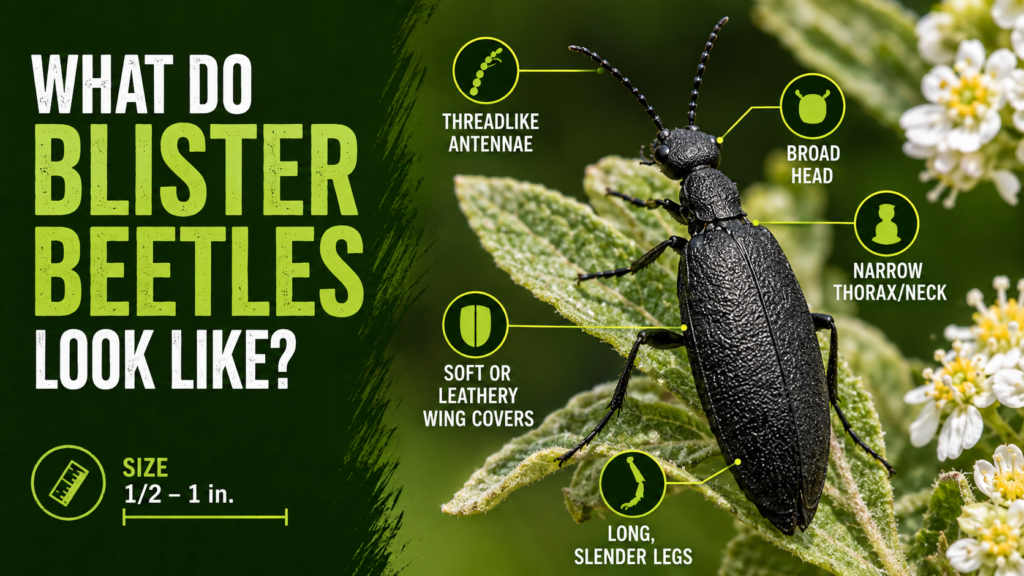
Color is not the most reliable way to identify a blister beetle. Some species are uniformly black or gray, while others are striped, spotted, or brightly marked. Shape is more useful.
- Elongated body with soft or leathery wing covers
- A distinctly narrow thorax or “neck”
- Head often wider than the thorax
- Long, slender legs and threadlike antennae
- Usually seen walking or feeding openly on flowers and foliage
- Often about 1/2 to 1 inch long, although species vary
University of Arizona identification guidance emphasizes the broad head and narrow thorax as one of the most useful field clues. NC State likewise highlights the narrow neck and soft wing covers as characteristic features.
Common Types of Blister Beetles
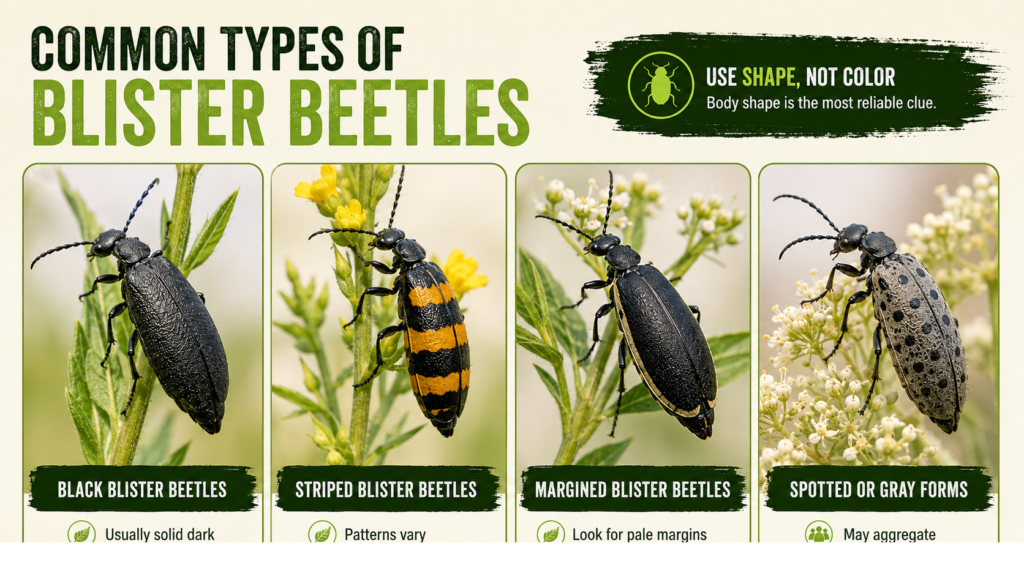
Thousands of blister beetle species occur worldwide, so a home gardener does not need to memorize every species. A few broad forms are especially useful to recognize:
| Type | Typical appearance | Practical note |
| Black blister beetles | Mostly black or very dark | Easy to confuse with other dark beetles; use neck/body shape. |
| Striped blister beetles | Longitudinal dark and pale/orange-brown stripes | Important in some crop and hay systems because they may aggregate. |
| Margined blister beetles | Dark body with pale margins or edging | Can feed on a range of crops. |
| Spotted or gray forms | Gray, mottled, or spotted | Appearance varies; shape remains the more dependable clue. |
Blister Beetle vs. Similar Beetles
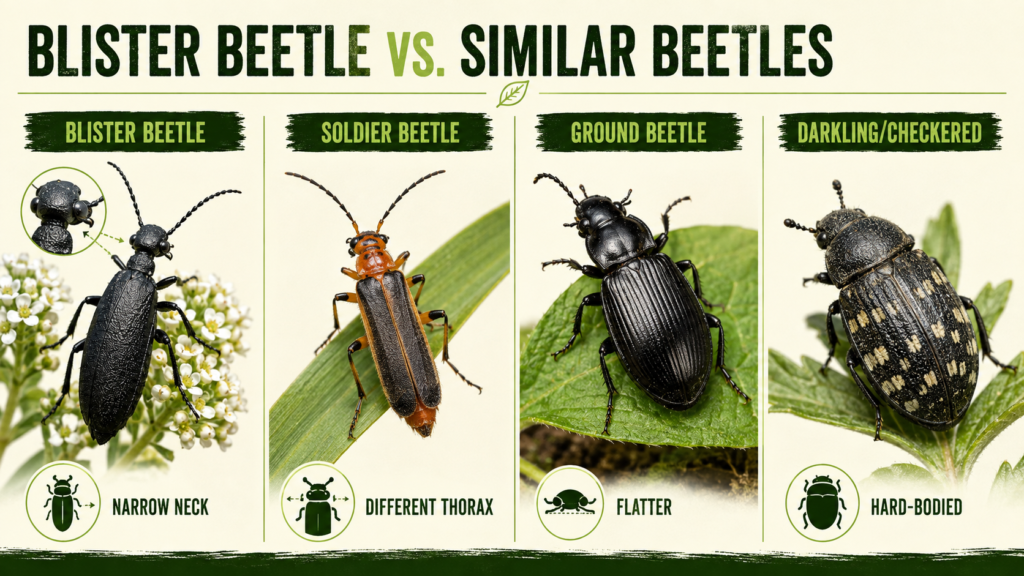
Misidentification is one of the biggest reasons gardeners make poor control decisions. Several beneficial or harmless beetles can look superficially similar, especially when seen quickly on flowers.
| Beetle | What can look similar | Best clue to separate it |
| Blister beetle | Long, soft-bodied form | Very narrow thorax/neck; head often wider than thorax |
| Soldier beetle | Soft-bodied and often found on flowers | Usually flatter and lacks the same pronounced narrow-neck profile |
| Ground beetle | Dark, elongated beetle | Harder-bodied, often fast-running on soil rather than clustered on flowers |
| Darkling/checkered beetles | May share similar colors or elongated shape | Body proportions and thorax shape differ; compare carefully before control |
When identification is uncertain, photograph the beetle from directly above and from the side and compare the head-to-thorax proportions before deciding on control.
Where Do Blister Beetles Live?
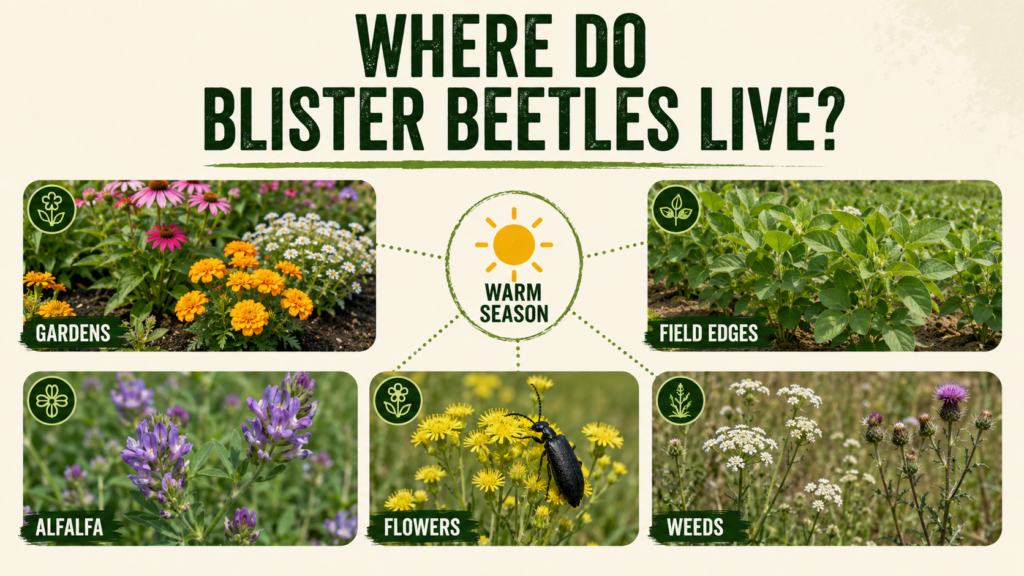
Adults are associated with flowers, crop foliage, weeds, gardens, field edges, and forage systems. They may appear suddenly because adults can move into an area and congregate where food is abundant. Local timing varies with climate and species; in many U.S. regions adults are most noticeable in the warmer part of the growing season.
In gardens and farms, attractive flowering weeds and crop blossoms can concentrate beetles. Oklahoma State notes that blister beetles may use plants such as pigweed and other flowering hosts, which is why weed management around fields and gardens can be part of an IPM program.
Blister Beetle Life Cycle
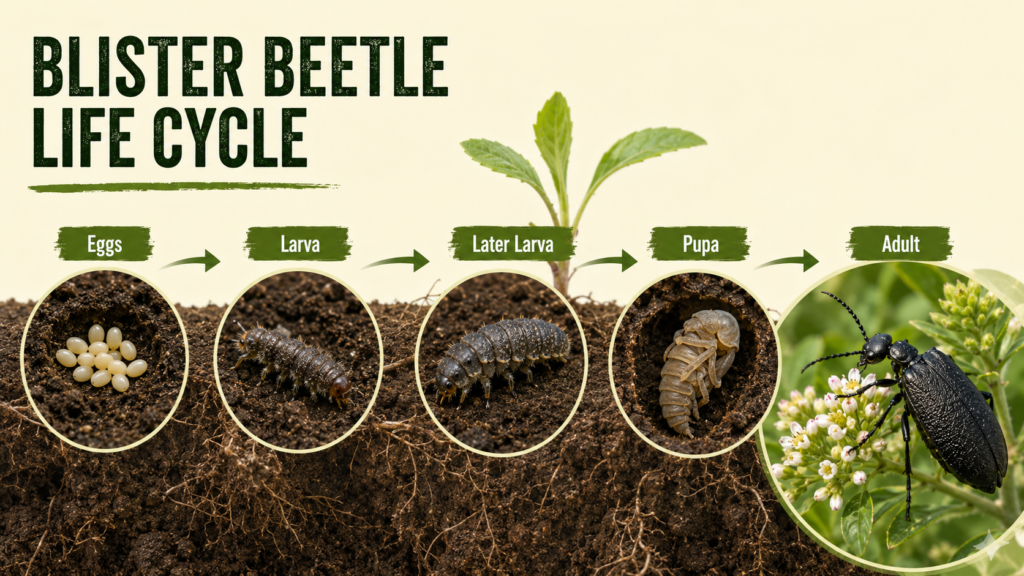
Blister beetles undergo complete metamorphosis: egg, larva, pupa, and adult. Their larval biology is unusually complex compared with many familiar garden beetles. Females typically lay eggs in soil, and the early larvae actively search for prey or hosts.
The adult is the stage gardeners usually see feeding on crops. The larvae are much less visible and may have a very different ecological role.
Are Blister Beetle Larvae Beneficial?
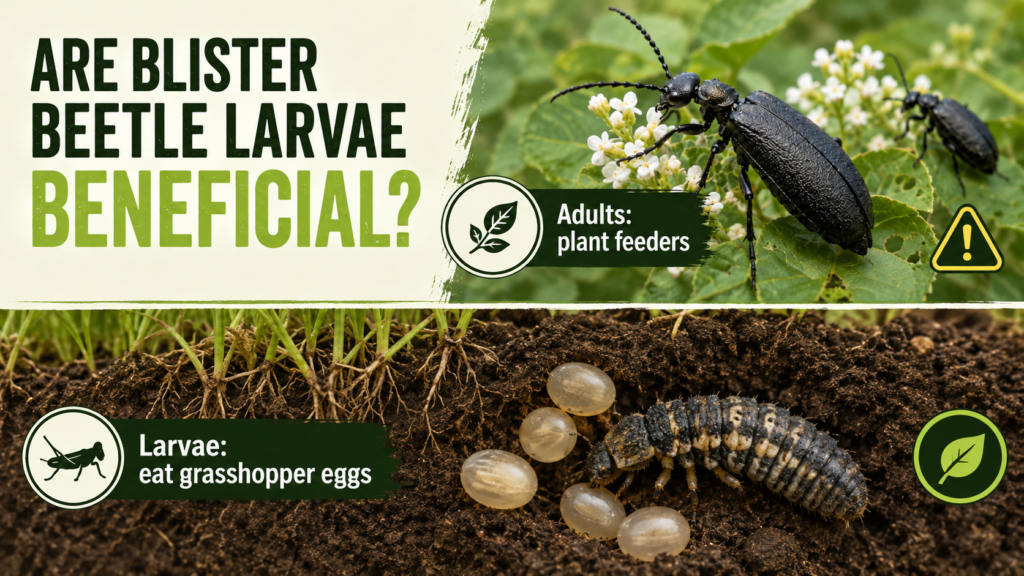
Often, yes. Larvae of many Epicauta species prey on grasshopper eggs in the soil, while larvae of some other blister beetles develop in bee nests. That means the insect’s ecological role changes across its life cycle: adults may be crop pests while some larvae can reduce other insect populations.
This is another reason to avoid broad, preventive insecticide use when only a few adults are present and plant injury is minor.
What Do Blister Beetles Eat?
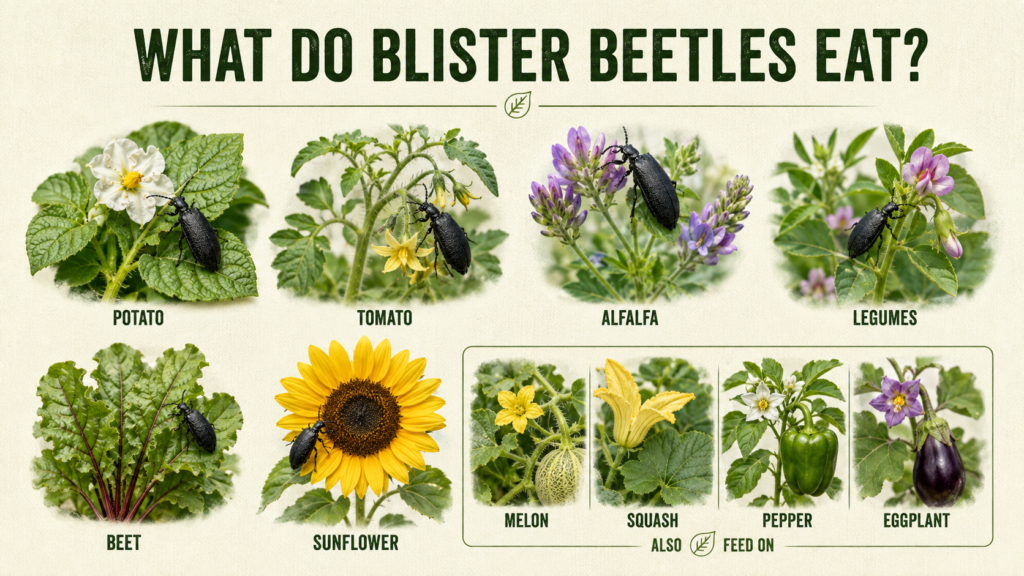
Adult blister beetles feed on plant material, particularly flowers and leaves. Host range varies by species, but Extension and medical references report blister beetles on a wide range of economically important plants.
- Potato
- Tomato and other solanaceous crops
- Alfalfa and sweet clover
- Beans, peas, and other legumes
- Beet
- Sunflower
- Melons, squash, pepper, and eggplant in some regions
- Flowering weeds and field-edge plants
What Does Blister Beetle Damage Look Like?
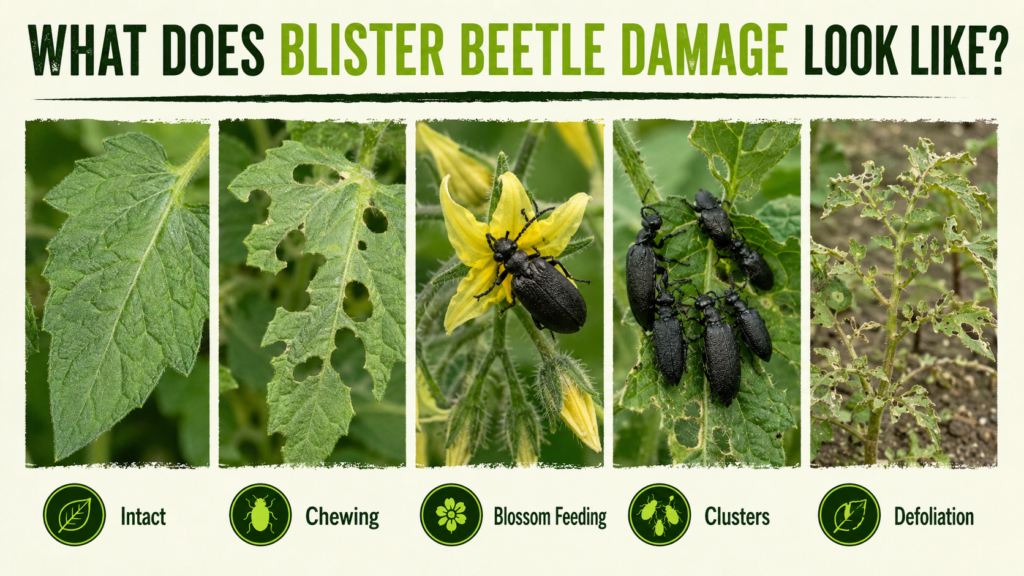
The adults have chewing mouthparts. Injury usually appears on the parts of plants where groups of beetles are actively feeding rather than as a hidden root problem.
- Irregular holes or ragged chewing on leaves
- Flowers or blossoms partly eaten
- Clusters of adult beetles concentrated on one plant or patch
- Rapid defoliation when large aggregations are present
- Feeding concentrated along field edges or around flowering hosts
A handful of beetles does not automatically mean serious crop loss. Control decisions should be based on plant injury, beetle numbers, crop value, and how quickly the group is increasing.
Which Garden Plants Are Most at Risk?
| Crop or plant | Typical adult feeding concern |
| Potato | Foliage feeding; adults may occur in groups. |
| Tomato / eggplant / pepper | Leaves, blossoms, and tender growth. |
| Alfalfa | Flowers and foliage; contamination of harvested hay is the greater livestock concern. |
| Beans and peas | Leaf and flower feeding. |
| Beet | Foliage feeding. |
| Sunflower and flowering plants | Adults may concentrate on flowers and pollen-rich parts. |
Are Blister Beetles Dangerous to People?
Blister beetles are a safety concern because of cantharidin, not because they aggressively attack people. When the beetle is crushed or rubbed, cantharidin-containing body fluid can contact skin and cause painful blistering. Eye exposure and ingestion are more serious concerns.
For gardeners, the practical rule is simple: do not crush blister beetles against bare skin, and do not rub your eyes after handling plants where beetles are present.
Do Blister Beetles Bite?
Blister beetles are not best thought of as biting insects. The characteristic blistering reaction is primarily caused by cantharidin released from the beetle’s body, especially when it is squeezed, crushed, or rubbed against skin.
What to Do After Skin or Eye Exposure
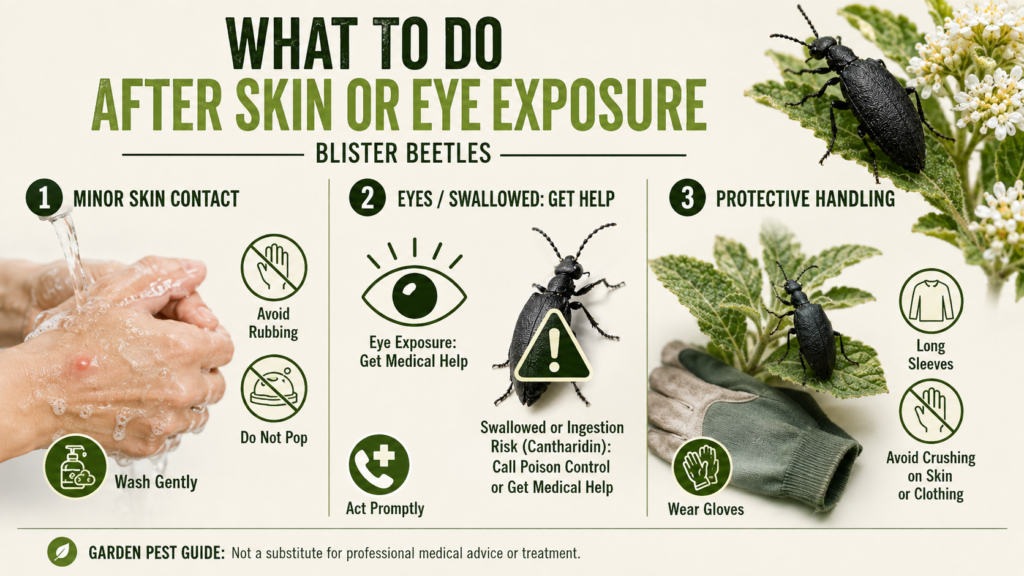
For minor skin contact, avoid further rubbing and wash the exposed area with soap and water. Do not intentionally break resulting blisters. If cantharidin gets into the eyes, if a beetle or cantharidin-containing material is swallowed, or if symptoms are severe, seek prompt medical or poison-control guidance. This article is a garden pest guide and is not a substitute for medical care.
Safety note: Wear gloves and long sleeves when removing blister beetles. Avoid crushing them against skin or clothing.
Why Blister Beetles Are Dangerous in Hay
For livestock owners, the major concern is not plant feeding but cantharidin contamination. Adult beetles may gather in alfalfa or other forage. If harvesting equipment crushes and traps them in hay, the toxic compound remains active in dried beetle bodies and fragments.
Horses are particularly sensitive. NC State and Oklahoma State both emphasize that contaminated hay can cause serious illness and, in severe cases, death. Because blister beetles may occur in dense local clusters, contamination can be uneven—one bale or part of a bale may contain far more beetles than another.
Hay producers and buyers should learn to identify adult beetles, inspect forage, manage flowering weeds, and follow region-specific harvesting recommendations. If livestock exposure is suspected, contact a veterinarian promptly.
How to Control Blister Beetles in the Garden
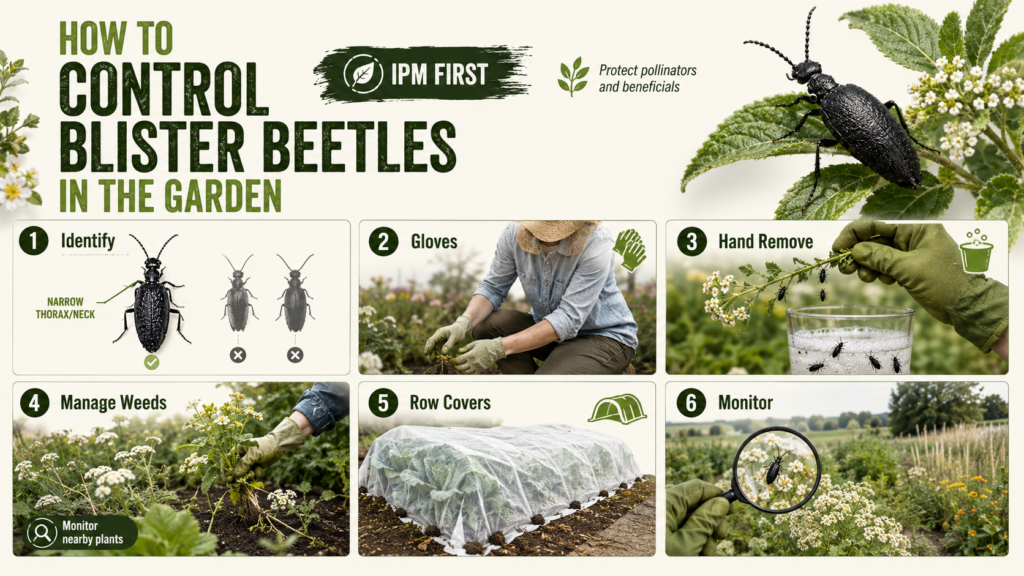
Use an integrated pest management approach. The goal is to stop meaningful plant injury while minimizing exposure to cantharidin and avoiding unnecessary harm to pollinators and beneficial insects.
1. Confirm the Identification
Before treating, check the narrow thorax/neck and compare the insect with soldier beetles, ground beetles, and other look-alikes. A wrong identification can turn a harmless or beneficial beetle into an unnecessary pesticide target.
2. Wear Gloves and Protective Clothing
Do not pick blister beetles up with bare hands. Wear gloves and long sleeves, particularly when brushing beetles from plants or removing groups by hand.
3. Remove Small Groups Manually
For a small garden infestation, manual removal is often the simplest option. Wearing gloves, knock or shake beetles into a container of soapy water. Handle them in a way that minimizes crushing against your skin or clothing.
4. Remove Attractive Weeds and Flowering Hosts
Flowering weeds in and around beds can attract adults. Manage problem weeds before they become major beetle gathering points, while remembering that abruptly removing a heavily infested host can sometimes cause adults to disperse to nearby plants. Monitor neighboring crops after weed removal.
5. Use Row Covers Where Practical
Well-secured row covers can help exclude incoming adults from susceptible vegetables. Covers work best when installed before beetles arrive and when edges are sealed. Remove or manage covers as needed for pollination on crops that depend on insect pollinators.
6. Monitor Garden Edges and Flowering Plants
Blister beetles can aggregate suddenly. Scout garden edges, weeds, flowers, and susceptible vegetables regularly during warm weather. Early detection makes hand removal far more practical.
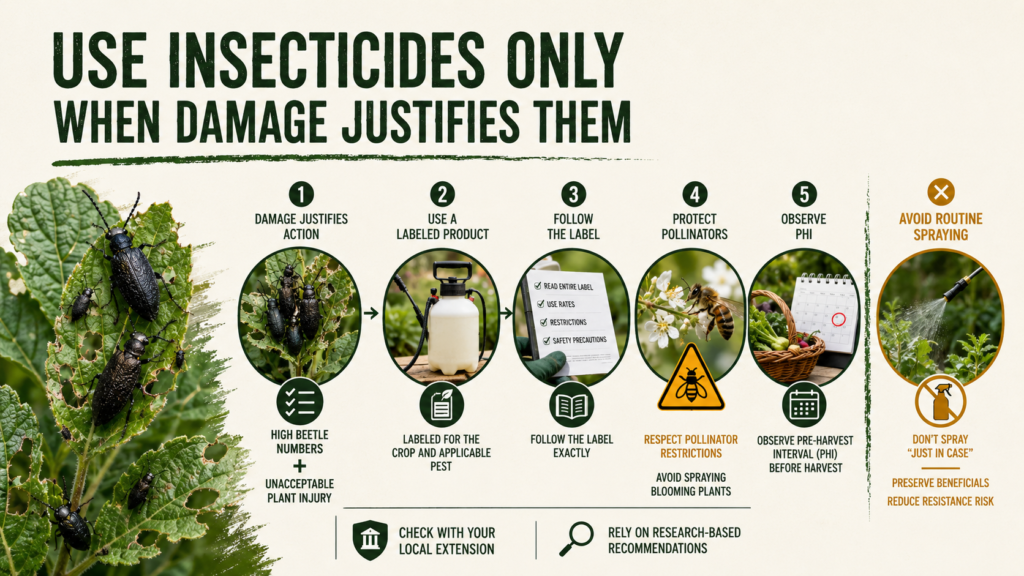
7. Use Insecticides Only When Damage Justifies Them
If beetle numbers are high and plant injury is unacceptable, choose an insecticide labeled for the crop and applicable pest, follow the label exactly, respect pollinator restrictions and pre-harvest intervals, and avoid routine broad-spectrum spraying. Product registrations vary by crop, location, and time, so the current label and local Extension guidance should be the authority.
How to Prevent Blister Beetle Problems
- Scout flowering crops and garden edges before populations build.
- Keep highly attractive broadleaf weeds from becoming unmanaged beetle reservoirs.
- Use exclusion covers on suitable vegetables before adults arrive.
- Avoid unnecessary broad-spectrum insecticide use that can disrupt natural enemies and pollinators.
- Know the local blister beetle season and species where you garden.
- For hay systems, inspect fields and follow forage-specific harvest recommendations.
Common Blister Beetle Control Mistakes
| Mistake | Why it matters | Better approach |
| Handling beetles bare-handed | Cantharidin may contact skin | Wear gloves and long sleeves |
| Crushing beetles against skin | Releases blistering body fluid | Knock into a container instead |
| Spraying before identification | Look-alikes may be harmless or beneficial | Confirm the narrow-neck ID first |
| Ignoring flowering weeds | Adults may concentrate on attractive hosts | Manage weeds and monitor nearby crops |
| Waiting until a large aggregation forms | Manual removal becomes harder | Scout regularly |
| Using broad-spectrum sprays routinely | Can harm pollinators and beneficial insects | Use IPM and treat only when justified |
| Assuming all life stages are pests | Some larvae prey on grasshopper eggs | Target damaging adult outbreaks |
| Treating hay risk like a home-garden issue | Livestock exposure requires different management | Follow forage and veterinary guidance |
Frequently Asked Questions
What is a blister beetle?
A blister beetle is a member of the family Meloidae. Adults are generally elongated and soft-bodied, with a narrow thorax or neck, and they produce cantharidin.
What does a blister beetle look like?
Look for a long, relatively soft body, long legs and antennae, and especially a head that appears broad compared with the narrow thorax.
Are blister beetles dangerous?
They can be. Cantharidin can blister skin and irritate eyes; ingestion is more serious. They are also an important livestock concern when contaminated beetles enter hay.
Do blister beetles bite people?
The main hazard is not biting. Blistering typically results from cantharidin released when the beetle is crushed or rubbed against skin.
What plants do blister beetles eat?
Adults can feed on flowers and foliage of crops including potato, tomato, alfalfa, legumes, beet, sunflower, and other garden plants, depending on species.
How do I get rid of blister beetles naturally?
For small infestations, wear gloves and knock beetles into soapy water, manage attractive weeds, monitor regularly, and use row covers where appropriate.