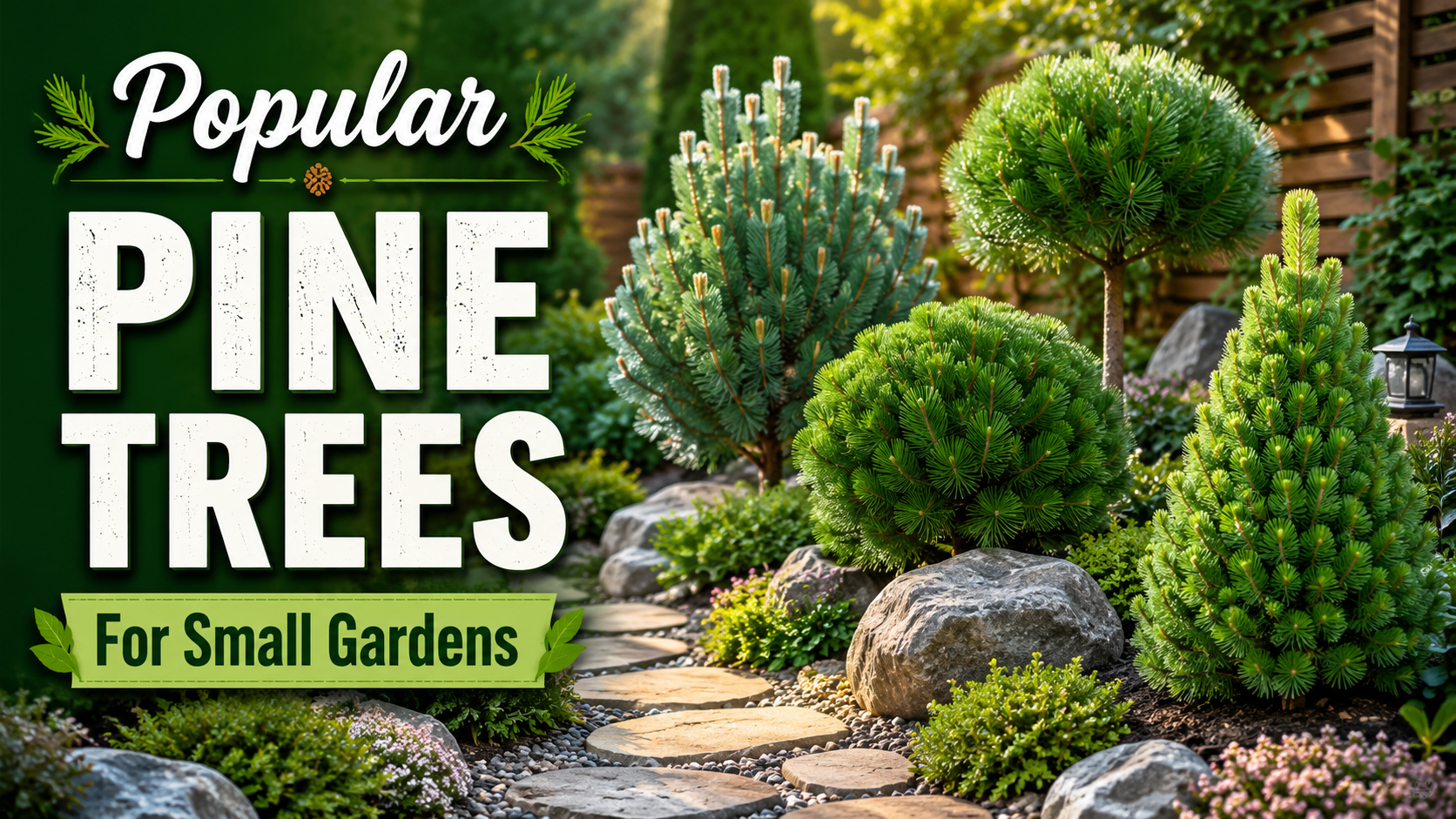

Compact, dwarf, and narrow pine trees that bring year-round structure to a small garden—without becoming tomorrow’s overcrowding problem.
pine trees can work beautifully in a small garden, but choose a named dwarf, compact, or naturally narrow cultivar and plan for its mature dimensions, not its nursery-pot size. For most compact spaces, a mugo pine, dwarf eastern white pine, or Japanese white pine cultivar is a safer starting point than a young standard pine.
Can pine trees grow in small gardens?
A true pine belongs to the genus Pinus. That matters because many plants sold casually as “pines” are actually spruces, firs, cedars, or cypresses, each with different growth habits. A genuine compact pine can give a small garden lasting winter color, texture, and a strong focal point—but only when its eventual height and spread suit the site.
Terms such as dwarf, compact, and slow-growing are useful but not absolute. A dwarf pine may still reach 6 to 10 feet over decades, while a slow-growing young standard pine can eventually become far too large. Growth changes with soil, rainfall, climate, root room, and regional conditions, so use published mature dimensions as a planning guide and confirm them with a reputable local nursery.
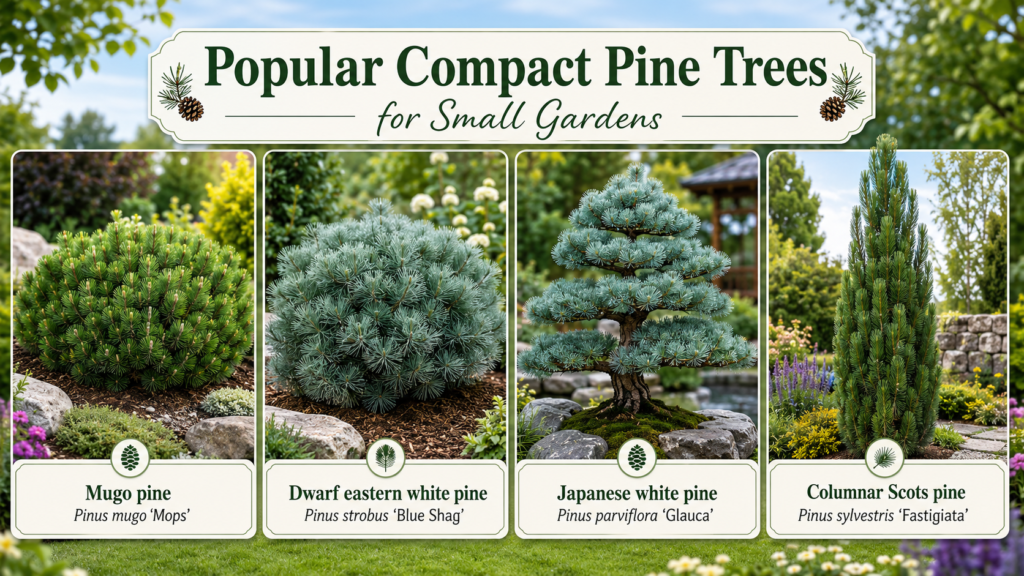
Popular compact pine trees for small gardens
The sizes below are realistic landscape estimates for commonly sold cultivars, not guarantees. Read cultivar labels carefully: two plants sharing the same species name can mature at very different sizes.
| Pine tree | Typical mature size | Growth & hardiness | Best use |
|---|---|---|---|
| Mugo pine, Pinus mugo ‘Mops’ | 3–5 ft tall × 5–7 ft wide | Slow; USDA Zones 2–7 | Sunny border, rock garden, low evergreen mass |
| Dwarf eastern white pine, Pinus strobus ‘Blue Shag’ | 4–6 ft tall × 5–6 ft wide | Slow to moderate; Zones 3–8 | Soft-textured focal point or mixed border |
| Japanese white pine, Pinus parviflora ‘Glauca’ | 6–15 ft tall × 6–12 ft wide | Slow; Zones 5–7 | Specimen tree where there is room to mature |
| Columnar Scots pine, Pinus sylvestris ‘Fastigiata’ | 15–25 ft tall × 5–8 ft wide | Moderate; Zones 3–7 | Narrow vertical accent; not for tiny beds |
Best all-round dwarf pine: mugo pine
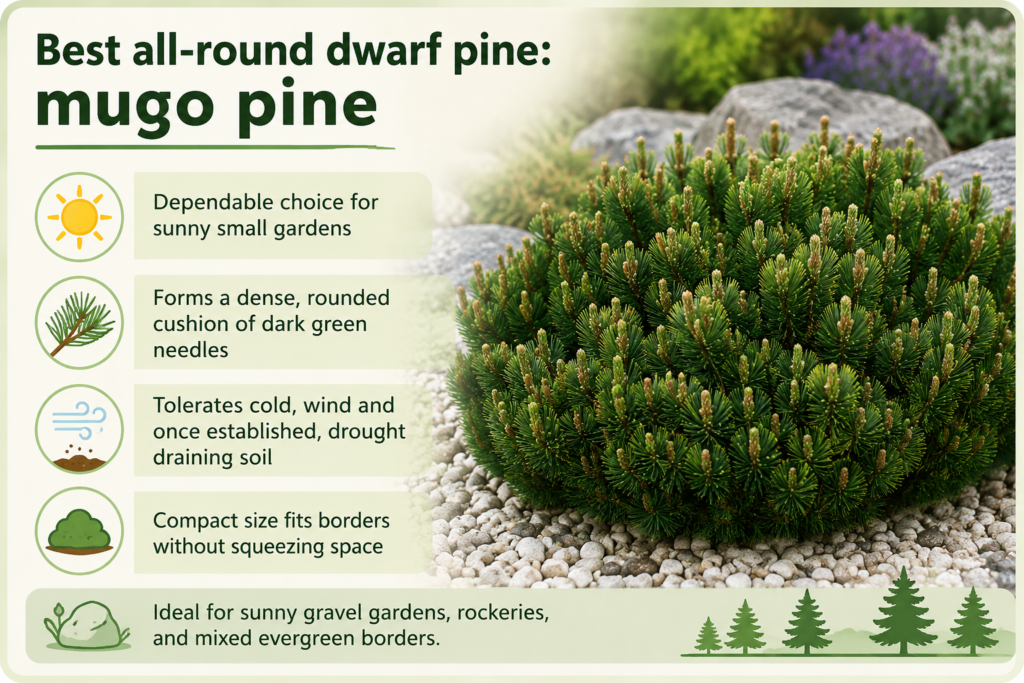
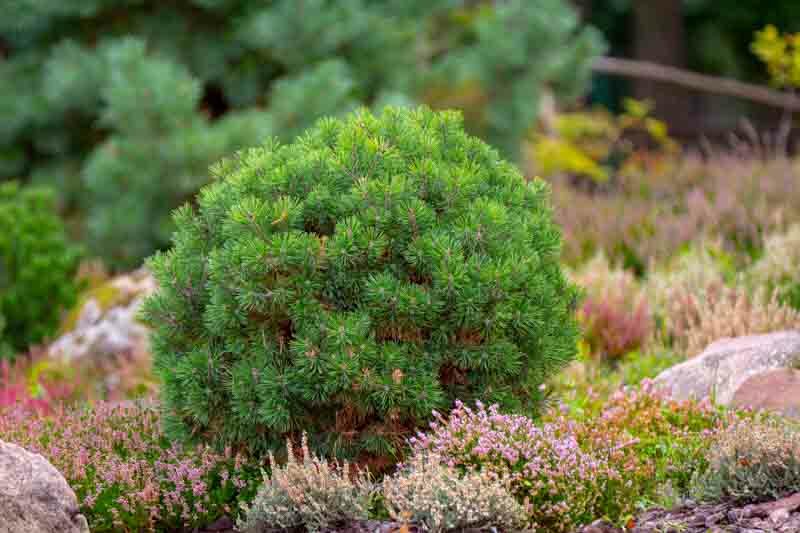
Mugo pine is one of the most dependable choices for a sunny small garden. Pinus mugo ‘Mops’ forms a dense, rounded cushion of dark green needles and is usually sold as a true dwarf selection. It tolerates cold conditions and wind well once established, but it needs freely draining soil. Its width is often greater than its height, so give it enough room at the front of a border rather than squeezing it between paving and a path.
Compact, rounded pines are especially useful in sunny gravel gardens, rockeries, and mixed evergreen borders.
For soft blue-green texture: dwarf eastern white pine
Pinus strobus cultivars offer soft, flexible needles that look less formal than many dense conifers. ‘Blue Shag’ is widely valued for its compact, rounded form and blue-green color. It is a good choice for cool to moderately cold climates, but eastern white pines can be vulnerable to white pine blister rust in some regions. Ask a local extension service or nursery whether that disease is significant where you live.
For a sculptural specimen: Japanese white pine
Japanese white pine, Pinus parviflora, has elegant blue-green needles and a naturally artistic habit. It is slower than many landscape pines and can make a memorable focal point, particularly in a gravel, Japanese-inspired, or architectural garden. It is not truly tiny, however. Choose a named dwarf cultivar where space is very limited, and do not rely on pruning alone to contain a standard form.
How to choose the right pine for your space
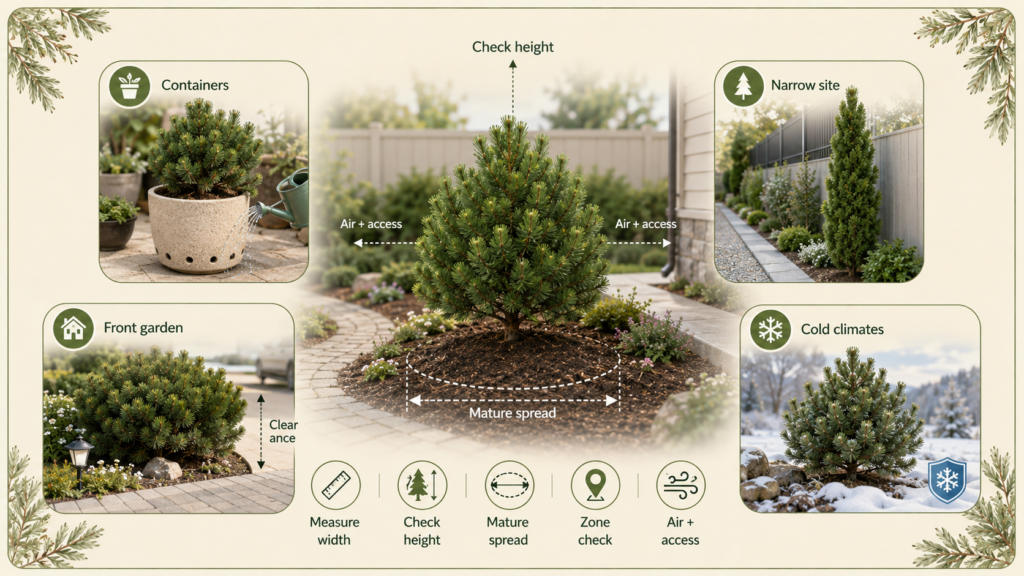
Start with the footprint, not the foliage. Measure the width available at ground level, check overhead wires and windows, and allow clearance from paths, fences, drains, and foundations. Then choose a pine tree whose mature spread fits that space with room for air and access.
Best pine for containers
Choose a genuinely dwarf mugo pine or a named miniature cultivar. Use a frost-resistant pot with large drainage holes, and plan to water more often than an in-ground plant.
Best pine for a narrow site
A narrow or fastigiate pine adds height without a broad canopy, but check the final height carefully. Columnar does not always mean small.
Best pine for a front garden
A mugo pine makes a low-maintenance, year-round anchor near lower planting. Keep its mature width clear of sidewalks and driveways.
Best pine for colder climates
Mugo pine is notably hardy and is commonly grown in cold-winter regions. Confirm the exact cultivar’s zone rating before buying.
Climate is a final filter, not an afterthought. Check USDA hardiness zones in North America or an equivalent local rating elsewhere, and ask about summer heat, humidity, salt exposure, and local pests. Also check regional invasive-species guidance before planting any pine.
A compact conifer can work in a large container, but restricted root space means watering and winter protection need more attention. When planting near a route through the garden, always allow for the mature width of branches—not only the trunk.
Planting and caring for a compact pine tree
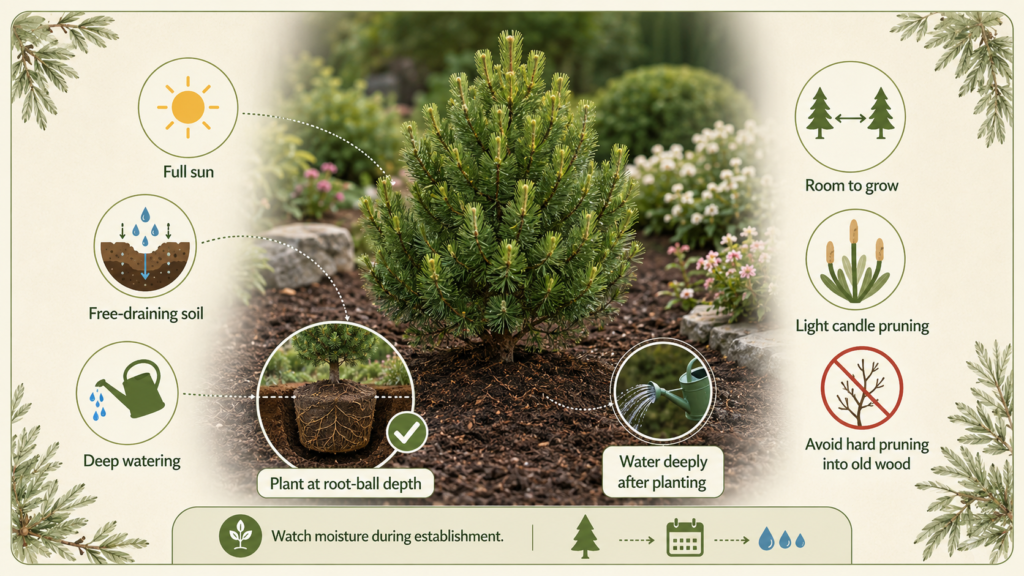
Most pines are low-maintenance once their roots are established, but planting site and drainage make a major difference. Plant in the cooler part of the growing season where possible, water deeply after planting, and watch the soil moisture through the first two summers.
Plant at the same depth as the root ball, water thoroughly, and keep mulch clear of the trunk.
- Sun: most pine trees need full sun—ideally at least six hours of direct light daily—to stay dense and healthy.
- Soil: free drainage is essential. Many pines tolerate ordinary garden soil but struggle where water sits around roots in winter.
- Water: give new trees a deep soak during dry weather. Established pines are often drought-tolerant, but container plants dry out quickly.
- Space: plant with the mature spread in mind. Pine roots are not usually aggressive in the way that some large trees can be, but any tree planted too close to paving or foundations can create future management problems.
- Pruning: do not use routine hard pruning to keep a large pine small. If needed, lightly shorten new spring candles before needles fully expand; never cut back into bare old wood expecting it to regrow.
Common mistakes to avoid
A compact pine can be an easy long-term plant, but most disappointments begin at selection or planting. These are the two issues worth preventing before the tree goes in the ground.
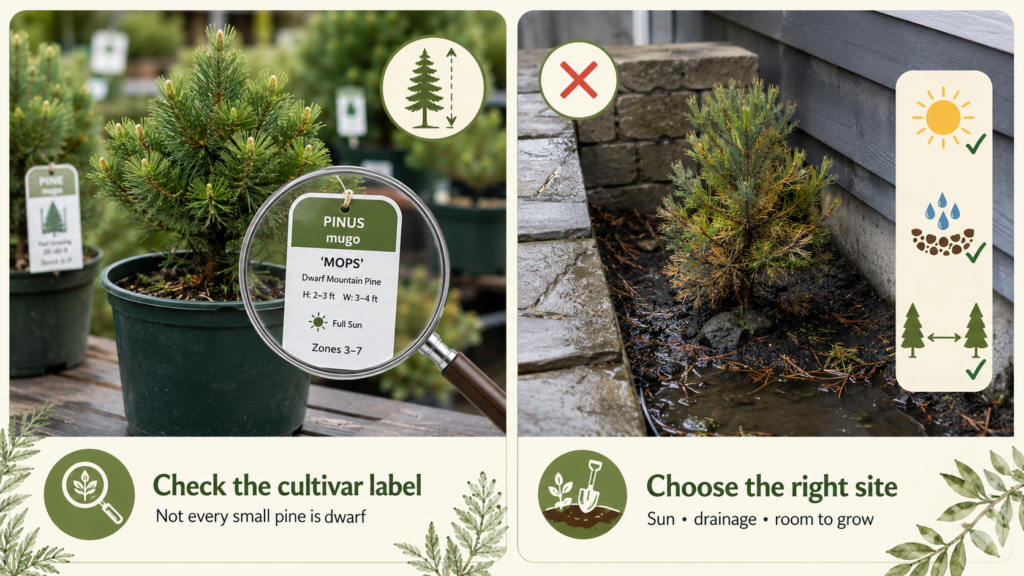
Buying a young standard pine as a “dwarf” tree
A small plant in a nursery container is not necessarily a dwarf cultivar. Look for a complete botanical label that includes the species and cultivar name, such as Pinus mugo ‘Mops’. Research its mature height and spread through a botanical garden, extension service, recognized nursery, or breeder listing before purchase.
Planting into shade, wet ground, or a tight corner
Pines generally become thin and open in insufficient light, and poor drainage can weaken roots. Avoid narrow strips between a house and paving, areas beneath roof runoff, and locations where future branch spread will block access or crowd neighboring plants.
Frequently asked questions
What is the smallest type of pine tree?
Named miniature and dwarf cultivars are the smallest options, rather than an entire pine species. Some dwarf mugo pines remain only a few feet tall and wide for many years. Always check the cultivar name and its long-term mature dimensions because “dwarf” does not mean it will never grow.
Can pine trees grow in containers?
Yes, provided you choose a compact cultivar and a substantial container with excellent drainage. A potted pine needs more regular watering, occasional repotting or root assessment, and protection from severe winter freeze-thaw cycles. Container growing slows growth but is not a substitute for choosing an appropriately sized pine.
Can I prune a pine tree to keep it small?
Only to a limited extent. Light candle pruning can modestly control annual extension growth on suitable pines, but it cannot safely turn a naturally large tree into a permanent dwarf. The reliable solution is to select a pine tree with a mature size that already fits your garden.