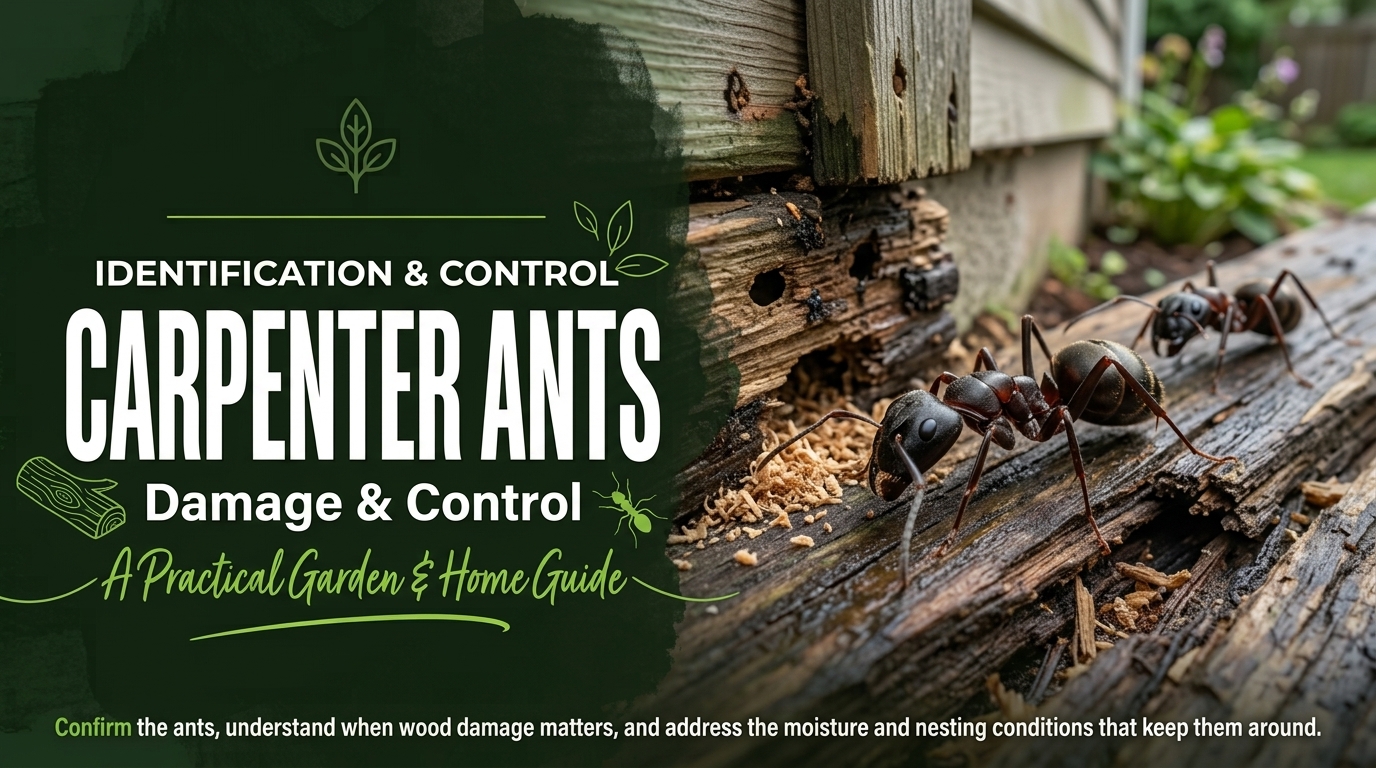

A practical way to confirm carpenter ants, understand when wood damage matters, and address the moisture and nesting conditions that keep them around.
Quick answer
Carpenter ants do not eat wood like termites. They excavate smooth galleries, usually in damp, decaying, or previously damaged wood. A few foraging ants outdoors may not need treatment; repeated indoor activity, sawdust-like debris, or moisture-damaged wood is worth investigating.
How to identify carpenter ants
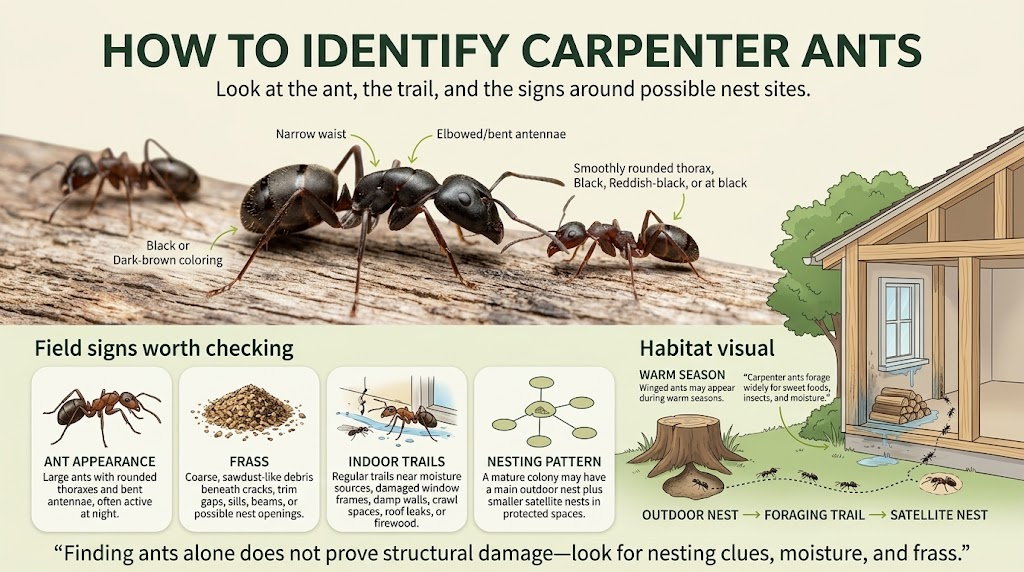
Carpenter ants are among the largest ants homeowners see, commonly black, reddish-black, or dark brown. Their body has a narrow waist, elbowed antennae, and a smoothly rounded thorax when viewed from the side. Workers vary in size within the same colony, so finding both large and smaller ants can be a useful clue.
Field signs worth checking
- Large ants with a rounded thorax and bent antennae, often active along branches, fences, or interior edges at night.
- Coarse, sawdust-like debris called frass below a crack, trim gap, sill, beam, or other possible nest opening.
- Regular indoor trails near a water source, damp wall, damaged window frame, crawl space, roof leak, or firewood storage area.
A mature colony may contain a main nest outdoors and smaller satellite nests in suitable protected spaces. Carpenter ants forage widely for sweet foods, insects, and moisture. Winged ants can appear during warm seasons, but one winged ant does not prove an indoor structural nest.
What damage do carpenter ants cause?
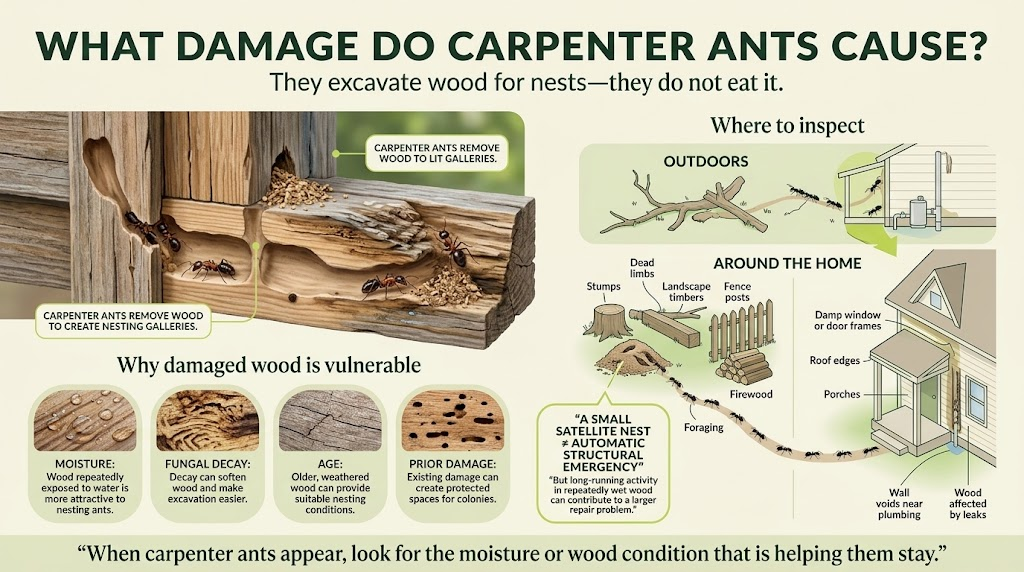
Carpenter ants remove wood to create nesting galleries; they do not consume it for food. Their tunnels are typically smooth and clean-looking inside. They are most likely to use wood softened by moisture, fungal decay, age, or prior damage. One small satellite nest is not automatically a structural emergency, but long-running activity in repeatedly wet wood can contribute to a larger repair problem.
Places they commonly nest or forage
Outside, carpenter ants commonly use stumps, dead limbs, landscape timbers, fence posts, and firewood. Around homes, inspect damp window or door frames, roof edges, porches, wall voids near plumbing, and wood that has stayed wet after a leak. They can also travel indoors from a nearby outdoor nest while foraging.
What can look like a carpenter ant?
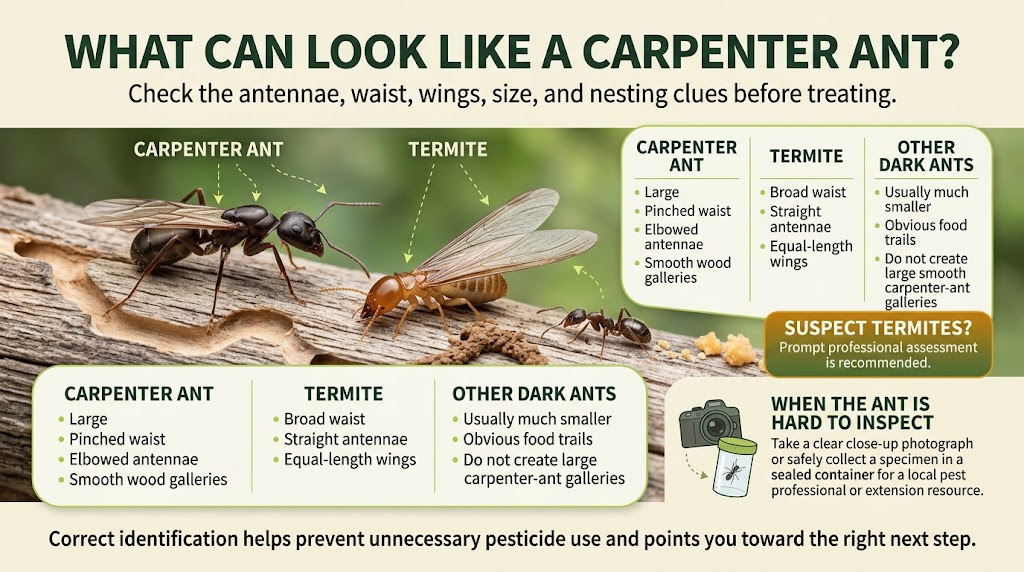
Correct identification prevents unnecessary pesticide use and helps you choose the right next step. When ants are difficult to inspect, take a clear close-up photograph or collect a specimen in a sealed container for a local pest professional or extension resource.
Termites
Termites have straight, bead-like antennae and a broad waist. Winged termites have four wings of similar length. Carpenter ants have elbowed antennae, a pinched waist, and front wings longer than back wings. Suspected termites deserve prompt professional assessment.
Pavement ants and other dark ants
Many household ants are much smaller than carpenter ants and often form obvious trails to crumbs or sweets. They can still be a nuisance, but they do not excavate the large, smooth galleries associated with carpenter ant nesting.
A least-disruptive carpenter ant control plan
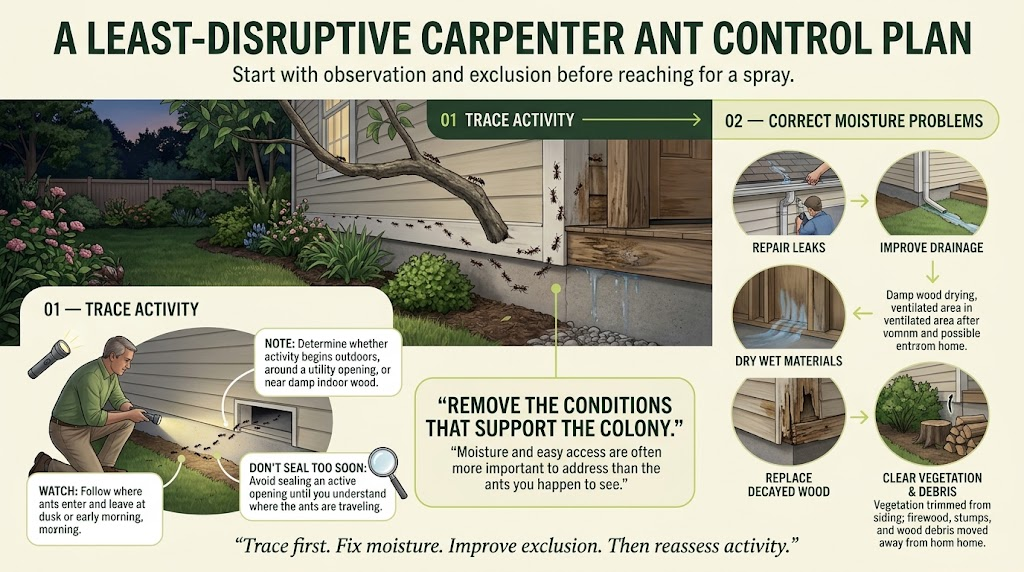
The most reliable long-term approach is to remove the conditions that support the colony, particularly moisture and easy access. Start with observation and exclusion before reaching for a spray.
Trace activity
Watch where ants enter and leave at dusk or early morning. Note whether activity begins outdoors, around a utility opening, or near damp indoor wood. Avoid sealing an active opening until you understand where the ants are traveling.
Correct moisture problems
Repair plumbing and roof leaks, improve drainage, dry wet materials, and replace badly decayed wood where practical. Trim vegetation away from siding and move firewood, stumps, and wood debris away from the home.
Use targeted treatment only if needed
For persistent indoor activity, a labelled ant bait or a treatment applied directly to an identified nest may be more useful than broad perimeter spraying. Follow the product label exactly and keep treatments away from children, pets, pollinators, and food areas.
What I avoid
Avoid repeatedly spraying visible foraging ants without addressing moisture or nest access. This may only disrupt a trail temporarily and can expose people, pets, and beneficial insects to more pesticide than necessary. Never use a product indoors or in a wall void unless its label specifically allows that use.
Prevention and when to get more help
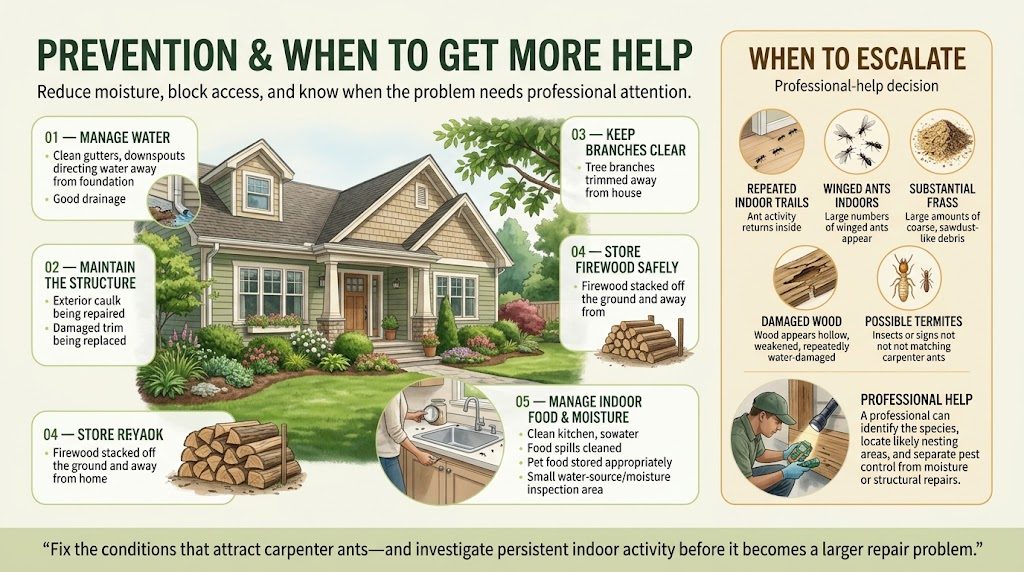
Keep gutters flowing, direct water away from the foundation, repair exterior caulk and damaged trim, and keep branches from touching the structure. Store firewood off the ground and away from the house. Indoors, clean food spills, manage pet food, and watch for recurring activity near water sources.
When to escalate
Contact a qualified pest-control professional or building repair specialist if you find repeated indoor trails, large numbers of winged ants indoors, substantial frass, hollow or water-damaged wood, or signs that could be termites. A professional can identify the species, locate likely nesting areas, and help separate pest control from needed moisture or structural repairs.
Frequently Asked Question’s
Are carpenter ants harmful to people or pets?
Carpenter ants are not generally dangerous to people or pets. They can bite if handled, but they do not sting and are not known to spread disease in homes. Their main concern is persistent nesting in moisture-damaged wood.
Why do I see carpenter ants in my kitchen?
Foragers may enter for sweet foods, grease, pet food, insects, or water. Seeing a few ants near food does not prove a nest is inside. Repeated activity at the same time or location, especially near moisture, is a stronger reason to inspect further.