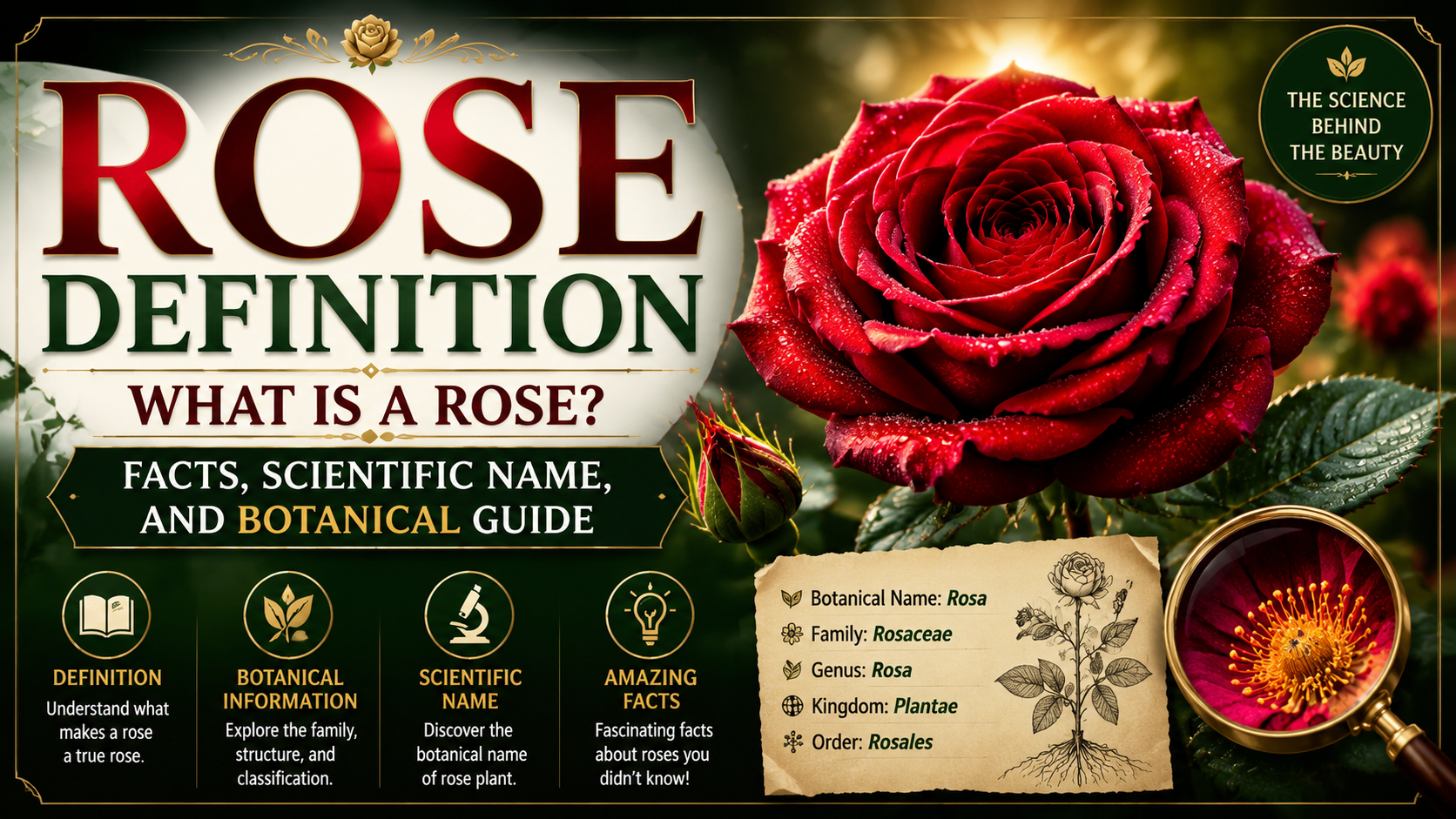

Discover the true definition of a rose, learn the scientific name and botanical classification, and explore fascinating facts about one of the world’s most important flowering plants.
The rose is far more than a beautiful flower — it is a scientifically fascinating genus with thousands of species, a 35-million-year evolutionary history, and a botanical classification that connects it to apples, strawberries, and almonds.
Whether you are a student researching plant biology, a home gardener wanting deeper knowledge, or simply curious about what makes a rose a rose, this guide provides accurate botanical facts and clear scientific explanations. We separate reliable plant science from oversimplified descriptions found elsewhere online.
What Is a Rose? The True Rose Definition

A rose is a woody perennial flowering plant belonging to the genus Rosa in the family Rosaceae. The rose definition in botany refers specifically to any species within this genus — a group of over 300 recognized wild species and tens of thousands of cultivated varieties (cultivars). Roses are characterized by their thorny stems, compound leaves with serrated leaflets, and showy flowers with multiple petals arranged in a spiral pattern.
What makes a flower a rose is its specific combination of botanical features: five-petaled flowers in wild species (cultivated roses may have many more through selective breeding), alternate compound leaves typically with 5–7 leaflets, prickles (not true thorns) on stems, and fruit called rose hips that develop after pollination. These features distinguish roses from other flowering plants.
Roses are native to Asia, with smaller numbers of species native to Europe, North America, and northwestern Africa. They grow as shrubs, climbers, or ground-cover plants depending on the species. Most wild roses have simple five-petal flowers, while the full, many-petaled blooms we associate with garden roses are the result of centuries of selective breeding by horticulturists.
Rose Scientific Name: The Botanical Name of Rose Plant
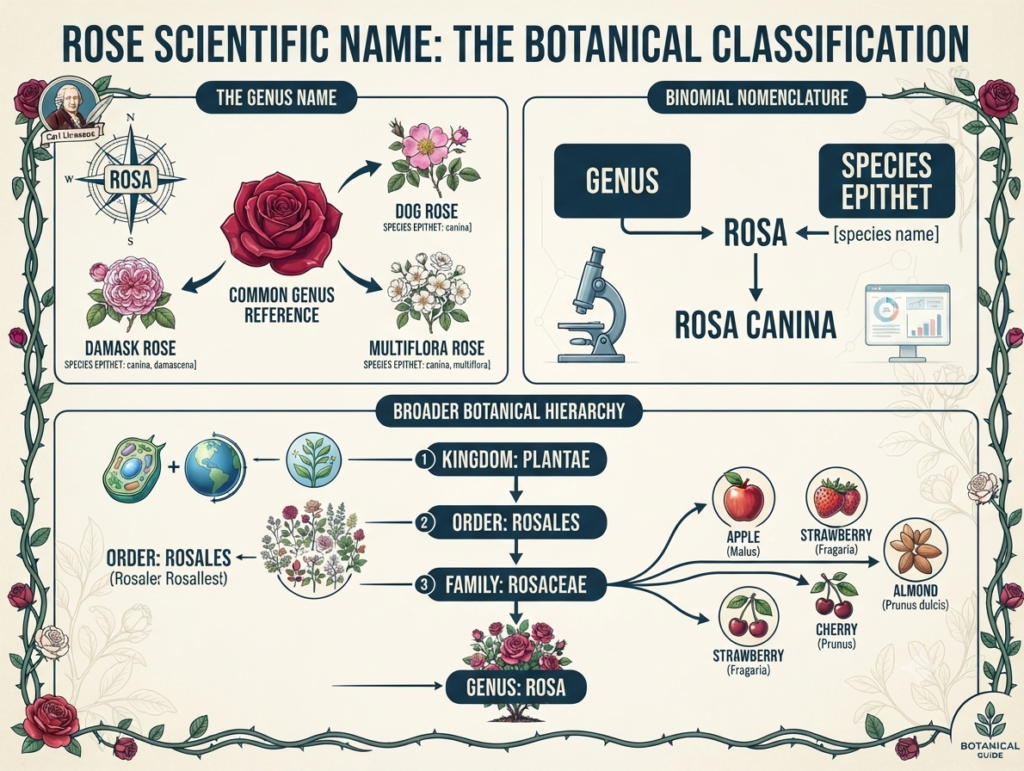
The botanical name of rose plant is Rosa, which serves as both the genus name and the common scientific reference for all rose species. When botanists refer to the rose scientific name, they use the binomial nomenclature system established by Carl Linnaeus in the 18th century. For example, the dog rose is Rosa canina, the damask rose is Rosa damascena, and the multiflora rose is Rosa multiflora.
The biological name of rose follows a two-part structure: the genus name (Rosa) followed by the species epithet. The rose science name places it within the broader classification: Kingdom Plantae, Order Rosales, Family Rosaceae, Genus Rosa. This family — Rosaceae — is remarkably diverse and includes familiar plants like apples (Malus), strawberries (Fragaria), cherries (Prunus), and almonds.
Understanding the botanical name rose helps gardeners and students identify relationships between plants. Because roses share a family with fruit trees, they are susceptible to similar diseases and benefit from similar growing conditions. The genus Rosa itself is divided into four subgenera and numerous sections, reflecting the enormous diversity within this single plant group.
Fascinating Facts About Roses Plants
Rose fossils dating back 35 million years have been discovered in Colorado, USA — making roses one of the oldest flowering plants still cultivated today. There are over 30,000 registered cultivated rose varieties worldwide, yet only about 150 species exist in the wild. The largest rose bush in the world, located in Tombstone, Arizona, covers over 8,000 square feet and produces more than 200,000 blooms each spring.
Roses reproduce both sexually (through seeds in rose hips) and asexually (through cuttings, layering, and grafting). A single rose hip can contain 5 to 160 seeds depending on the species. Rose hips are exceptionally rich in Vitamin C — containing 20 times more than oranges by weight — and have been used in traditional medicine for centuries. Rose petals are edible and used in cooking, perfumery, and cosmetics worldwide.
The rose industry is enormous: over 150 million rose plants are purchased by gardeners every year, and the global cut rose market produces billions of stems annually. Ecuador, Colombia, Kenya, and the Netherlands are the world’s largest rose exporters. Roses require at least 6 hours of direct sunlight daily and prefer well-drained, slightly acidic soil with a pH between 6.0 and 6.5 for optimal growth.
Rose Botanical Classification at a Glance
Understanding where roses fit in the plant kingdom helps explain their characteristics, relatives, and evolutionary history.
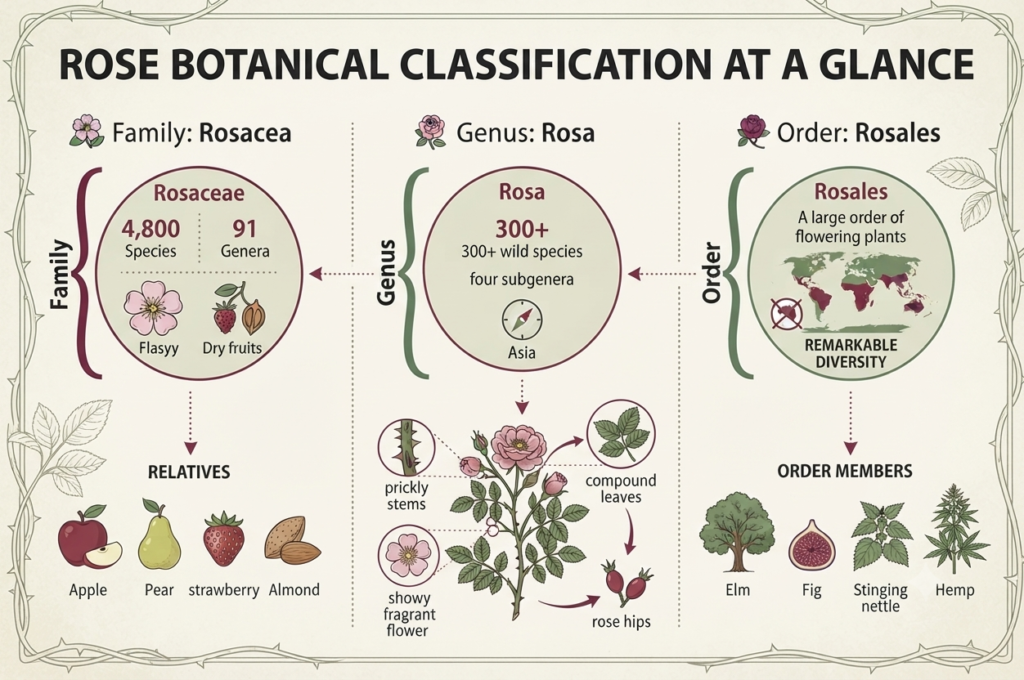
Family: Rosaceae
The rose family includes over 4,800 species across 91 genera. Members share features like five-petaled flowers and fleshy or dry fruits. Relatives include apples, pears, strawberries, and almonds.
Genus: Rosa
Contains 300+ wild species divided into four subgenera. Native primarily to Asia. Characterized by prickly stems, compound leaves, and showy fragrant flowers that develop into rose hips.
Order: Rosales
A large order of flowering plants that also includes elms, figs, nettles, and hemp. Rosales members are found on every continent except Antarctica and display remarkable ecological diversity.
Rose Plant Structure: Anatomy and Growth
A rose plant consists of roots, stems (canes), leaves, flowers, and fruit (hips). The stems are woody and covered with prickles — sharp outgrowths of the stem’s outer layer (epidermis). Contrary to popular belief, roses have prickles rather than true thorns. True thorns are modified stems, while prickles are extensions of the bark that can be easily broken off.
Rose leaves are pinnately compound, meaning multiple leaflets are arranged along a central stalk (rachis). Most species have 5–7 oval leaflets with serrated (toothed) edges. The leaves are alternate — growing one per node in a spiral pattern up the stem. Leaf color ranges from bright green to deep burgundy depending on variety and new growth stage.
Rose flowers in wild species have five petals, five sepals, and numerous stamens. Cultivated roses may have 25 to over 100 petals due to a mutation called ‘doubling’ where stamens transform into additional petals. Roses are pollinated primarily by bees, and their fragrance — produced by volatile oils in petal cells — evolved to attract these pollinators.
The Evolutionary History of Roses
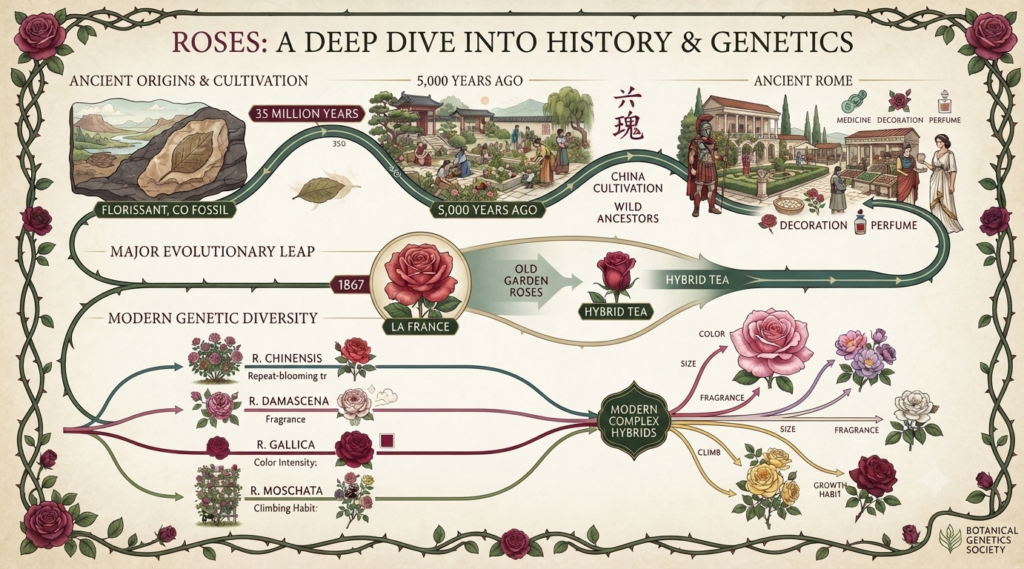
Fossil evidence shows roses have existed for at least 35 million years. The oldest known rose fossil was found in Florissant, Colorado. Roses were cultivated in China as early as 5,000 years ago, and ancient Romans grew roses extensively for decoration, medicine, and perfume. The modern hybrid tea rose — the classic long-stemmed flower shop rose — was first bred in France in 1867.
Today’s garden roses are complex hybrids combining genetics from species across Asia, Europe, and the Middle East. Key ancestors include Rosa chinensis (repeat-blooming trait), Rosa damascena (fragrance), Rosa gallica (color intensity), and Rosa moschata (climbing habit). This genetic diversity explains why modern roses display such extraordinary variation in color, size, fragrance, and growth habit.
Frequently Asked Questions About Roses
What is the scientific name of a rose?
The scientific name (botanical name) of rose is Rosa. This is the genus name that covers all rose species. Individual species have two-part names like Rosa damascena (damask rose), Rosa canina (dog rose), or Rosa gallica (French rose). The genus Rosa belongs to the family Rosaceae, order Rosales.
What family does a rose belong to?
Roses belong to the Rosaceae family, commonly called the rose family. This is one of the largest plant families with over 4,800 species. Other familiar members include apples, pears, strawberries, cherries, almonds, and raspberries. All Rosaceae members typically have flowers with five petals and numerous stamens.
How many types of roses exist?
There are approximately 300 wild rose species and over 30,000 named cultivated varieties (cultivars). Cultivated roses are grouped into categories including hybrid teas, floribundas, grandifloras, climbing roses, shrub roses, miniature roses, and old garden roses. New varieties are registered every year through breeding programs worldwide.
Where do roses originally come from?
Roses are native primarily to Asia, with the greatest species diversity in China and surrounding regions. Smaller numbers of species are native to Europe, North America, and northwestern Africa. Fossil evidence shows roses existed in North America 35 million years ago. Human cultivation began in China approximately 5,000 years ago and spread to Persia, Greece, and Rome.
Do roses have thorns or prickles?
Botanically, roses have prickles — not thorns. The difference is that thorns are modified branches or stems (like on hawthorn), while prickles are sharp outgrowths of the outer bark layer (epidermis). Rose prickles can be snapped off cleanly without damaging the underlying stem tissue. Some rose species are nearly prickle-free.
Why are roses important plants?
Roses are economically important for the cut flower industry (billions of stems annually), perfume production (rose oil from Rosa damascena), food (rose hips, rose water, edible petals), traditional medicine, and ornamental gardening. Ecologically, wild roses provide food and habitat for pollinators, birds, and small mammals through their flowers, hips, and dense growth.
How do roses reproduce?
Roses reproduce sexually through seeds (contained in rose hips after pollination by insects) and vegetatively through suckers, layering, and human-assisted methods like cuttings and grafting. Most commercial roses are propagated by grafting a desired variety onto a hardy rootstock, which produces stronger plants than growing from seed.