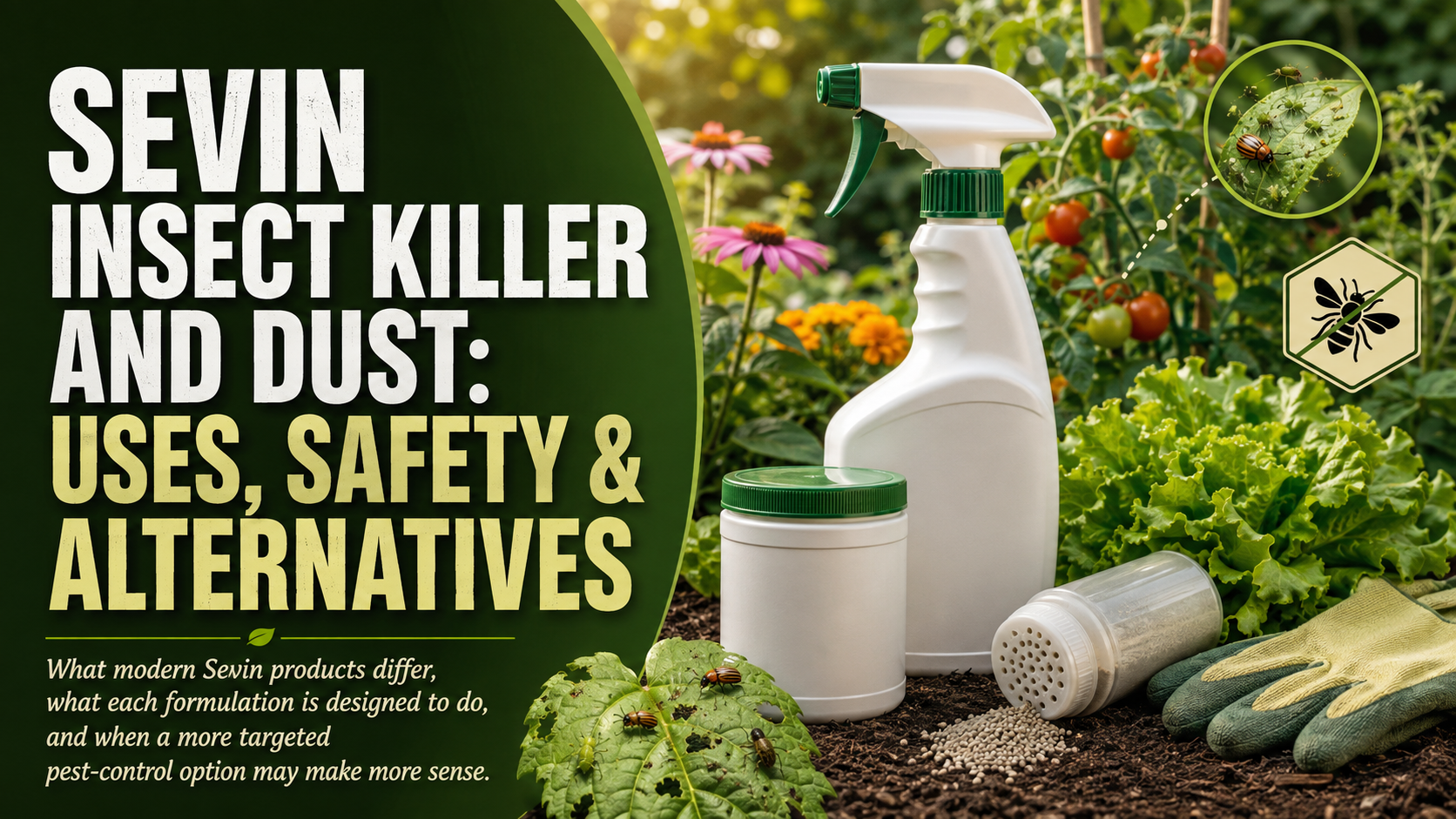

How modern Sevin products differ, what each formulation is designed to do, and when a more targeted pest-control option may make more sense.
Quick Answer
Sevin is a brand name, not one single pesticide ingredient. Older Sevin products were strongly associated with carbaryl, but current GardenTech products can use different active ingredients depending on the formulation. Dusts, ready-to-use sprays, concentrates and granules also have different application methods, pest lists, re-entry directions and harvest restrictions. The safest way to use Sevin is to identify the pest first, match it to the exact labeled product and site, follow the current label, and protect pollinators and other non-target organisms. When a narrow, nonchemical or more selective option can solve the problem, that may be the better IPM choice.
Sevin at a Glance
| What is Sevin? | A brand family of outdoor insect-control products. |
| One active ingredient? | No. Active ingredients vary by product and can change over time. |
| Common forms | Dust, ready-to-use spray, ready-to-spray, concentrate, lawn/perimeter granules. |
| Broad-spectrum? | Many Sevin products are broad-spectrum and can affect non-target insects. |
| Vegetable use | Only when the exact label lists the crop and use pattern. |
| Pollinators | Avoid exposing bees and other pollinators; do not treat open blooms when prohibited by the label. |
| Re-entry | Follow the product label; many liquid or watered-in treatments require the area to dry first. |
| Harvest timing | Use the crop- and product-specific pre-harvest interval (PHI). |
What Is Sevin Insect Killer?
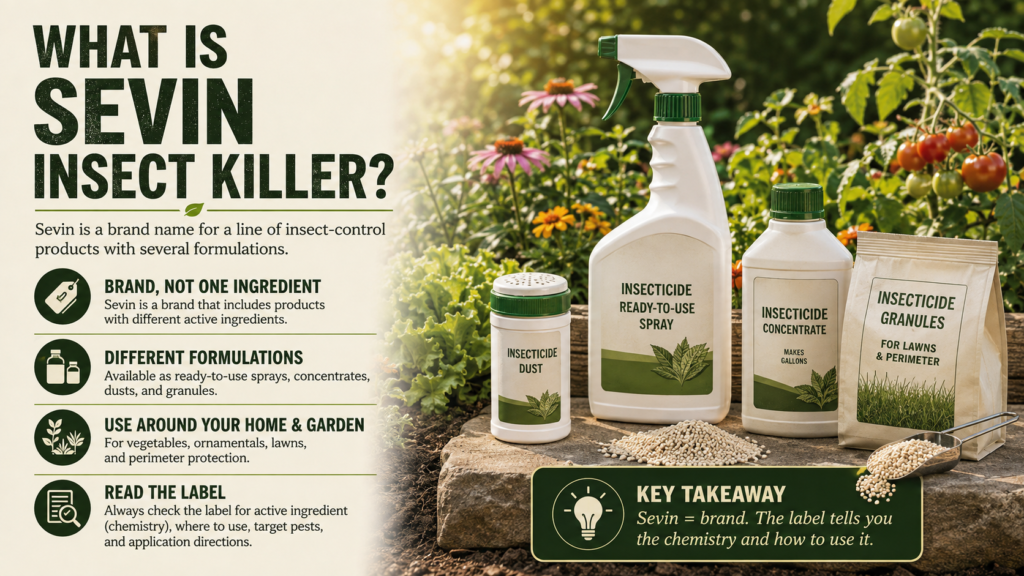
Sevin is a long-established garden and outdoor pest-control brand sold in several formulations. Depending on the product, it may be intended for vegetables, ornamental plants, lawns, landscape areas or outdoor perimeter treatment. That variety is convenient, but it is also the source of much of the confusion around the name “Sevin.”
A gardener can no longer assume that two containers carrying the Sevin name contain the same active ingredient or are used the same way. The exact product name, active ingredient statement, target pest list, crop or site list and directions for use matter more than the brand name by itself.
Key takeaway: “Sevin” tells you the brand. The label tells you the chemistry, where it may be used and how it must be applied.
Is Sevin Still Carbaryl?
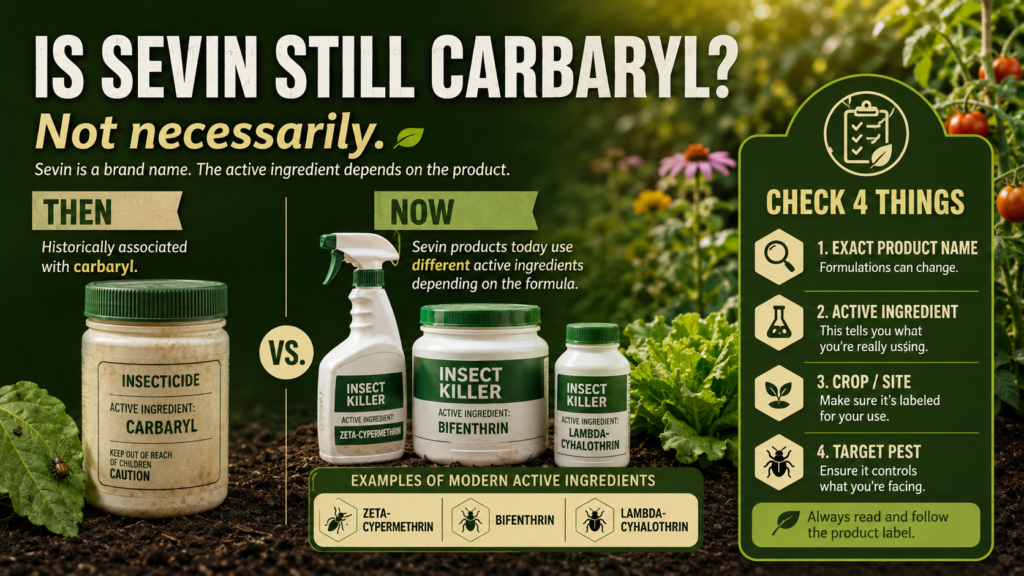
Not necessarily. For decades, many gardeners used “Sevin” almost as a synonym for carbaryl because carbaryl was historically the best-known Sevin active ingredient. Modern Sevin formulations, however, may contain pyrethroid active ingredients such as zeta-cypermethrin, bifenthrin or lambda-cyhalothrin, depending on the specific product and market.
This distinction matters because the active ingredient influences the pest spectrum, residual activity, environmental cautions, protective-equipment requirements and application directions. An old article describing carbaryl should not automatically be used as instructions for a current Sevin product.
Before using any Sevin product, check four things on the container: the exact product name, the active ingredient, the target crop or site, and the target pest.
What Active Ingredients Are in Sevin Products?
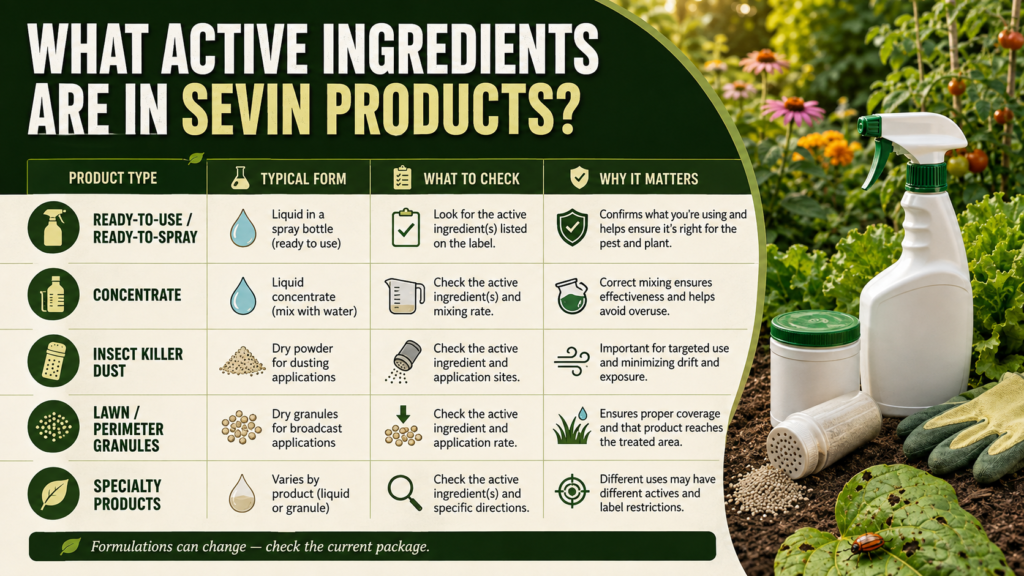
The current Sevin lineup includes multiple formulations, and formulations can change. Rather than memorizing one ingredient list, use the active-ingredient panel on the current package as the authority. The table below shows the kind of variation a shopper may encounter.
| Product type | Typical form | What to check | Why it matters |
| Ready-to-use / ready-to-spray | Liquid | Active ingredient + crop/pest list | Applied to plant surfaces; bloom and drift precautions matter. |
| Concentrate | Liquid concentrate | Dilution directions + active ingredient | Mixing accuracy is essential. |
| Insect Killer Dust | Dry dust | Active ingredient + dust-use directions | Drift and inhalation exposure require extra care. |
| Lawn / perimeter granules | Granular | Active ingredient + watering instructions | Granules are generally spread on soil/lawn and often watered in. |
| Other Sevin-branded specialty products | Varies | Full label | Branding may be similar even when chemistry and use differ. |
What Bugs Does Sevin Kill?
Sevin products are marketed for broad pest control, but the exact list varies by formulation. Commonly listed targets across the brand family can include aphids, Japanese beetles, Colorado potato beetles, cabbageworms, flea beetles, grasshoppers, hornworms, whiteflies, cutworms and other chewing or sucking pests.
That does not mean every Sevin product controls every one of those pests. A lawn granule label can differ substantially from a vegetable spray label, and a dust may have a different pest list again. If the pest is not listed for the product and site you want to treat, choose another control method.
Sevin Dust vs. Spray vs. Granules
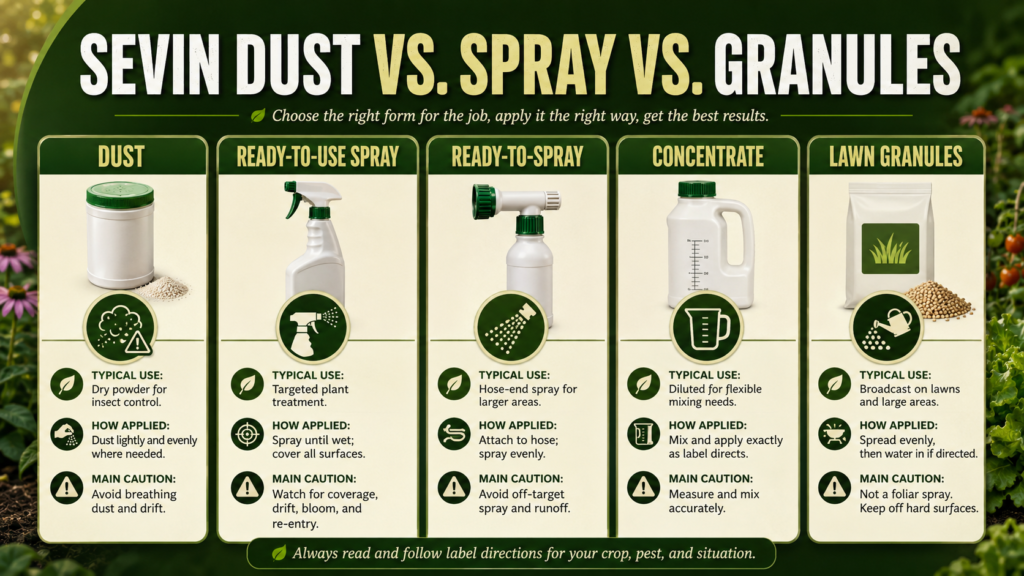
| Formulation | Typical use pattern | How it is applied | Main caution |
| Dust | Plant-surface treatment where labeled | Applied as a dry powder | Avoid breathing dust and minimize drift. |
| Ready-to-use spray | Targeted plant treatment | Sprayed directly from bottle | Coverage, drift, bloom and re-entry directions matter. |
| Ready-to-spray | Larger-area hose-end treatment | Connected to a garden hose | Avoid off-target application and runoff. |
| Concentrate | Custom-volume plant treatment | Diluted exactly as label directs | Incorrect dilution can underdose or overdose. |
| Lawn granules | Lawn/soil surface pest control | Broadcast evenly, then water in if directed | Not a substitute for foliar spray; keep granules off hard surfaces. |
How to Use Sevin Insect Killer Safely
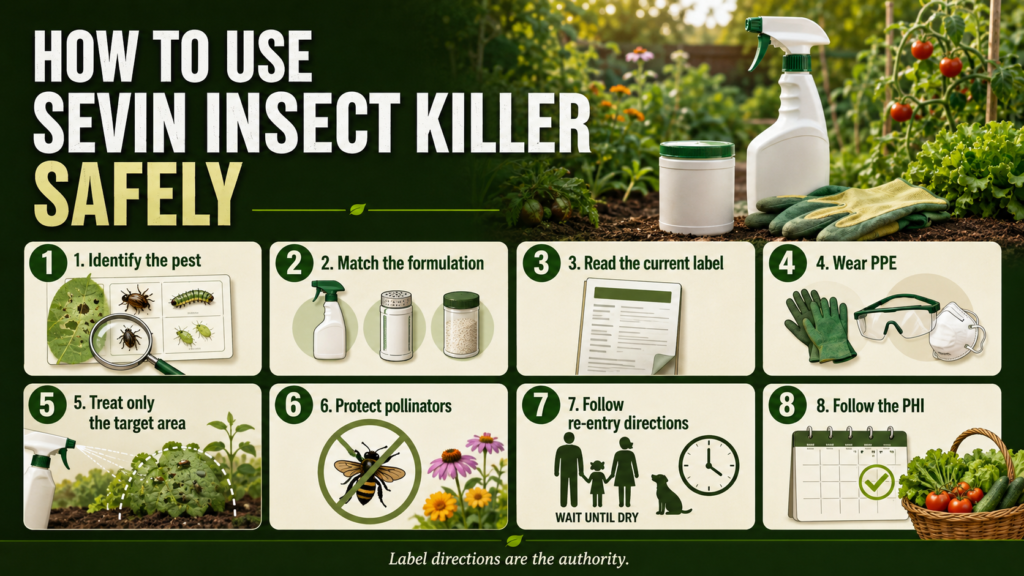
1. Identify the pest first
Do not start with the pesticide bottle. Confirm what insect is causing the damage and whether control is necessary. Broad-spectrum products can also kill predators and parasitoids that naturally suppress pests.
2. Match the formulation to the site
A dust, foliar spray and lawn granule are not interchangeable. Use only a product whose label includes the crop, plant, lawn or landscape site you plan to treat.
3. Read the current label before mixing or applying
Directions can change, and rates often differ by crop or target pest. The label also gives required personal protective equipment, re-entry information, environmental precautions and harvest intervals.
4. Wear the required protective equipment
At minimum, avoid unnecessary skin and eye exposure. Follow the label for gloves, clothing and other PPE. With dusts, take special care to avoid creating airborne clouds.
5. Treat only the target area
More pesticide is not better control. Apply the labeled rate and avoid overspray, unnecessary perimeter treatment or runoff into drains, ponds and waterways.
6. Protect pollinators
Do not expose bees and other pollinators to a broad-spectrum insecticide unnecessarily. Follow all bloom restrictions, bee warnings and timing requirements on the label.
7. Follow re-entry directions
Keep people and pets out of the treated area until the label allows re-entry. For many liquid or watered-in formulations, that means waiting until the treated surface is dry.
8. Follow the pre-harvest interval
On edible crops, the PHI is the minimum time between the last application and harvest. It is crop- and product-specific; there is no single universal waiting period for all vegetables.
How to Use Sevin Dust
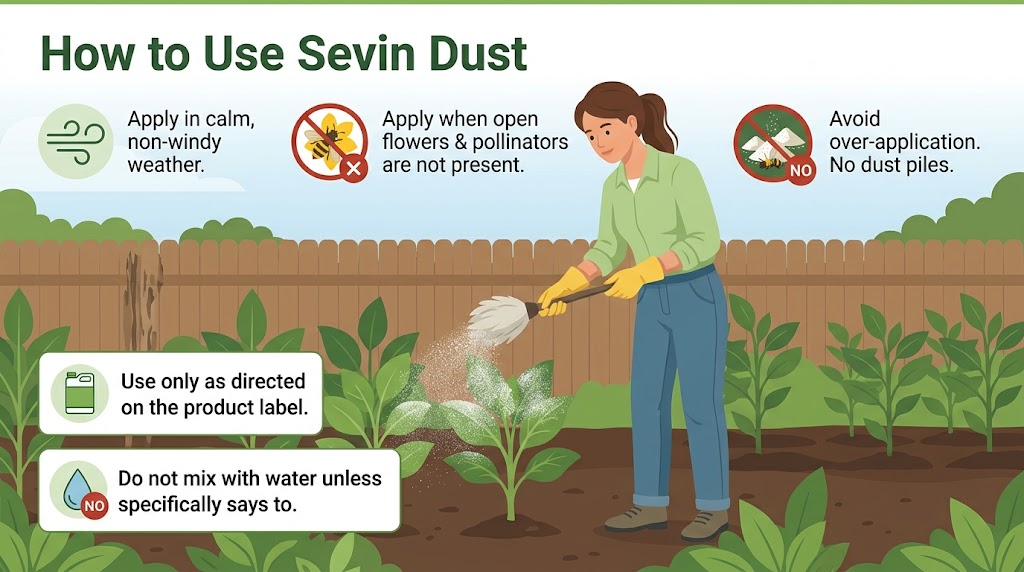
Dust formulations are designed to be used as dusts when the label says so. Apply a light, even coating only to listed plants or sites and only for listed pests. Avoid creating a visible cloud, avoid windy conditions, and keep the product off open blooms when label restrictions or pollinator precautions apply.
Do not assume a dry Sevin dust can be mixed with water simply because another Sevin-branded dust or sulfur product can. Formulations are different. If the label does not provide a mixing-with-water direction, do not invent one.
Use the smallest labeled amount that achieves coverage. Heavy dusting increases exposure and does not automatically improve pest control.
How to Use Sevin Spray
Liquid Sevin products include ready-to-use sprays, hose-end products and concentrates. The goal is generally to treat the listed target surfaces evenly without excessive dripping or runoff. When treating foliage, inspect where the pest is actually feeding; some pests spend much of their time on leaf undersides.
Avoid spraying in windy conditions or immediately before conditions that would wash the treatment away when the label advises against it. Pay close attention to blooming crops and ornamental flowers, because broad-spectrum insecticides can expose bees and other beneficial insects.
How to Use Sevin Granules
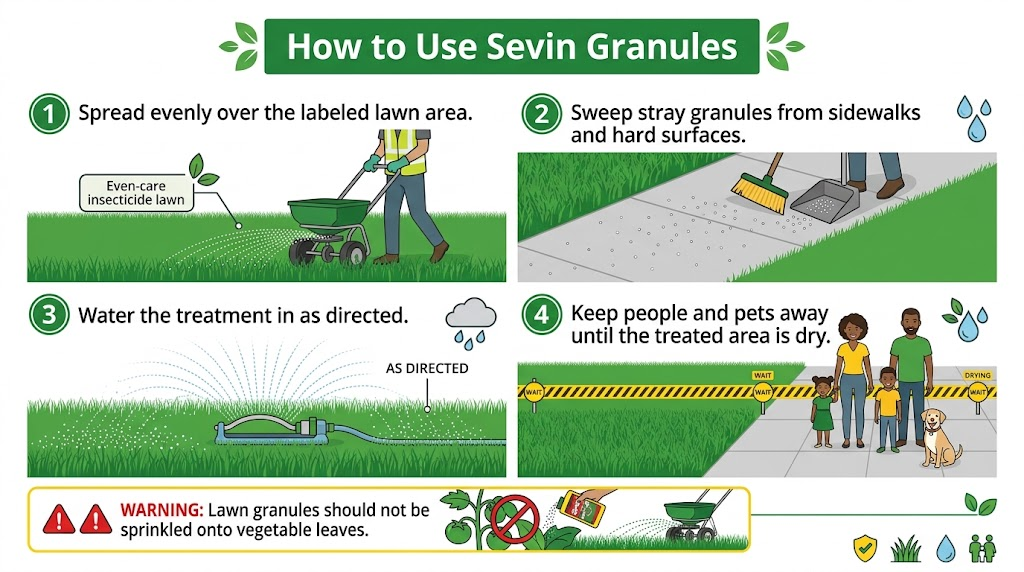
Granular Sevin products are used very differently from foliar products. GardenTech’s lawn-granule guidance follows a practical sequence: spread the granules evenly over the labeled area, sweep stray granules off sidewalks and hard surfaces, water the treatment in as directed, and keep people and pets out until the area has dried.
Do not sprinkle lawn granules onto vegetable leaves or use a granule rate intended for lawns as a substitute for a vegetable-garden spray rate. Formulation and site directions are part of the legal label instructions.
Is Sevin Safe for Vegetables?
Some Sevin formulations are labeled for specific edible crops, but “vegetable safe” is not a blanket property of the brand. The exact crop must appear on the current product label, and the directions may differ from one vegetable to another.
For edible crops, two label details are especially important: the allowed number or frequency of applications and the pre-harvest interval. Washing produce is good food-handling practice, but washing does not replace the required PHI or make an off-label treatment acceptable.
What Is a Pre-Harvest Interval?
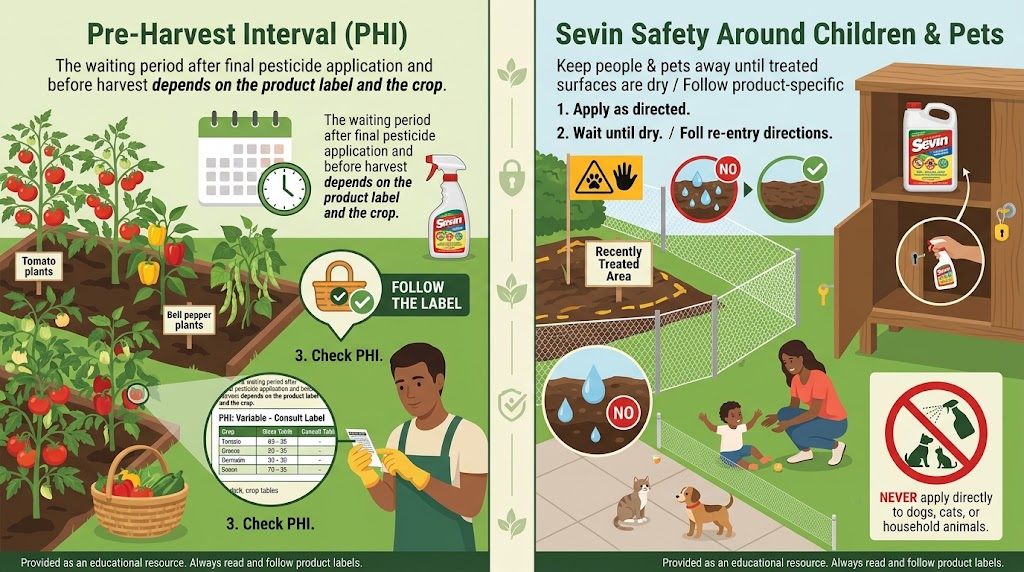
The pre-harvest interval, or PHI, is the minimum amount of time that must pass between the final pesticide application and harvest. A product may have different PHIs for tomatoes, peppers, beans or other crops, so do not rely on a generic “wait seven days” rule unless that is what the current label specifies for that exact crop and product.
Is Sevin Safe Around Children and Pets?
Keep children and pets away during mixing and application and follow the product-specific re-entry directions. GardenTech notes that people and pets may generally return after applicable treated surfaces have dried, but the exact label should always take priority.
Store pesticide containers securely in their original packaging and never apply a garden Sevin product directly to a dog, cat or other household animal. A lawn or garden insecticide is not a veterinary treatment.
Is Sevin Safe for Bees and Other Pollinators?
This is one of the most important tradeoffs with broad-spectrum insecticides. Products that kill many pest species may also affect bees, predatory insects, parasitoids and other non-target arthropods if they are exposed.
GardenTech specifically warns users to avoid spraying open blooms with certain Sevin products to protect pollinators. More broadly, an IPM approach asks whether treatment is needed at all and whether a more selective control can solve the problem with less disruption.
Environmental Safety: Drift, Runoff and Water
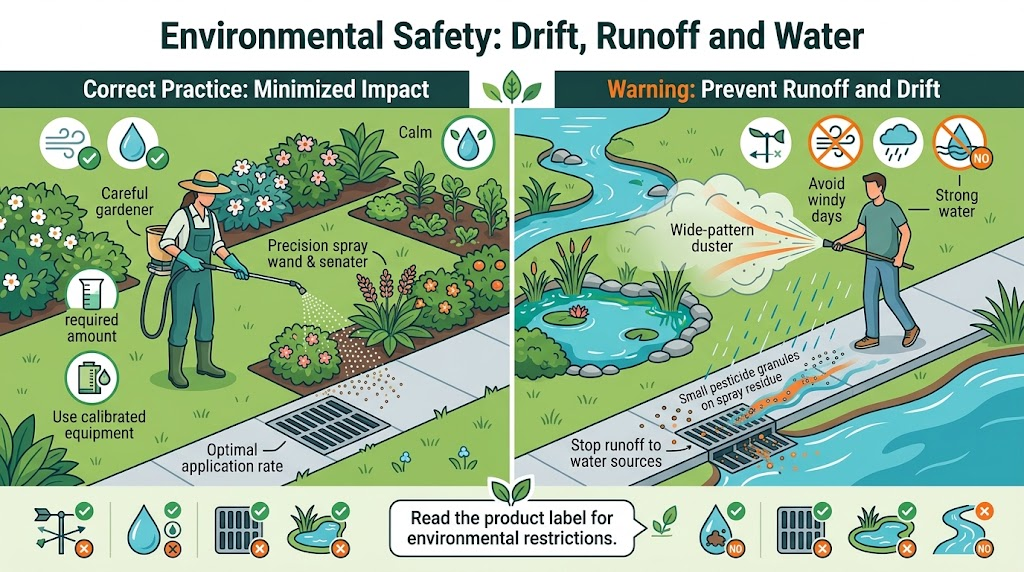
Keep spray and granules out of storm drains, ponds, streams and other water bodies unless a label specifically allows the use. Avoid treating hard surfaces where granules can wash into drainage systems. With sprays, minimize drift by treating in suitable weather and using only the amount and spray pattern required.
Environmental warnings differ among active ingredients, which is another reason to read the label rather than relying on brand familiarity.
How Long Does Sevin Last?
There is no single answer for the entire Sevin brand. Residual control depends on the active ingredient, formulation, target pest, treated surface, weather and product directions. Some current Sevin products advertise extended control, while others are intended primarily for direct or shorter-term surface treatment.
Do not use an advertising claim such as “up to three months” as a universal reapplication schedule. Reapply only when the label allows it and pest pressure justifies another treatment.
When Should You Not Use Sevin?
- You have not identified the insect causing the damage.
- The exact pest, crop or treatment site is not listed on the label.
- The plant is blooming and treatment would expose pollinators contrary to label precautions.
- Wind, rain or runoff conditions make off-target movement likely.
- A few pests can be removed by hand or tolerated without meaningful plant injury.
- A more selective treatment can control the pest while conserving beneficial insects.
- You are relying on directions from an old carbaryl-based article rather than the current product label.
Alternatives to Sevin: Start With the Pest, Not the Brand
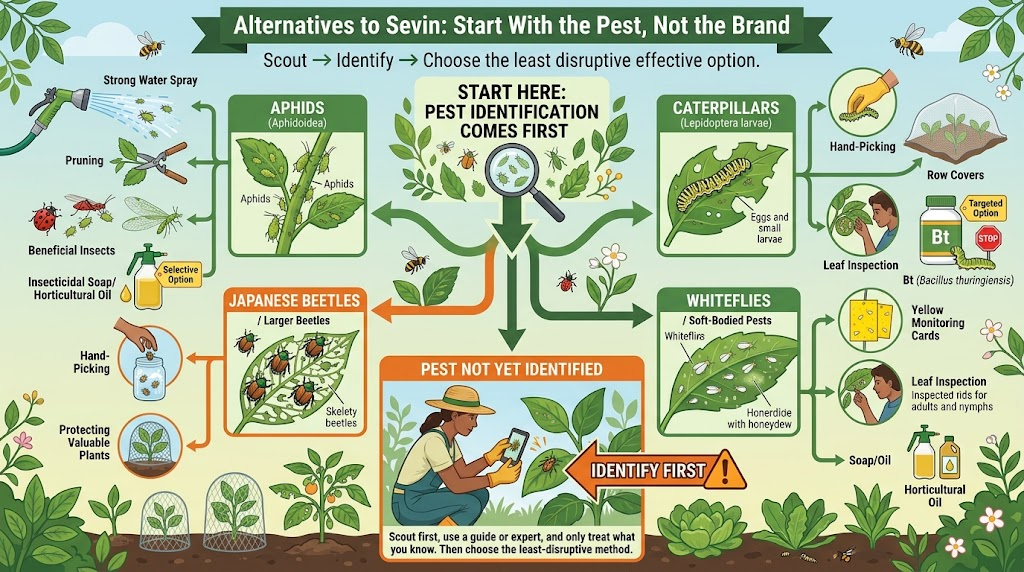
There is no single “Sevin alternative” that is best for every situation. The right substitute depends on the pest, crop and level of damage. In many home gardens, nonchemical or selective tactics are sufficient.
| Problem | First options | Selective option when appropriate | Why it may be preferable |
| Aphids | Strong water spray, prune heavily infested tips, conserve predators | Insecticidal soap or horticultural oil where labeled | Targets soft-bodied pests with less broad residual impact. |
| Caterpillars | Hand-pick, row covers, inspect leaves | Bt products for susceptible caterpillars where labeled | More targeted to caterpillar pests. |
| Japanese beetles / larger beetles | Hand-pick early in the day, protect high-value plants | Crop-specific selective option where labeled | Can reduce unnecessary broad-spectrum treatment. |
| Whiteflies / soft-bodied pests | Yellow monitoring cards, leaf inspection, remove heavily infested foliage | Soap or oil where appropriate | Useful for localized infestations. |
| Garden pest not yet identified | Scout and photograph first | None until identification is confirmed | Prevents treating the wrong insect. |
Common Sevin Mistakes
| Mistake | Why it matters | Better approach |
| Assuming Sevin always means carbaryl | Modern formulations may use different active ingredients. | Read the active-ingredient panel. |
| Using one formulation like another | Dust, spray and granules have different directions. | Match the exact formulation to the site. |
| Treating an unidentified insect | Beneficial insects may be killed unnecessarily. | Identify first and assess damage. |
| Spraying open flowers | Can expose pollinators. | Follow bloom restrictions and use IPM. |
| Applying extra product “for better control” | Raises exposure and may violate the label. | Use the labeled rate only. |
| Ignoring the PHI | Can lead to harvesting too soon after treatment. | Check the crop-specific waiting period. |
| Treating before rain or on hard surfaces | Increases runoff and off-target movement. | Follow weather and site precautions. |
| Relying on old online instructions | Formulations and labels change. | Use the current package label and local Extension guidance. |
Frequently Asked Questions
Is Sevin still carbaryl?
Not necessarily. Carbaryl is historically associated with Sevin, but current formulations may use other active ingredients. Check the exact product label.
What is the active ingredient in Sevin?
It depends on the product. Different Sevin formulations can contain different active ingredients, so the active-ingredient statement on the package is the authority.
What insects does Sevin kill?
The brand covers many listed garden, landscape and lawn pests, but the exact pest list varies by formulation. Confirm the pest on the current label.
Is Sevin safe on vegetables?
Some Sevin products are labeled for specific vegetables. Use only on crops listed on the exact label and follow the crop-specific application and pre-harvest interval.
How long after Sevin can I eat vegetables?
There is no universal waiting period. Follow the PHI listed for the crop and product you used.
Is Sevin safe for bees?
Broad-spectrum insecticides can harm bees if they are exposed. Follow pollinator warnings and avoid treating open blooms when prohibited.