
Discover why marigolds are one of the most rewarding flowers for any garden — from pollinator support and companion planting to easy, season-long colour.
Marigold Growing Snapshot
| 🌼 Type: Annual (common garden marigolds) | ☀️ Light: Full sun (6+ hours daily) |
| 💧 Water: Moderate, when soil surface is dry | 🌱 Soil: Well-drained, average fertility |
| 🌸 Bloom: Late spring to first frost | 📏 Height: 15–90 cm depending on variety |
What Are Marigolds?
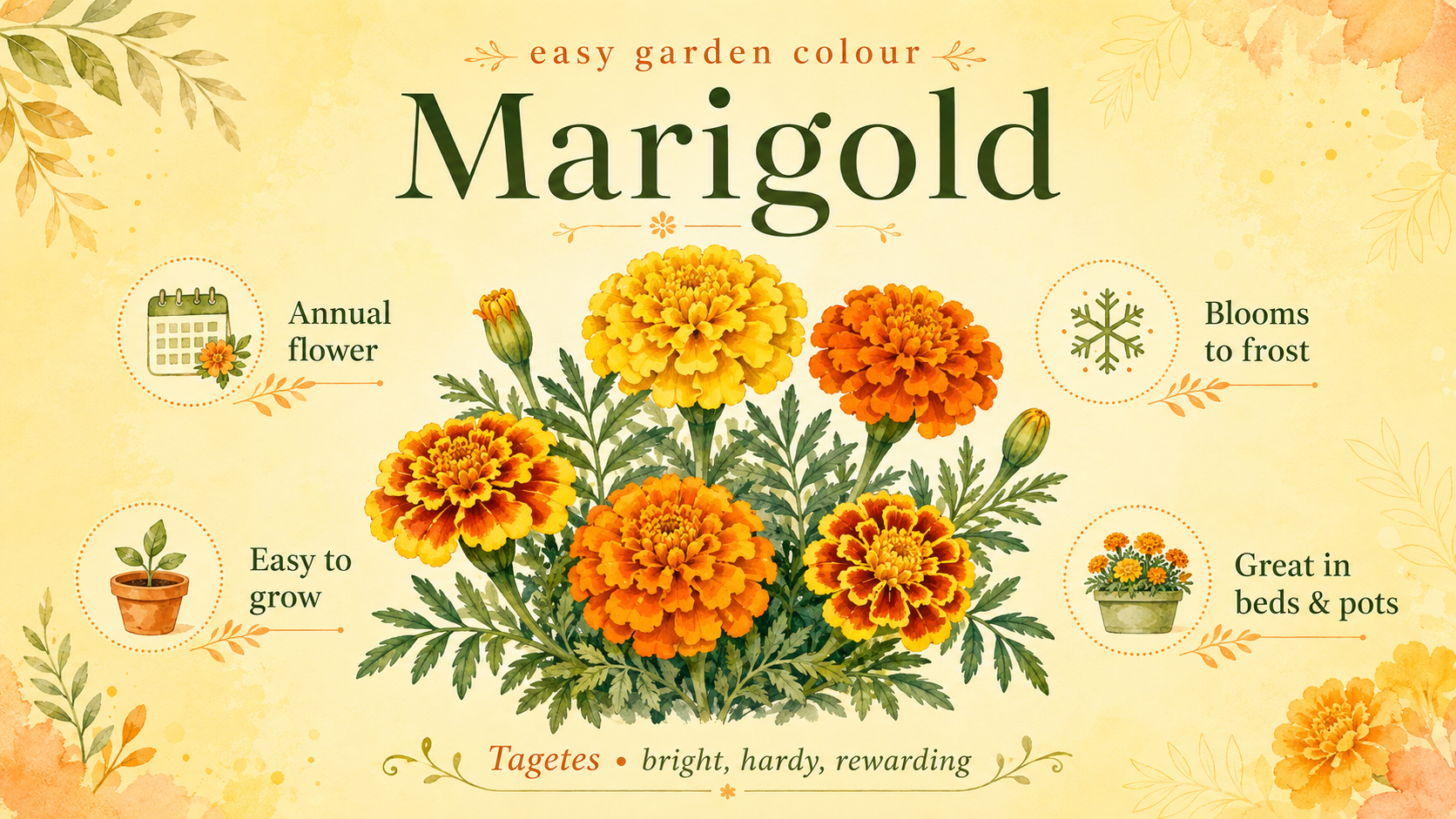
Marigolds (Tagetes) are cheerful annual flowers native to the Americas. They produce dense, ruffled blooms in shades of yellow, orange, red, and bicolour combinations from late spring until the first hard frost. Gardeners worldwide grow them for their bright colour, easy care, and practical benefits in vegetable gardens and borders.
The three types most commonly grown in home gardens are French marigolds (Tagetes patula), African marigolds (Tagetes erecta), and signet marigolds (Tagetes tenuifolia). Despite the common names, all three originate from Central and South America.
Key Benefits of Growing Marigolds
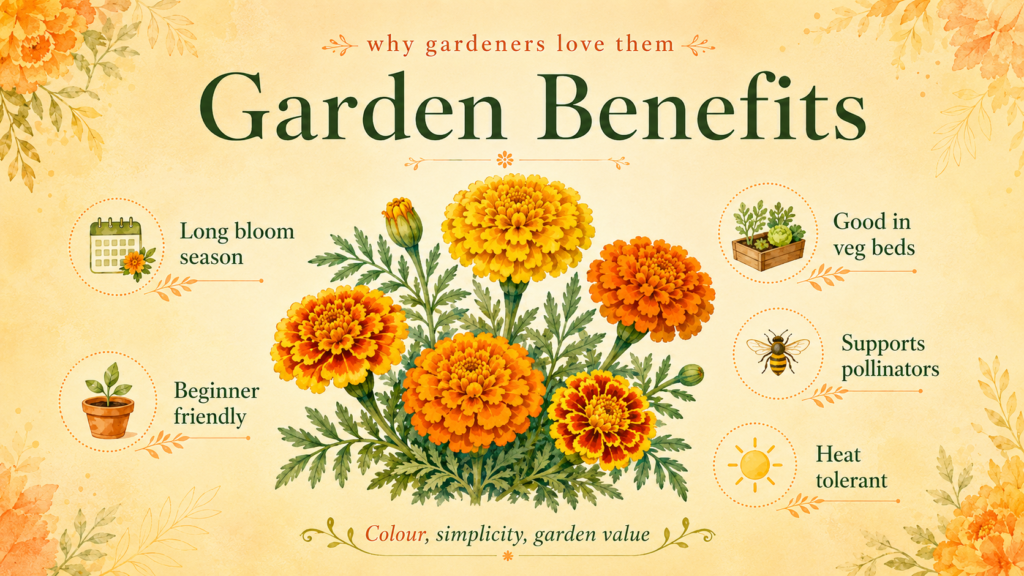
Marigolds offer a combination of ornamental and practical advantages that make them one of the most versatile garden flowers:
- Season-long colour — With deadheading, marigolds bloom continuously from early summer to autumn frost.
- Beginner-friendly — They germinate quickly, tolerate heat, and need minimal attention once established.
- Pollinator support — Open-centred varieties attract bees, hoverflies, and butterflies.
- Companion planting value — They fit neatly between vegetables and may help deter certain pests.
- Nematode suppression — Certain Tagetes species can reduce root-knot nematode populations when grown as a cover crop.
Pollinators & Beneficial Insects
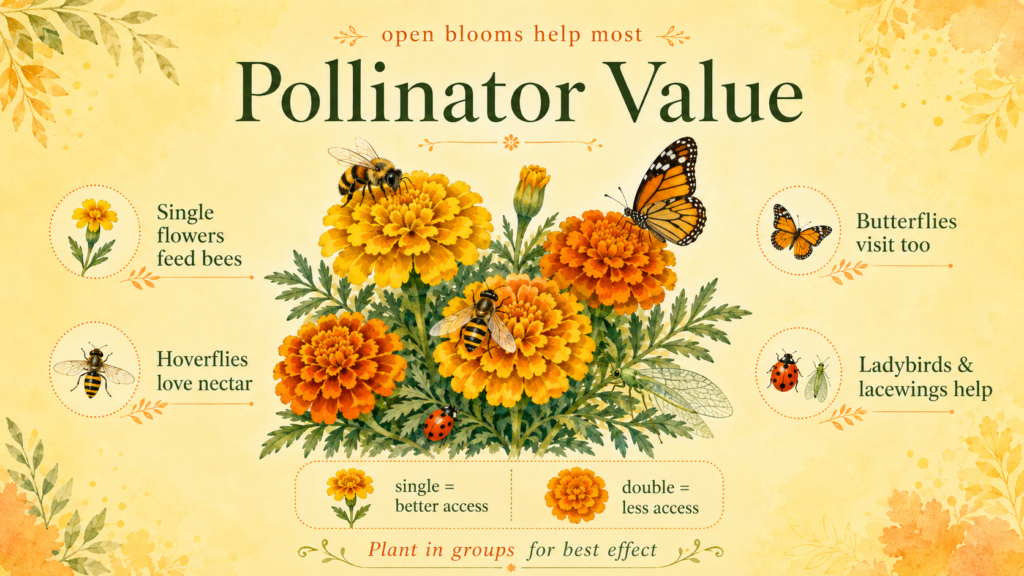
Single-flowered and semi-double marigold varieties (such as many French marigolds and all signet types) provide easy access to pollen and nectar for bees, hoverflies, and small butterflies. These open-centred blooms are more pollinator-friendly than fully double pom-pom types, whose tightly packed petals can prevent insect access.
To maximise pollinator benefit, choose single-flowered cultivars and plant them in groups. Marigolds also attract beneficial predatory insects like ladybirds and lacewings, which help keep aphid populations in check.
Companion Planting & Vegetable Gardens
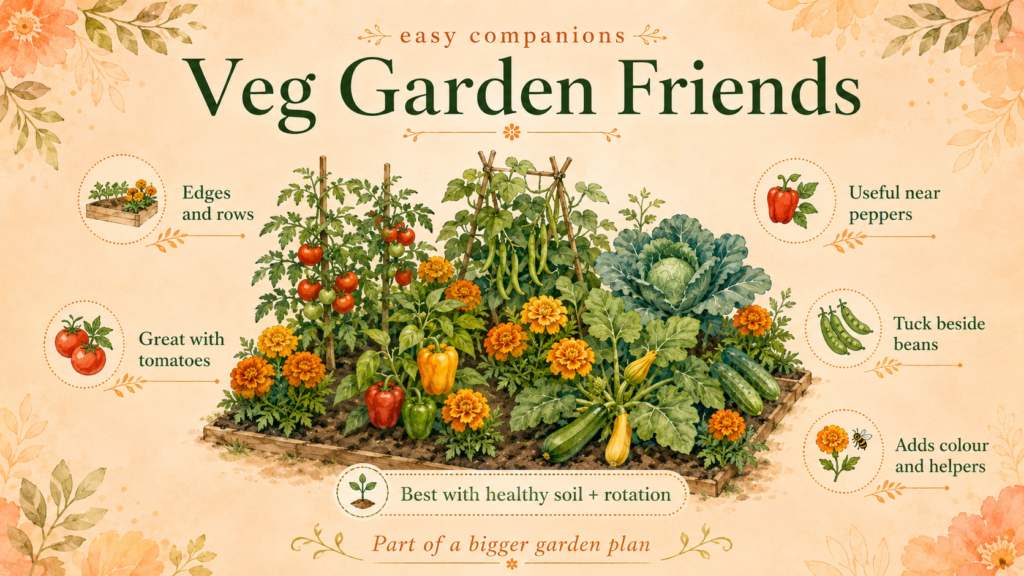
Marigolds are one of the most popular companion plants for vegetable gardens. Their compact size makes them easy to tuck along bed edges, between rows of tomatoes, or around brassicas. Gardeners often plant French marigolds beside tomatoes, peppers, beans, squash, and cucumbers.
The companion-planting benefit comes primarily from attracting beneficial insects and, in certain cases, deterring whitefly from nearby crops. However, marigolds are not a silver bullet — they work best as part of an integrated approach alongside good soil health, crop rotation, and physical barriers where needed.
Pest & Nematode Management: Myth vs Fact
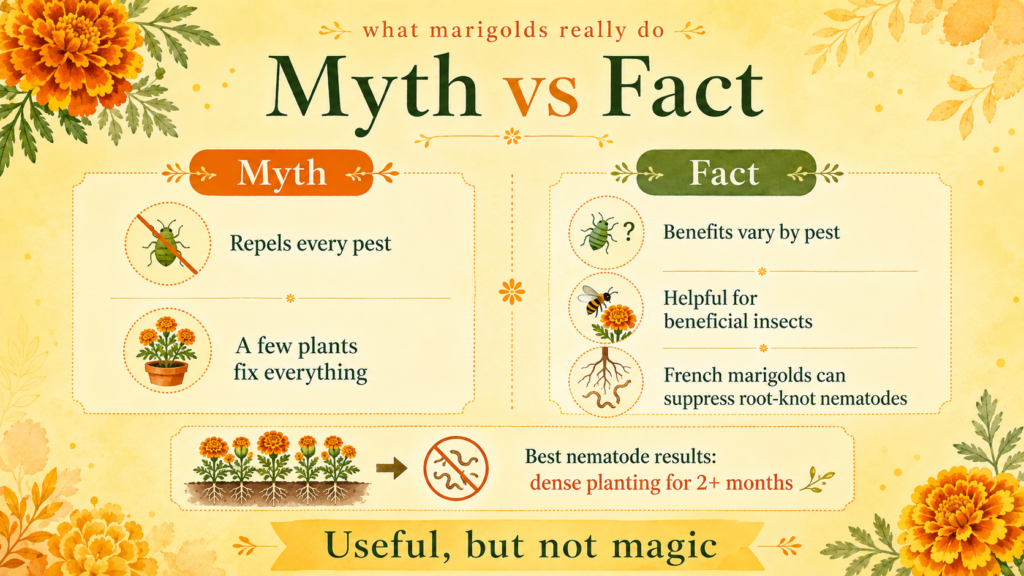
Myth: Marigolds repel all garden pests simply by being present. Fact: There is limited scientific evidence that marigolds broadly repel insects through scent alone. Some studies suggest French marigolds can deter whitefly when interplanted with tomatoes, but results vary.
The strongest research-backed benefit involves root-knot nematodes. Certain Tagetes species — particularly French marigolds (T. patula) — release compounds from their roots (alpha-terthienyl) that suppress nematode populations in the soil. This effect works best when marigolds are grown densely as a cover crop for at least two months before a susceptible vegetable crop is planted.
Important: Simply planting a few marigolds at the edge of a bed will not eliminate a serious nematode problem. For genuine nematode suppression, treat marigolds as a targeted soil treatment, not a casual companion. For everyday pest management, their real value is supporting beneficial insect populations rather than directly repelling pests.
Popular Marigold Varieties
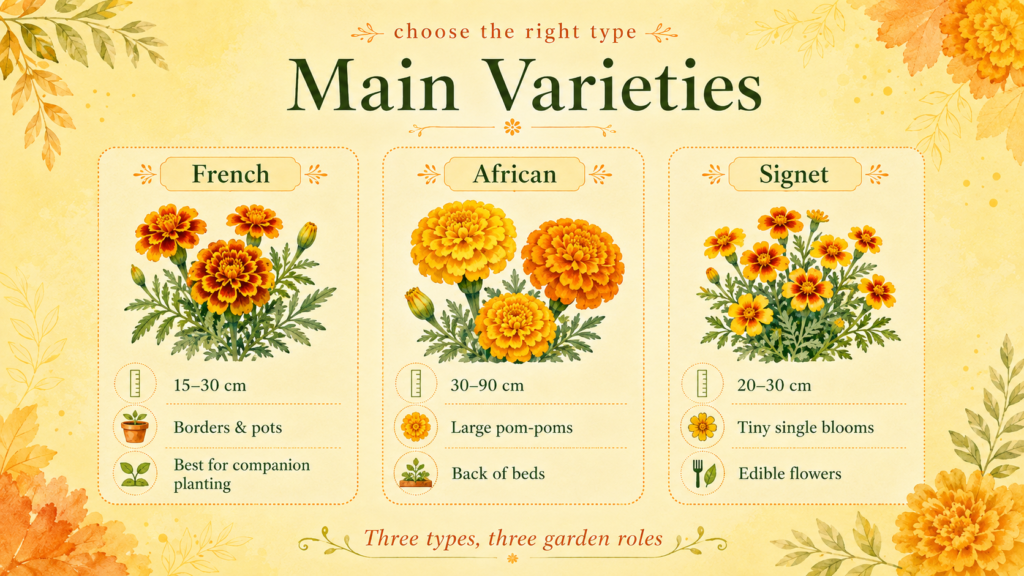
The three main types suit different garden situations. French marigolds are the most popular for companion planting due to their compact habit and proven nematode-suppressing roots. African marigolds produce large, showy blooms perfect for cutting gardens and back-of-border colour. Signet marigolds have fine, ferny foliage and tiny edible flowers — lovely for path edges and salads.
| Feature | French Marigold | African Marigold | Signet Marigold |
|---|---|---|---|
| Species | Tagetes patula | Tagetes erecta | Tagetes tenuifolia |
| Height | 15–30 cm | 30–90 cm | 20–30 cm |
| Flower size | Small–medium | Large pom-poms | Tiny, single |
| Best use | Borders, pots, companion planting | Back of beds, cutting | Edging, edible flowers |
How to Grow Marigolds
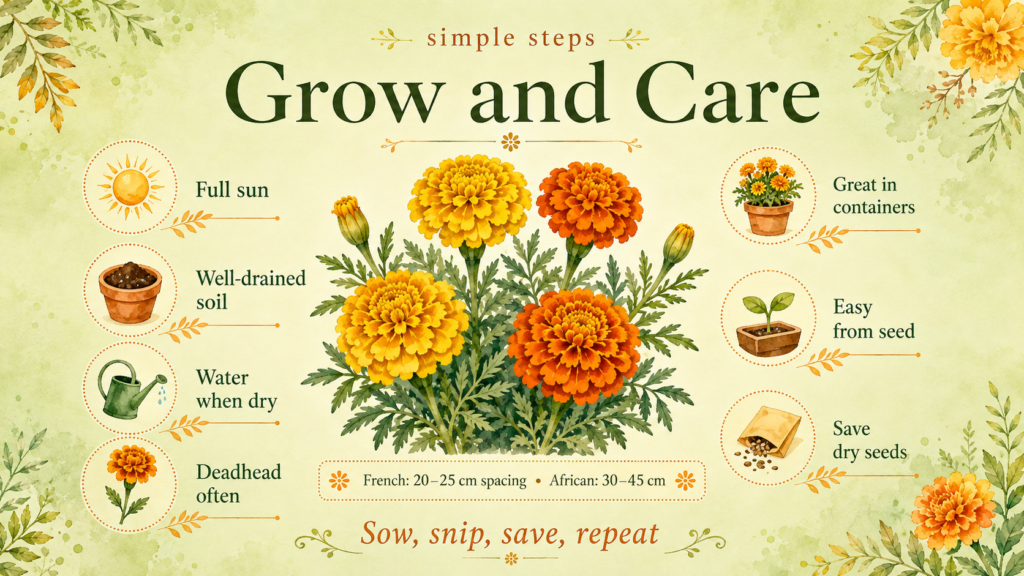
Sunlight: Marigolds need full sun — at least 6 hours of direct sunlight daily. They tolerate heat well and actually bloom more profusely in warm, sunny positions. In partial shade they tend to become leggy with fewer flowers.
Soil: Average, well-drained garden soil is ideal. Marigolds are not fussy about fertility — overly rich soil can produce lush foliage at the expense of flowers. Avoid waterlogged ground, which causes root rot.
Watering: Water at the base when the soil surface feels dry. Established marigolds are fairly drought-tolerant. Avoid overhead watering, which can promote powdery mildew on leaves in humid conditions.
Deadheading & Maintenance
Regular deadheading (removing spent flowers) encourages marigolds to keep producing new blooms rather than setting seed. Pinch or snip the faded flower head just above the next set of leaves. Without deadheading, plants will still flower but less prolifically and may become untidy by late summer. A fortnightly feed with a balanced liquid fertiliser during peak season helps sustain flowering.
Containers & Borders
Marigolds thrive in pots, window boxes, and raised beds. Use any general-purpose potting mix with drainage holes. French and signet types are particularly well-suited to containers because of their compact size. Combine different heights and colours for a cheerful display, or use a single variety for a clean border edge.
Growing From Seed & Saving Seeds
Marigolds are one of the easiest flowers to grow from seed. Sow indoors 6–8 weeks before your last frost date, or direct-sow outdoors once soil has warmed. Seeds germinate in 5–7 days and seedlings grow fast. Space French types 20–25 cm apart; African types 30–45 cm apart.
To save seeds, let a few flowers dry completely on the plant at the end of the season. Pull the dried petals apart to reveal the long, thin seeds inside. Store in a paper envelope in a cool, dry place over winter. Note that hybrid varieties may not come true from saved seed — open-pollinated types produce the most reliable results.
Frequently Asked Questions
Are marigolds annuals or perennials?
All common garden marigolds (French, African, and signet) are annuals. They complete their lifecycle in one growing season and do not return from roots the following year. However, they self-seed freely if spent flowers are left on the plant.
Do marigolds really repel mosquitoes?
There is very little scientific evidence that growing marigolds repels mosquitoes from a garden area. While marigold leaves contain compounds used in some insect-repellent research, the living plant does not release enough to deter mosquitoes in open air.
Which vegetables grow best near marigolds?
Tomatoes, peppers, beans, cucumbers, and squash are the most common companions. Marigolds are also useful around brassicas and lettuce. Avoid planting them very close to beans if using African marigolds, as the larger plants can shade low-growing crops.
Do marigolds bloom all summer?
Yes — with regular deadheading, marigolds flower continuously from early summer until the first hard frost in autumn. Plants that are not deadheaded will still bloom but tend to slow down by mid-summer as energy shifts to seed production.