
Everything you need to know about growing beautiful, pollinator-friendly salvia in your garden.
Key Takeaways
- Salvia is a genus of 1,000+ species including both ornamental flowers and culinary sage.
- Most ornamental salvias need full sun (6+ hours) and well-drained soil to thrive.
- Salvias are among the best plants for attracting bees, butterflies, and hummingbirds.
- Many perennial salvias are drought-tolerant once established and need minimal maintenance.
What Is a Salvia Plant?
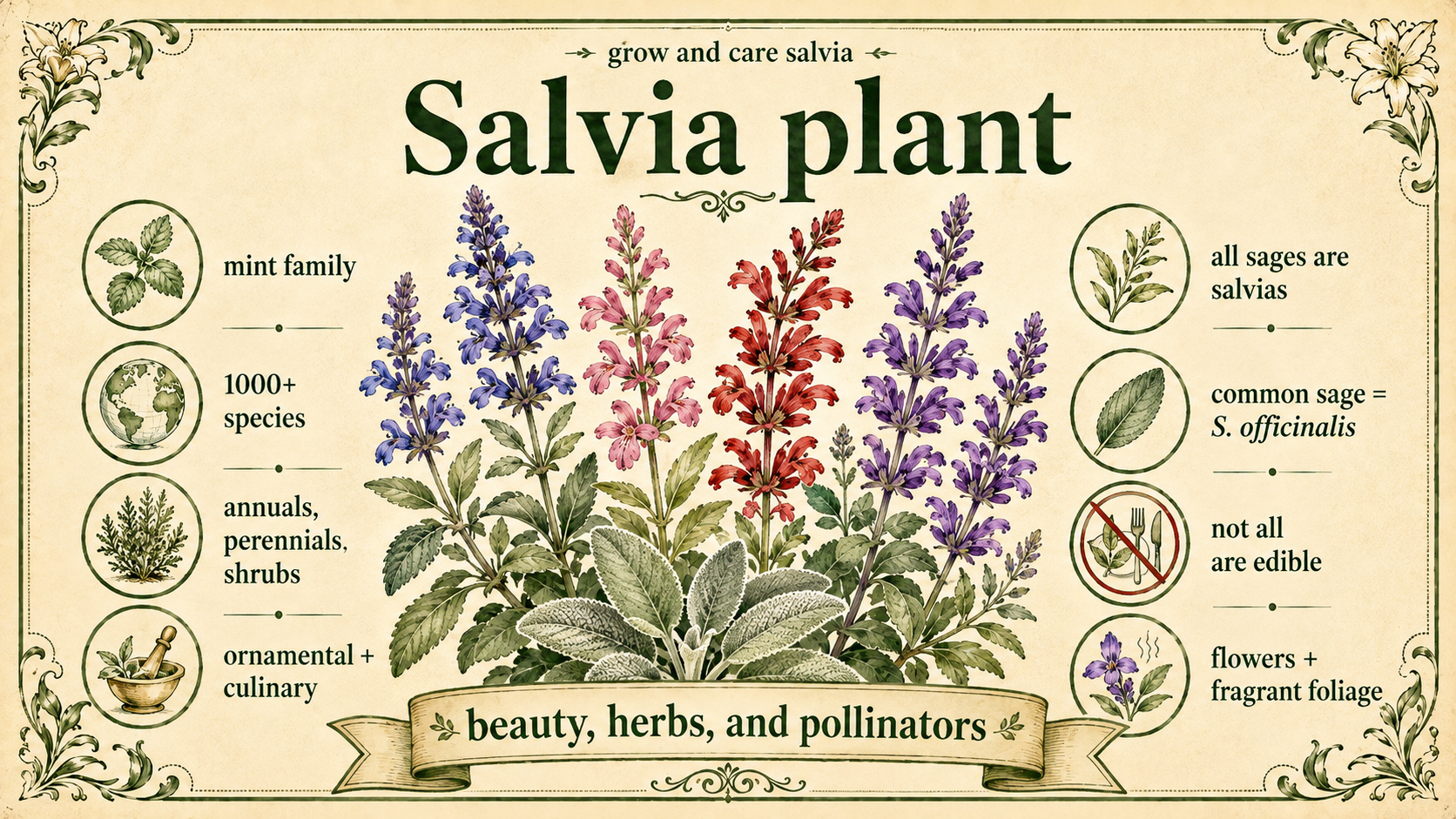
Salvia is the largest genus in the mint family (Lamiaceae), containing over 1,000 species of annuals, perennials, and shrubs found across every continent except Antarctica. The name comes from the Latin ‘salvere’, meaning to heal — a nod to the medicinal history of common sage.
If you’ve ever wondered whether salvia and sage are the same thing — they are! All sages are salvias. However, when gardeners say ‘salvia’, they usually mean the ornamental flowering types, while ‘sage’ typically refers to the culinary herb Salvia officinalis.
Not all salvias are edible. Only Salvia officinalis (common sage) and a few close relatives are used in cooking. Most ornamental salvias are grown purely for their flowers, fragrant foliage, and pollinator value.
Popular Types of Salvia
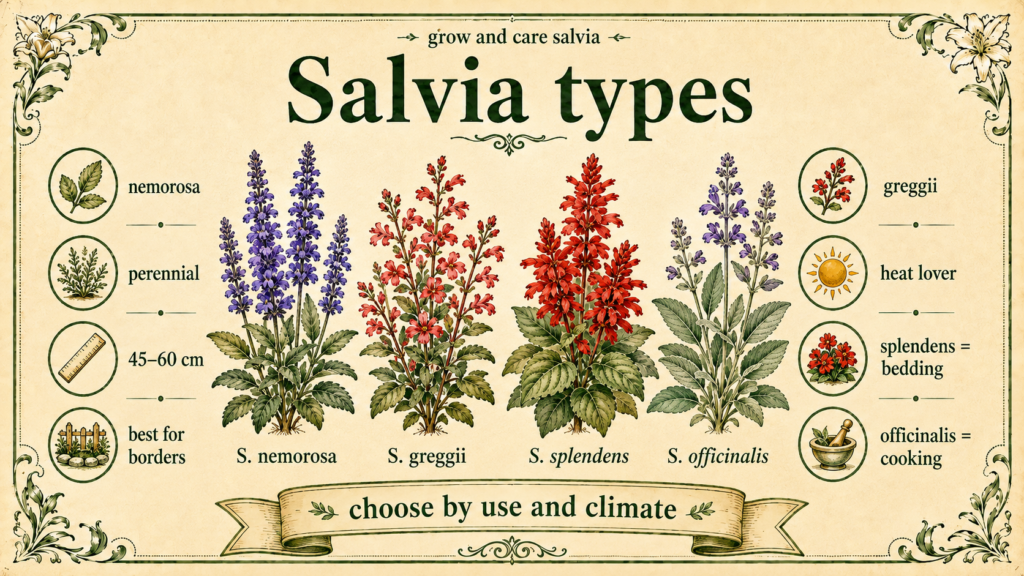
Salvia nemorosa (Woodland Sage)
A hardy perennial forming neat clumps of violet-blue flower spikes from late spring to mid-summer. Excellent for cottage garden borders and mass planting. Deadheading encourages a second flush of blooms.
Height: 45–60 cm
Type: Perennial
Hardiness: Zones 4–9
Best for: Borders, pollinators
Salvia greggii (Autumn Sage)
A shrubby, heat-loving salvia that flowers from spring to frost in shades of red, pink, coral, and white. A magnet for hummingbirds. Thrives in hot, dry conditions where many other plants struggle.
Height: 60–90 cm
Type: Perennial
Hardiness: Zones 7–10
Best for: Hummingbirds, dry gardens
Salvia splendens (Scarlet Sage)
The classic bright-red bedding salvia seen in parks and formal displays. Treated as an annual in most climates. Modern cultivars come in purple, salmon, and white too. Provides bold, continuous colour all summer.
Height: 25–45 cm
Type: Annual/tender perennial
Hardiness: Zones 10–12
Best for: Bedding, containers
Salvia officinalis (Common Sage)
The culinary sage used in stuffing, butter sauces, and teas. A hardy evergreen sub-shrub with soft grey-green aromatic leaves. Produces small purple-blue flowers in early summer. Ornamental varieties include purple, tricolour, and golden sage.
Height: 30–60 cm
Type: Perennial herb
Hardiness: Zones 4–8
Best for: Cooking, herb gardens
How to Grow & Care for Salvia
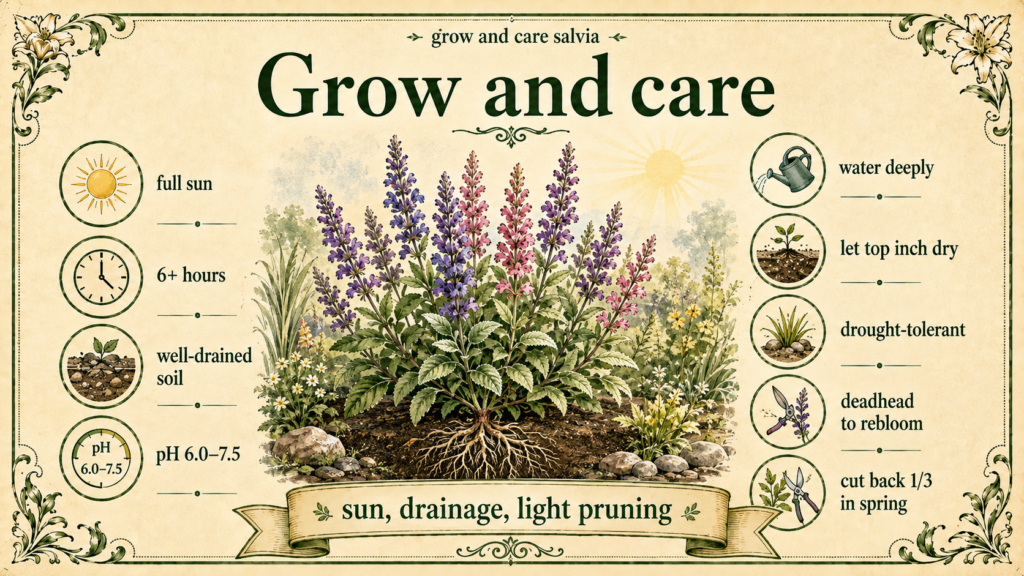
| ☀️ Sunlight Most salvias need at least 6 hours of direct sun daily. Insufficient light causes leggy growth and fewer flowers. A few woodland species tolerate part shade. |
| 🌱 Soil & Drainage Well-drained soil is essential — salvias hate sitting in water. Amend heavy clay with grit or perlite. A slightly alkaline to neutral pH (6.0–7.5) is ideal for most species. |
| 💧 Watering Water deeply but infrequently. Once established, most salvias are drought-tolerant. Overwatering is the most common mistake — let the top inch of soil dry between waterings. |
| ✂️ Pruning & Deadheading Deadhead spent flower spikes to encourage reblooming. In early spring, cut perennial salvias back by one-third to promote bushy, compact growth. Never hard-prune into old wood. |
Salvia for Pollinators & Wildlife
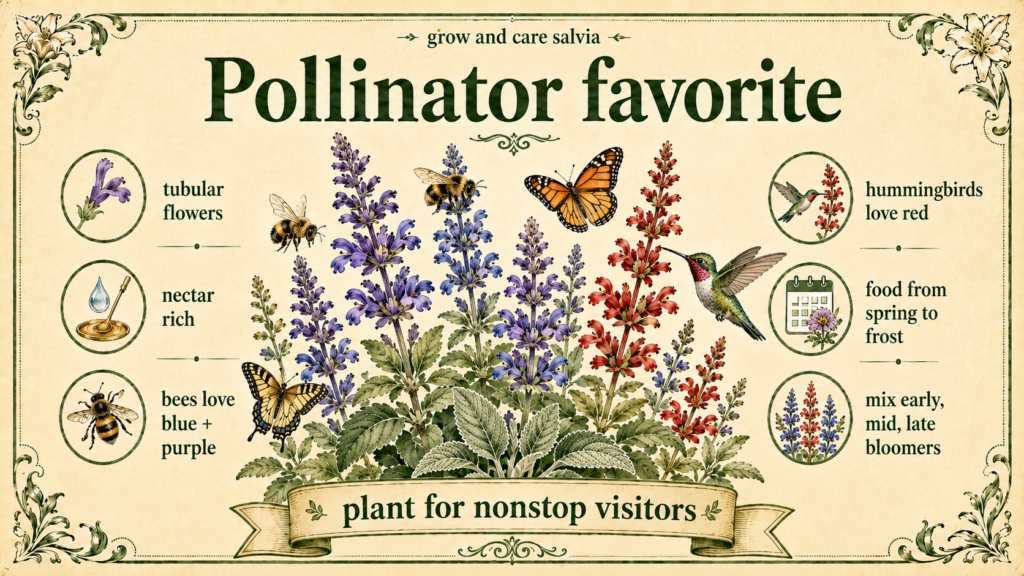
Salvias are pollinator powerhouses. Their tubular flowers are perfectly shaped for bees, butterflies, and hummingbirds. A single plant can attract dozens of visitors daily during peak bloom.
For bees, choose blue and purple varieties like S. nemorosa. For hummingbirds, red-flowered species such as S. greggii and S. coccinea are irresistible. Planting a mix of early, mid, and late-season salvias provides food from spring to frost.
Growing Salvia in Containers
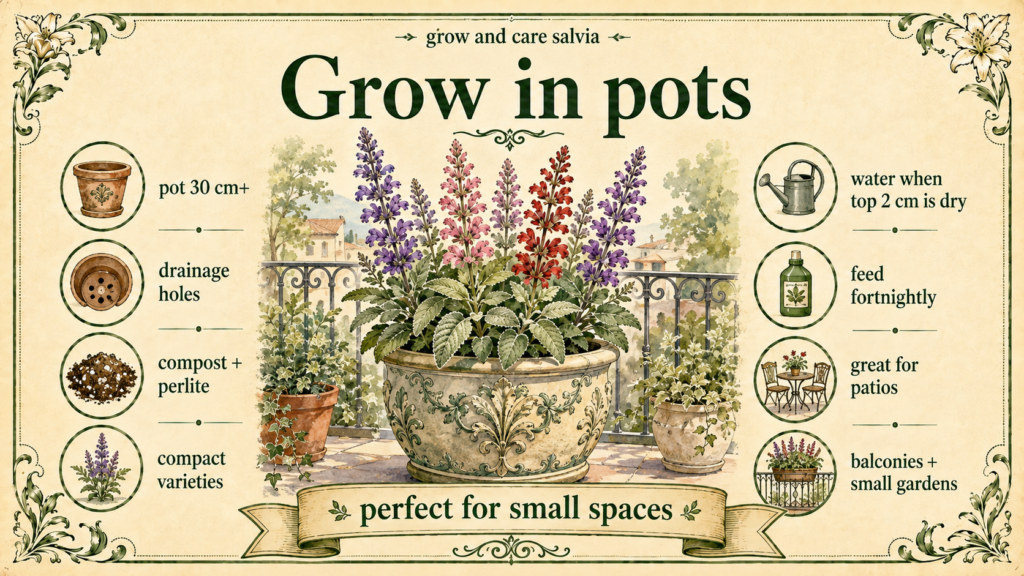
Many salvias thrive in pots, making them perfect for patios, balconies, and small gardens. Choose compact varieties like S. splendens or dwarf S. greggii. Use a pot at least 30 cm wide with drainage holes.
Use a free-draining compost mixed with perlite. Water when the top 2 cm feels dry — containers dry out faster than borders. Feed fortnightly with a balanced liquid fertiliser during the growing season.
Frequently Asked Questions
Does salvia come back every year?
It depends on the species. Salvia nemorosa, S. greggii, and S. officinalis are perennial in their respective hardiness zones and return reliably each spring. Salvia splendens and S. farinacea are typically grown as annuals in colder climates.
Why is my salvia not blooming?
The most common causes are insufficient sunlight (less than 6 hours), over-fertilising with nitrogen (which promotes leaves over flowers), or failing to deadhead spent spikes. Move the plant to a sunnier spot and switch to a potassium-rich feed.
Is salvia the same as sage?
Yes — ‘sage’ is simply the common English name for plants in the Salvia genus. However, only Salvia officinalis (common sage) is widely used in cooking. Most ornamental salvias are not edible.
Can salvia grow in shade?
Most salvias strongly prefer full sun. A few woodland species such as Salvia glutinosa tolerate partial shade, but flowering will always be reduced compared to a sunny position.
When should I prune salvia?
Prune perennial salvias in early spring once new growth appears at the base. Cut back by about one-third. Avoid cutting into old bare wood as it rarely regrows. Deadhead throughout summer to extend fl